One problem is the issue of no war v. WW1 as we know it v. Germany and Austria against Russia and Serbia. Germany/Austria beating the crap out of Russia still likely not a good thing for the Tsar. “no war” was not on the table.
2 Likes
Don’t worry the Desis have the counter factuals covered for all you history buffs. How? Well they figured out how to get the large language models to bypass principled model selection criteria in the guise of discovering causal graphs!
“Large Causal Models from Large Language Models.”
1 Like
Anduril Founder @PalmerLuckey Reveals the Hidden Risk of Chinese Hardware:
— Anduril Appreciator (@A1Anduril) December 29, 2025
“There were multiple times we discovered actual wiretap electronics in product samples that were given to us.”
“The risks apply to everything that’s made with Chinese components… computers, servers,… pic.twitter.com/1Uavl6L8aF
9 Likes
But, but, but … FreeTrade, for goodness sake! All the best people tell us that Free Trade is an unmitigated benefit, makes everyone better off, let’s us get that really low-cost Chinese hardware.
4 Likes
Trade with China isn’t free trade. The continued assault on free trade based on China is actually an attack on Capitalism. Why have free trade between States if free trade is horrible? Mostly free trade worked extremely well for between 60 and 150 years prior to China. The range of years is because free trade is spectrum.
What little discussion the Founders had around the including of the interstate commerce power to the Federal government was due to problems with tariffs between States.
The assault on Free Trade is very similar to the assault on relationships. A person dates a terrible man/woman and starts convincing everyone dating is a terrible idea.
If you play cards with a cheater and then blame the game, you don’t understand the root cause of the problem.
5 Likes
That is too narrow. Why does the USA run a Trade Deficit with high-wage Germany? Why does the USA run a Trade Deficit with high-wage Japan? A lot of struggling people who would once have had good jobs in automobile manufacturing plants would like to know how they benefitted from that “Free Trade”.
The premise of “Free Trade” is that trade balances out – there can be no persistent trade surpluses or trade deficits. Clearly, something is wrong with the current situation – and it is not just China’s decision to have export-led development.
2 Likes
Comparative advantage in the absence of protection of homestead as the foundation for the next generation, has always been about genocidal labor arbitrage.
3 Likes
Because many of the US exports to Germany are accounted through low-tax jurisdictions like Ireland or Netherlands.
3 Likes
And you can manufacture at a 13% corporate tax rate in Germany or any part of the EU as long as your headquarters is in Switzerland.
4 Likes
Toyota’s midsized sedan sold for a $2,000–$4,000 premium over the GM equivalent long before GM abandoned the segment. While it is tedious to compare pickup trucks precisely, my own recent purchase—a 2024 GMC—confirmed the same pattern: Toyota was more expensive. The takeaway is simple but important. A firm can be a high-cost manufacturer and still succeed, sometimes spectacularly so.
This observation illustrates that competition in business isn’t just manufacturing cost and I will highlight how manufacturing costs are not driven by wage differential.
Some time ago, I drafted a response to a post arguing that free trade cannot work and that tariffs are the optimal framework for international exchange. I no longer have the link, but I do have a summary of the argument and several illustrative claims.
Summary of the Anti–Free Trade Argument
The author’s position can be summarized as follows:
-
Free trade is not sustainable because it ignores cost differences arising from externalities.
-
Factors of production do not move easily between industries.
-
Capital is internationally mobile, which undermines comparative advantage.
-
Free trade emphasizes short-term efficiency at the expense of long-term growth.
-
Any short-term benefits may not persist.
-
Therefore, trade should be governed by importer tariffs and exporter taxes rather than free exchange.
The author uses automobile manufacturing in Michigan versus Alabama to illustrate these claims.
He further argues that absolute advantage is the natural state of capitalism, while comparative advantage is a special or outdated case.
Michigan vs. Alabama: What Actually Changed?
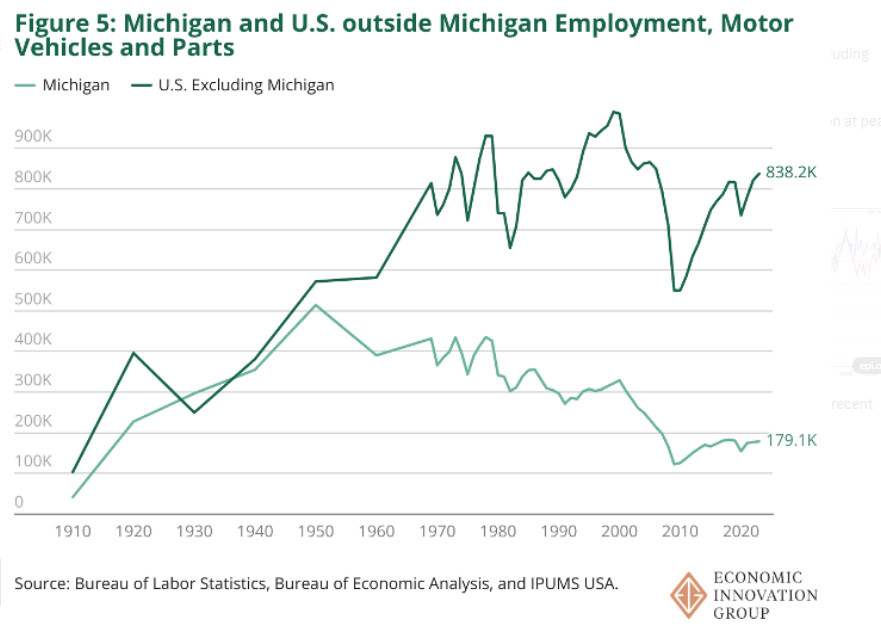
The author states: In 1950, Michigan had an absolute advantage in automobile manufacturing, while Alabama had an advantage in cotton. By 2000, auto plants were closing in Michigan and opening in Alabama. This benefited Alabama, but not necessarily Michigan—unless Michigan had transitioned into higher-value industries.
The author attributes this shift primarily to capital mobility and concludes that absolute advantage now dominates.
I disagree on several fronts.
First, capital has been mobile for centuries. While its mobility has increased internationally, mobility in the US wasn’t constrained between States. Michigan already had access to capital, equipment, and infrastructure. If anything constrained capital flows within the United States, it was not economic inevitability but political and institutional barriers—often industry-specific and frequently reinforced by government policy.
Second, I reject the claim that Michigan had an “absolute advantage” in the strict sense. Alabama may have an absolute advantage in growing cotton due to climate. Michigan’s advantage in automobiles was not natural; it was constructed—through capital investment, technology, and accumulated knowledge.
That distinction matters.
Technology Undermines “Natural” Advantage
Even Alabama’s agricultural advantage is not as fixed as it appears. Corn production illustrates the point clearly.
Land near my place of birth—once considered marginal pasture—is now producing 180–200 bushels per acre. Drain tile, long standard in Iowa, is only now being installed (with government funding), further increasing yields. Land costs are less than half of Iowa’s; pastureland can be converted at roughly one-quarter the price. Larger contiguous holdings improve efficiency of operation.
These gains are driven almost entirely by innovation: seed genetics, fertilizer chemistry, and application techniques. What was once poor land has become excellent land.
If technology can overturn natural advantage in agriculture, it can do so anywhere. “Owning the mine” is an advantage—until someone learned how to manufacture diamonds cheaply.
Innovation Is Missing from the Standard Model
Economics traditionally defines four factors of production: land, labor, capital, and entrepreneurship. Innovation and human capital are buried within these categories, but they deserve explicit recognition.
Innovation is not a marginal adjustment; it is often the dominant force. It reshapes cost curves, productivity, yield, and even what counts as an advantage in the first place.
Closely related is what I would call cross-pollination critical mass—the phenomenon where concentrations of knowledge and expertise in one domain generate breakthroughs in others. Silicon Valley is sort of an example, but the principle is broader.
Michigan’s advantage within the U.S. was the same advantage the U.S. had over China 30 years ago: concentrated capital, accumulated knowledge, and embedded innovation.
Why Did Michigan Actually Lose Auto Manufacturing?
If Michigan lost automobile production to Alabama, why did it happen?
The standard answer is low-cost labor. The author seems to suggest it is low cost labor. I do not accept that explanation.
The wage difference between auto workers in Alabama and Michigan was roughly 30 cents per hour—about 3 percent. No rational firm builds a new manufacturing facility on the basis of a 3 percent labor cost reduction, especially when doing so risks losing decades of accumulated expertise.
That low wage logic only works if you believe manufacturing consists of interchangeable workers performing mindless tasks. In reality, small changes in yield or productivity overwhelm any plausible labor cost savings. Labor quality directly affects both.
How many defective iPhones can you afford to throw away in order to replace a $30-per-hour worker with a $2-per-hour worker?
Unionization and tax structure provide far more likely explanations. Eliminating a union can improve productivity by 30 percent or more and increases yield and improves quality. It also unleashes the magic called innovation. Michigan’s tax system—effectively a value-added tax—was materially worse for high-labor industries than the net-profit tax regimes in southern states.
Capital Mobility Does Not Eliminate Knowledge Constraints
If capital mobility were sufficient, every state and every country would have a Silicon Valley. All you would need is a building and some college graduates.
But this is obviously false.
If it sounds absurd to believe that buying cheap office space and hiring lower-cost graduates could outcompete Silicon Valley, it should sound equally absurd to believe that one can easily replicate sophisticated manufacturing in a location lacking machinists, electrical technicians, tool-and-die expertise, reliable infrastructure, etc or institutional knowledge.
Manufacturing is harder to replicate than software development, not easier. You cannot manufacture electrical tape in a home office connected to the internet.
A Concrete Capital Allocation Example
My last major capital project before retirement involved expanding manufacturing capacity in Brookings, South Dakota. As part of the decision process, we conducted a full source-of-supply P&L analysis comparing locations worldwide.
Singapore—a near-zero tax jurisdiction—showed a $150 million advantage purely from tax differences.
This advantage remained even after accounting for:
-
Higher headcount (12 operators versus 8),
-
Dedicated maintenance staff,
-
Duplicate engineering, supply chain, and management roles.
The Brookings engineers argued—correctly—that inexperience would be costly. The company could have mitigated this by paying U.S. operators and maintenance staff $500,000 per year for five years to transfer knowledge—and Singapore would still have retained a substantial advantage.
This illustrates how tax policy, not labor wages, often dominates location decisions.
Externalities, Regulation, and Trade Agreements
The article emphasizes unpriced externalities such as pollution. This concern has merit, but it is overstated and misleading in my opinion. Many regulatory costs have little to do with genuine externalities and much to do with politically driven mandates.
Free trade has never meant the absence of rules. Trade agreements exist precisely to exclude bad actors. Arguing that free trade requires zero standards is a straw man.
In the US a larger business cannot hire the people they believe are necessary for success. In a practical sense you are forced to hire minorities and women and you must do extra work in order to try to remove them. The amount of work makes it prohibitive simply because you may face a costly lawsuit regardless of whether the firing was righteous. You are forced to promote them not based on competence but based on their physical characteristics. Many countries don’t have to pay for this. This wanting to make everyone equal is a much larger cost than any pollution control or safety requirement.
The relevant question is not whether externalities exist, but whether regulatory costs are proportional to the benefits they produce—and whether they distort competition unnecessarily.
The Labor Wage Narrative
Labor wage has become a convenient narrative.
-
Labor can blame foreign competition.
-
Management avoids accountability for lack of innovation.
-
Politicians avoid confronting tax policy or trade partner choices.
-
Wall Street continues allocating capital toward growth.
Everyone that is accountable benefits from the narrative.
Alabama did not beat Michigan because of wages. It likely won because of non-union facilities and a more favorable tax structure.
Another Real World Example
3M had manufacturing plants across the globe when I was hired in 1989. This continued to expand and they have manufacturing facilities in nearly every meaningful country in the world. We called them sister plants. They manufactured the same components and products as plants in the US. The only time we imported from any of these locations was when there was a capacity constraint. They manufactured the same components and products and often they used improved process and equipment designs. They were not lower cost. In some cases, like China, the only reason they existed was because of tariffs.
A side note. China basically forced businesses to manufacture in China first by tax incentives and then by tariffs. They would then steal the technology and then would sell at a lower cost. If wouldn’t have stolen the technology if they had a better way. They didn’t have a wage advantage because the operations are all in China. They use direct government subsidies as well as subsidized transportation and power. They will sell at lower than manufacturing cost which is a violation of international trade law.
Manufacturing Competes on Knowledge, Not Just Cost
Every firm chooses how it competes: product innovation, branding, or manufacturing excellence.
Warren Buffet said that he tried to compete in the textile industry (that is what Berkshire was when he bought it), but he would have to buy new equipment every few years to keep up with the competition on costs and margins could not be improved. Warren is a bean counter. He doesn’t understand manufacturing any more than the wages are everything crowd. You cannot compete on cost by buying off the shelf equipment. You have to innovate. Either innovate in manufacturing or innovate in product design or innovate in marketing.
Gore (Gore-Tex), 3M (Thinsulate), Under Armour, Sitka, Lululemon are all examples of being successful in the textile market using innovation in product design and or marketing.
Manufacturing success comes from continuous improvement driven by everyone—from operators to engineers to management.
Today, contrary to the narrative, there is all kinds of innovation happening in the US. Most of it is in product innovation. These innovators have to send their product to China to be manufactured and China will rip off the design (since they know how to make it) and sell it as their own. That is not a free trade problem. If you develop a better mouse trap, China will steal it and the people will beat a path to their door.
Final Observation
Labor wage is rarely the dominant cost in modern manufacturing. In semiconductor fabrication, labor contributes pennies to a few dollars per chip. Yet we continue to build trade narratives around wages.
When competition exists, innovation follows. When innovation stagnates, it is often a sign that competition has been suppressed—not that labor costs are too high.
We have structural problems within the US that often are prohibitive to manufacturing products efficiently. Prohibitive to innovation. Most of them come from these so called externalities. Now we face a choice. We can further protect this system that imposes very high costs or we can throw off the shackles.
About your statement
Hopefully this long reply illustrated that it isn’t about free trade. That is just the latest boogie man to distract people from the real reasons they lost their job.
I can’t help but wonder why none of these folks have moved to any of the manufacturing locations where I worked in the US? They have had shortages of people for over 10 years now. Why they didn’t show up in the oil fields in North Dakota? I guess if they haven’t been willing to go find a well paying job, they probably aren’t the type of people that have made those plants extraordinarily successful.
7 Likes
An example of what I am talking about.
P&G does something like $750,000 of sales per employee. This dude is doing $1.5 million. Yet, I am willing to bet that if you were allowed to view a P&G factory making a very similar product (package filled with stuff) there would be much less labor hours per unit than this guy’s production line. Universities like Harvard have nearly as many administrators as students and corporations like P&G have nearly as many administration employees as factory workers (especially if you measure in dollar units). They need many of these admin employees to insure that all the externalities are fully baked into the cost.
I will also bet that this dude, will integrate the molding of the bottle at zero additional labor cost.
Maybe it is only obvious to me how this guy innovated. He used low cost materials to construct his line. Everything from the two x fours to the Arduino. He used no automation and semi-automation until it made sense to fully automate. The stuff in the bottle may also be an innovation, I just don’t know what is in the bottle. I notice he didn’t print multiple labels just to have translations for twenty five different languages. By the way, I am pretty sure the government regulates the font size for printing in different languages. Externalities.
If you look at a similar line from a large company in the US, they will likely have tens if not hundreds of thousand dollars of PLC and associated IO modules. That line would be nearly fully enclosed in guarding, it would never be allowed to fit into 600 sq ft due to various safety, ergonomic, maintenance conscious engineering regulations and self imposed rules. Externalities.
It comes as no surprise that P&G manufactures in China for export.
When I used to walk around in Taiwan and China, I would pass all kinds of places that looked just like this guy’s operation.
My hope is that he starts making nearly everything companies like P&G make. Most of their products have not been innovated on in years. They can only be successful in our current system of no competition.
6 Likes
Alabama is a right to work state?
1 Like
yes, but it doesn’t matter specifically. The South in general took auto jobs from Unionized states
2 Likes
3 Likes
I really like this guy. He’s hilarious.

1 Like
>be Palmer Luckey
— Jaynit (@jaynitx) January 15, 2026
>born 1992, Long Beach, California
>homeschooled by mom, dad's a car salesman
>build railguns, Tesla coils, lasers in the garage as a teenager
>electrocute yourself, burn a gray spot into your own vision cleaning a laser
>no regrets
>start college courses at 14… pic.twitter.com/9c9asWrKZC
2 Likes

3 Likes
1 Like
Why Long Beach, for heaven’s sake?
4 Likes