Regarding the Plasmak paper https://web.archive.org/web/20120712235535/http://www.prometheus2.net/ICC_2002_POSTER.pdf (I was involved in that work), IMHO the photos and measurements are intriguing but much more ambiguous than claimed. I am tempted to record a critique.
6 Likes
Please do, Chuck! This is an important piece of history to which you are the most informed living person. Moreover, you have, at least in my mind, demonstrated you are ruthlessly devoted to the truth are are competent to pursue it in this area.
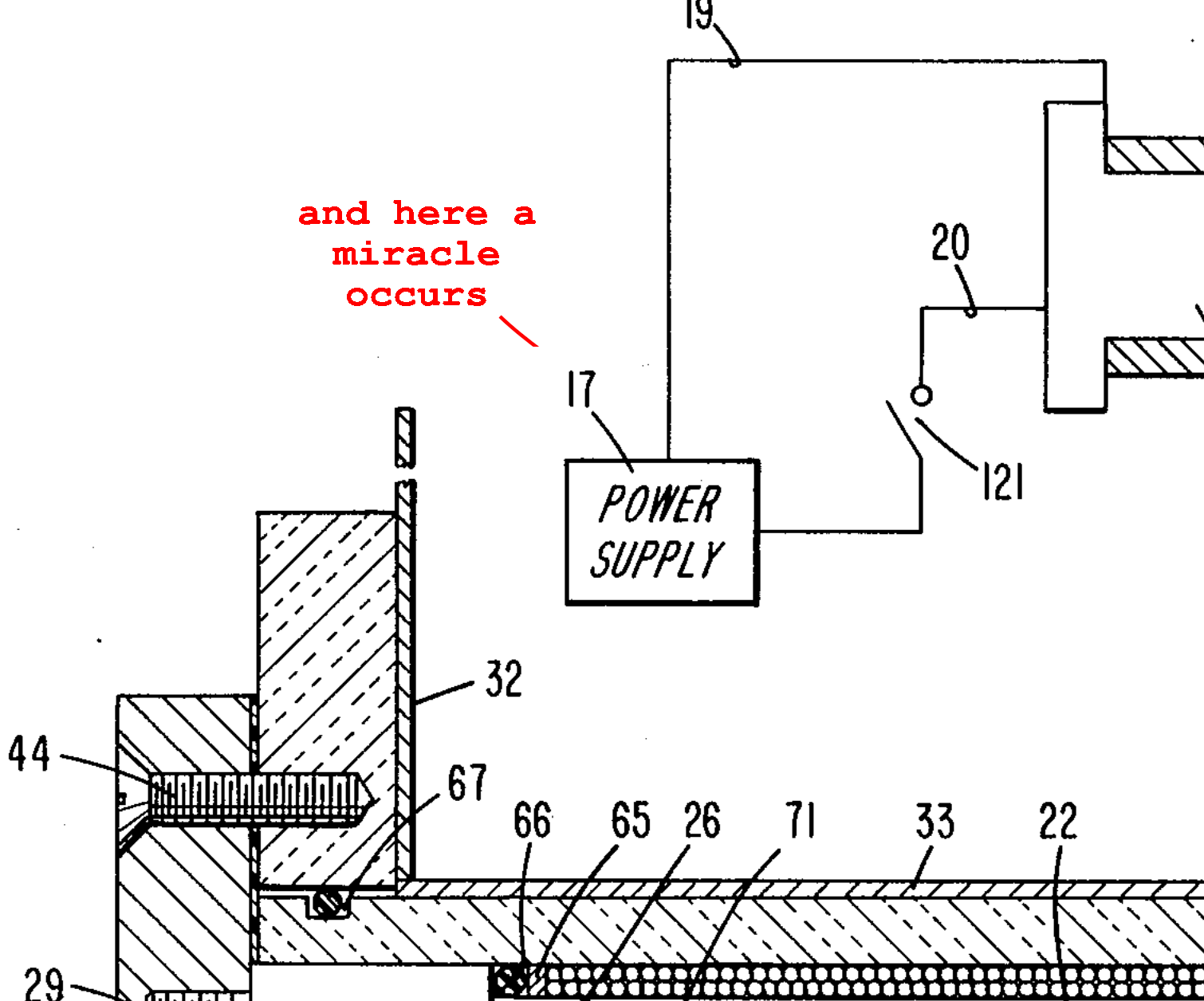
Regarding the circuit diagram and associated pulse, it doesn’t appear to incorporate the massive inductor for the fast rise time that Paul told me he was looking for. This is perhaps not too surprising to an electrical engineer since my naive SPICE circuit just kind of wished into existence a switch that probably could not exist.
When I brought this up with a colleague who did the computational MHD for the Princeton torus, he pointed me to this patent of his:
https://image-ppubs.uspto.gov/dirsearch-public/print/downloadPdf/4715261
I extracted from that patent the detail of the figure that would have embodied the large inductor(s) and noted that it wasn’t really disclosed:
A quote:
“Yes. We hired a solid-state power engineer who spent considerable time (and money) designing and testing solid-state opening switches. None proved fast enough at the currents we required. We could charge the inductors, but we couldn’t switch their current into the plasme circuit fast enough.”
4 Likes
IIRC the inductor-fed, opening-switch pulser was a fairly late design (after I had moved out West and was participating more sporadically). The work I recall more clearly was based on closing a switch to the charged capacitor bank. To get reasonably short rise time it was important to minimize the inductance between the capacitors and the gun – there was a good deal of wide-parallel-plate and coaxial construction with that intent.
Now you’ve got me thinking about this old project, but I don’t really intend to take it up again seriously. I am moving out of the country and I actually just passed on my old files (along with most of my workshop (StuffPics – Google Drive) to a retired physics enthusiast here in Seattle. He’s intrigued but I can’t judge his level of engagement.
I think I share some of your “important piece of history” view - at least potentially - but I can’t bear the primary load of following up. If we gathered a small group who could share the task, I would participate. If we could include someone capable of wielding modern MHD modeling software, that could be worthwhile.
4 Likes
Helion is probably the best bet at this point, but this looks to be an amateur with MHD simulation skill that is interested in FRC:
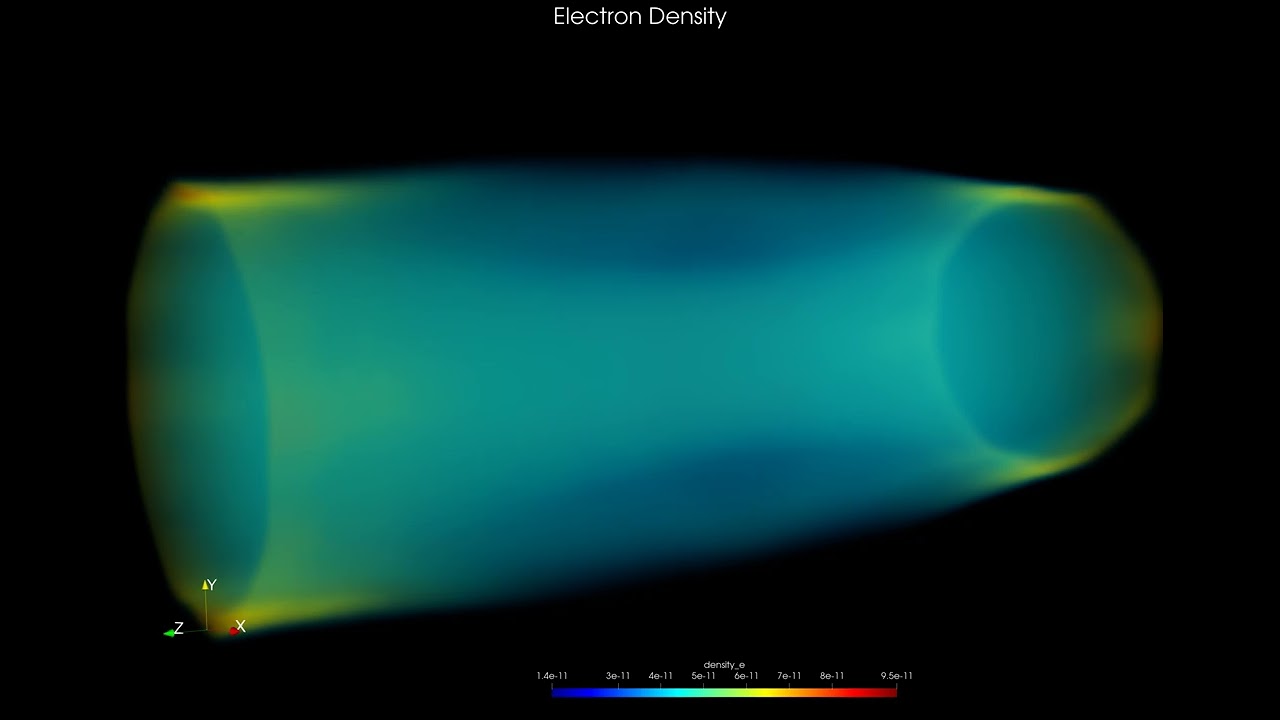
I posted a response to his most recent simulation (a mere 8 days ago):
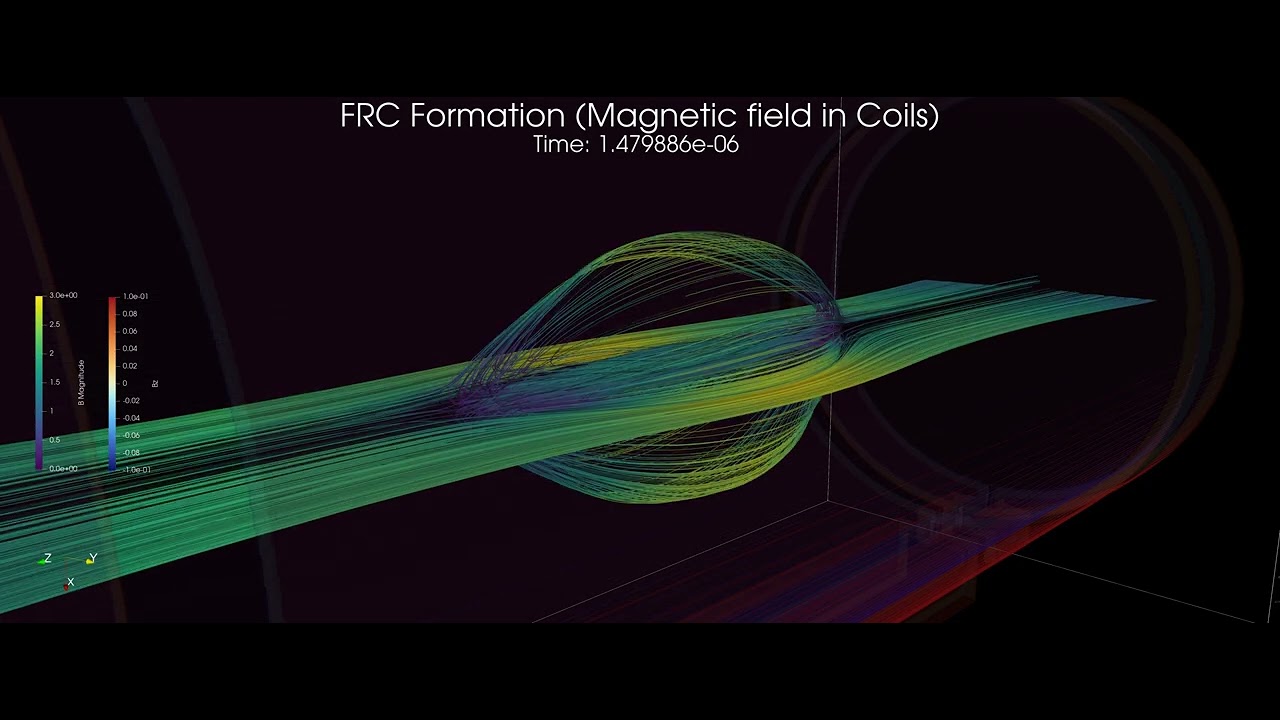
Musk has made quite a bit of noise discounting fusion energy technology but, as you no doubt recall, Bruce Pittman was highly motivated by the rocket propulsion potential of the Plasmak. Atomic energy adds value to precious reaction mass for orbital transfer burns.
As Musk ramps up his reliance on lunar resources, he’ll run headlong into the capital utilization rate limitations of solar energy given the long lunar night. Locating at the poles may make virtue of necessity in the sense that one may have a combination of hydrogen (lunar H2O frozen in continual crater shadows) with continual solar energy not attenuated by trip through a horizon sun. So maybe that’s an inevitable result of Musk’s solar religion, but on the other hand, he’ll be limited to a 1D solar array due to the polynomial cost of raising the height of solar collectors. And that 1D array must be rotated 360 degrees every lunar month, which may be even more of a killer.
But transporting He3 from the poles could be far more economic than adding battery capacity. Also fusion combined with lunar reaction mass, even if only electrolytically liberated oxygen from molten regolith, might be a way of initially getting lunar mass to escape velocity, including SBSP satellites manufactured on the lunar surface from lunar material as Musk as recently indicated he might pursue.
3 Likes
The Trump family is on the FRC bandwagon as of a few weeks ago:
This makes me wonder if Paul Koloc’s work in the early '00s went dark instead of merely dying with him
1 Like
When Bob Bussard endorsed my proposed fusion energy prize awards legislation, his PolyWell was another fusion approach I became interested in but not to the point that I got involved.
When these videos on the PolyWell popped up in my YouTube feed today, I was surprised to discover the amount of work that had gone into that approach – all apparently for naught. However, as discussed by Moynihan toward the end of his first video, PolyWell has, from the outset, been under military classification restrictions, so it is difficult to discern what is going on.