Regime Change: the weight loss drugs

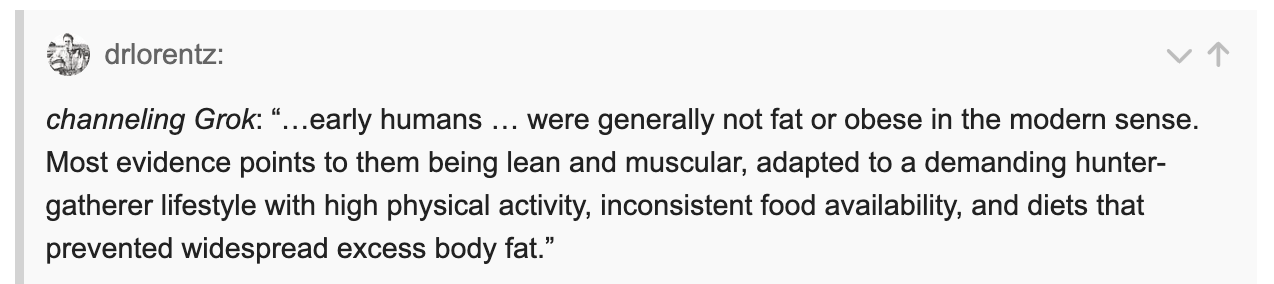
It is gratuitoustly deceptive of you to make it appear that I wrote “channeling Grok” as you did in this comment, viz.,

Furthermore, you failed to respond to the arguments made in a prior comment, explaining why your conjecture was unlikely to be correct. My Grok reference was an afterthought. Nevertheless, your glib dismissal of the Grok summary overlooks the fact that 45 references* were given. This one is pretty good.

Do you have a critique of all 45? How about even one? Or perhaps you didn’t bother to look at any of them. Instead, we are treated to a reference to a pop-medicine book.

Maybe, since you are citing this as the only evidence for your conjecture, you might provide a summary and the scientific literature to back it up. I mean, did you read the book, or just the title?

*there are some duplicates

1 Like

Once again, you completely duck the issue, Mr. Lorentz. Why don’t you read Doctor Johnson’s book and give us all a relevant sensible critique of his well-supported reasonable explanation of the obvious spread of obesity we have all observed in the last half-century?

This reminds me of an exchange in the movie Dumb and Dumber. Loyd asks the lady what the chances are that they could end up together. She replies not good. He asks if not good is 1 in 100. She says more like 1 in a million. He closes with so there still is a chance.

In my comment I said <20% can maintain weight loss. In studies of obese less than 1% even reach a healthy weight. For severely obese (BMI >40) it is less than 1 in 1000. There still is a chance.

The side effects include a reset of your base metabolism. As you noted when a person diets and restricts calories their base metabolism will drop making it even harder to maintain a healthy weight. I have no idea if the medical community would call this a side effect, but in my opinion it is obvious that if you do something and the result has a negative impact on how your body functions it is a side effect. As much so as having stiff joints from taking a medication. Switching a diet rapidly can cause constipation and diarrhea. These may be more minor and temporary side effects, but diarrhea and nausea are often mentioned as side effects of the GLP 1 agonists. Dieting done wrong (such as yo yo dieting) have a negative impact on your body. Just think if everyone that sold a diet had to add the side effects of: Will likely result in a higher weight and could reduce your metabolism such that you have to eat even less to not gain weight.

I don’t think it is clear whether GLP 1s will work long term. Weight maintenance becomes easier after 2 to 5 years with normal dieting/lifestyle change. Meaning if you can be successful at eating well for 2 to 5 years, you have a decent chance of making it stick. Hardly anyone makes it 2 years, right? My opinion (not backed by studies) is that GLP 1s will increase the probability that individuals will make it 2 to 5 years. It won’t work for people that think the drug is the solution. I think it might work for people that have used a healthy diet (not a starvation diet) to lose weight, but have fallen off the diet in a few months because of some event that caused them to “fall of the wagon”. It will help them make it 2 years in place of 2 months and maybe the healthy lifestyle will take hold.

I don’t know if there are long term studies centered around weight loss, but for the longer term (3+ years) studies for these type of drugs for diabetes and cardiovascular issues, weight loss maintenance is better than normal dieting (~80% are 5% lower in weight).

I understand your point and I also wish we could fix obesity without drugs. I wonder if I am suffering from “hopium”. Hoping a problem that is maybe a societal issue can be fixed with a drug. It is fair to compare my hope that drugs will fix obesity with the hope that “the pill” would fix unwanted pregnancy. The pill just made things worse.

3 Likes

lol

Thanks, I needed a chuckle this evening.

On the odd chance that you were serious, I urge caution in following the advice of pop-medicine doctors. I don’t know about this fellow in particular but, anecdotally, a friend started following the suggegstions of one of these YouTube/podcaster/pop-docs so I looked into it a bit. This guy, in spite of his credentials, turned out to be a quack, as in, you could hear the quacking from the next county. One of this guy’s tricks was to misinterpret the results of the literature he cited. Another was to use underpowered and unreplicated studies. As John Ioannidis showed in his famous paper, most published research findings are false. The replication crisis is real.

1 Like

I’m not sure exactly what the argument between Gavin and DrL is about at this point, except, y’know, being right.
My recollection from my anthro courses (and please, don’t demand that I cite the textbooks I had back then; I dk where they are now) is that humans back on the Ur-continent had—idk if it’s instinct, maybe a survival strategy— to absolutely gorge themselves whenever a big game animal (elephant, rhino, giraffe, buffalo) was killed. to the point of satiety and somnolence. Seasons didn’t come into it in Africa . When food was (temporarily) abundant, to the point where the fiercest, dominant members of the tribe couldn’t guard it all for themselves (as they easily could if the dead prey was just a gazelle or sump’n) then EVERY man, woman and child just ate as much as they could choke down. People in cold continents learned to preserve meat, like the North American primitives with their pemmican, but that wasn’t an option in tropical, abundantly insect-infested climes ( which is where we humans somehow survived and against all odds, and despite the best efforts of our toxic parent, Mother Nature, began to flourish.)

These glut-feasts probably didn’t happen very often. I mean really, it took patience, lotsa patience, and cunning, to bring down an elephant or sump’n. Beasts like that are much, much stronger and faster than people. Sometimes we even ate the equivalent of roadkill; like, they’d let a big cat do the killing, then chase it off and eat its lunch for it.

….so you COULD say, well, okay then! It’s hard-wired into us to just keep on eating until the food is gone! And in our society, the food never IS gone. So we get fat and fatter, and fatter

You COULD, but I wouldn’t. Because: culture. We naked apes NEED our cultural accoutrements, we depend on ‘em. I live in the temperate zone and I could not survive one night in the woods in winter, nay, autumn, without clothing and shelter. I couldn’t survive winter without stored and preserved food. We are a long way from the savannahs now. People on the savannahs had, and needed, culture too. But because of the scarcity of meat and the difficulty of getting it, IMHO culture didn’t come into that aspect of their lives to the extent it does in contemporary societies. We can afford to, nd we do, have a complicated, nuanced relationship with comestibles.
6 Likes

No doubt that culture is part of adaptation to different climatic zones. Even so, none of us would have any difficulty in distinguishing a Zulu from an Inuit, even at a distance of 100 feet – and not due to culture alone. Clearly environment, culture, and genetics have been engaged in a dance for tens of thousands of generations.

And so today we are living through the consequences of a rather abrupt change in the environment – year-round access to plentiful food. One cultural trend is trying to adapt to this world of plenty, witness the Woke adverts displaying grossly obese individuals. Another cultural trend is pushing medications. Running behind this is the probable situation that the Age of Plenty will be short lived, at least in terms of the many generations required for breeding selectivity to adjust.

Culture is only one element in a complex situation.

No. Culture is THE situation.

1 Like

With respect, I have to disagree about the primacy of Culture – certainly over the long haul of the natural selection effect on populations over hundreds of generations. Think Vitamin D / skin pigmentation; it was not Culture which resulted in northern populations having lighter skin pigmentation.

Arguably Culture could have had an effect on the sudden emergence of widespread obesity in today’s populations; in many traditional tribal societies, only the chief was fat. But we cannot rule out the post-WWII effect of plentiful affordable food supplies, transported across the Equator to eliminate the effects of seasonal variation in supplies.

But if I am missing something, please educate me.

1 Like

What I ws taught, and have believed :folded_hands:ever since Anthro 101, is that culture is the air we breathe, our entire sphere. But most famously Marvin Harris developed the theory of cultural materialism, that culture itself is determined by the available resources and the composition of the demographics of a society. Jared Diamond had the same idea—I’ve never understood why his work was so universally pilloried. It’s obviously true on some levels. F’rinstance, Slavic churches wave pussy willow on Palm Sunday, instead of palm fronds. Do we hafta study why they prefer the fur-like buds to the spear-like fronds of the palm? Or can we just skip that and take notice that there ARE no palm trees in Eastern Europe …..:thinking:

2 Likes

Exactly. Nobody gets fat by one or two glut-feasts. Nobody picks up 40 lbs. in one day, one week, or even one month.

Agreed. The propensity to continue to over-eat may have evolutionary roots but that doesn’t mean those early humans were fat, nor does it mean that it is evolutionarily adaptive to be fat. It’s evolutionarily adaptive to eat when food is available until sated. Big difference! Humans dealt with the intermittent availability of food, as @hypatia points out, by learning to preserve meat and fish.

Hence, the notion that “Nature Wants Us To Be Fat,” to coin a phrase, is false. Being fat is not adaptive; it leads to disability and early death. You can’t chase after a gazelle like a good hunter if you’re hauling around an extra 50 lbs of fat. That, in a nutshell, is the disagreement between @Gavin and me.

2 Likes

Yup, culture is downstream from biology. That’s why Magic Dirt Theory is wrong.

Why would a fat guy need to chase after a gazelle? That hunter is already well-fed and can afford to sit around the campfire and sing songs.

It is blatantly obvious that life was different for our progenitors in Tropical zones with fairly steady year-round food availability. Then there was indeed no survival value in having the ability to put on fat in the good times. Once our human ancestors began to migrate towards non-Tropical areas with very limited winter food supplies, the hunter who had not gained weight by the autumn had a lower chance of still being around in the next spring – and therefore had less likelihood of reproductive success.

It is damn cold outside today in my neighborhood. However, in our Culture, we have quickly become accustomed to living & working year-round in air-conditioned buildings and having year-round well-stocked supermarkets – leading to today’s epidemic of obesity. For our ancestors, the seasons dominated their Culture and their lives and influenced their weights.

I’m not sure you even understand your own thesis. If your claim is that these hunters fattened up to get through the lean periods, that means they used up those fat reserves and became thin again while singing songs ‘round the campfire. Presumably, that’s how they were able to hunt again next time. This is very different from the perpetual, and steadily increasing, obesity of the modern era. Or, do you imagine that these ever-more-obese ‘hunters’ were able to hunt their prey, perhaps using mobility scooters: the triumph of the Rascal scooter.

I urge you to re-read my prior comment for a more detailed exposition. Obesity causes disability and disease. It even lowers fertility. Natural selection works against all of these; to the degree overweight/obesity has any genetic component, it will be selected against.

Addendum: I don’t mean to imply even your repaired thesis is correct. These primitive hunters didn’t balloon up to BMI 35 over the summer, only to collapse to a lean, mean 20 over the winter. The evidence, cited previously, says otherwise. Chronic obesity is a feature of modernity.

1 Like

My goodness! You finally get it, Lorentz!

I finally get you, yes. :joy:

Did you read the rest, or was that too much?

JUST IN: Weight loss drugs like Ozempic on track to save U.S. airlines more than half a billion dollars in fuel costs this year.

— Polymarket (@Polymarket) January 18, 2026
7 Likes

Let’s hope they’re all round trip (:grin:) tickets and the passengers get back home before they gain back all the weight!:joy::joy::joy::smiling_face_with_tear:

5 Likes

No idea if this is true but it is hilarious. Don’t you think it belongs in the humor thread, though?

3 Likes

I see what you did there.

3 Likes

https://www.bloomberg.com/news/articles/2026-01-15/weight-loss-drugs-hold-promise-of-big-savings-for-us-airlines

https://archive.vn/nQHCY

The growing use of weight-loss products may end up saving the biggest US airlines as much as $580 million in fuel costs this year as passengers shed pounds and make planes lighter, according to a Jefferies analysis.

The top four US carriers, including United Airlines Holdings Inc. and Delta Air Lines Inc., are expected to spend $38.6 billion combined on jet fuel this year. Slimmer flyers could cut one of the industry’s biggest expenses by as much as $580 million, analysts including Sheila Kahyaoglu said in a report.

2 Likes