# Word Recognition by Men and Women
**URL:** https://scanalyst.fourmilab.ch/t/word-recognition-by-men-and-women/2410
**Category:** Context
**Tags:** english-language, sex-differences, linguistics
**Created:** [7 December 2022 14:10 UTC](https://scanalyst.fourmilab.ch/t/word-recognition-by-men-and-women/2410 "2022-12-07T14:10:43Z")
**Posts on this page:** 2
**Page:** 1
### Author:  [@johnwalker](https://scanalyst.fourmilab.ch/u/johnwalker)
#### Post date: [7 December 2022 14:10 UTC](https://scanalyst.fourmilab.ch/t/word-recognition-by-men-and-women/2410/1 "2022-12-07T14:10:43Z")
In a paper published on 2018-07-02 in _Behavior Research Methods_, “[Word prevalence norms for 62,000 English lemmas](https://link.springer.com/article/10.3758/s13428-018-1077-9)”, the authors studied knowledge of English words by a large body of people, as described in the abstract.
> We present word prevalence data for 61,858 English words. _Word prevalence_ refers to the number of people who know the word. The measure was obtained on the basis of an online crowdsourcing study involving over 220,000 people. Word prevalence data are useful for gauging the difficulty of words and, as such, for matching stimulus materials in experimental conditions or selecting stimulus materials for vocabulary tests. Word prevalence also predicts word processing times, over and above the effects of word frequency, word length, similarity to other words, and age of acquisition, in line with previous findings in the Dutch language.
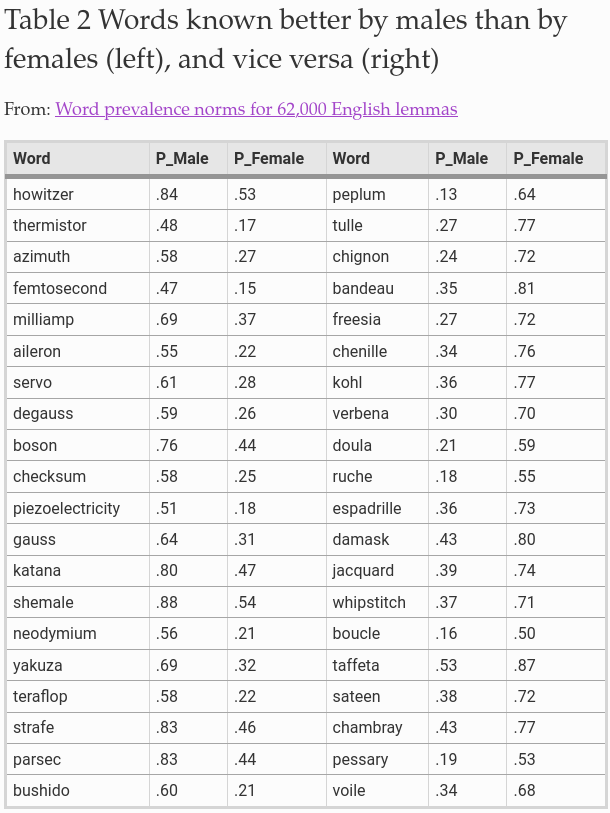
Among the interesting results was this table of words known better by men than women and vice versa.
[](https://link.springer.com/article/10.3758/s13428-018-1077-9/tables/2)
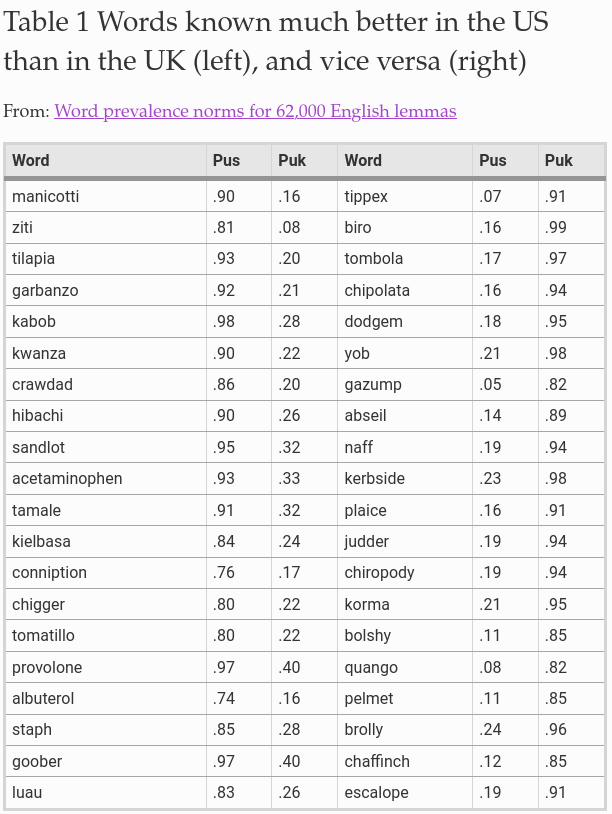
Also fascinating, here are words known much better in the U.S. than the U.K. and vice versa.
[](https://link.springer.com/article/10.3758/s13428-018-1077-9/tables/1)
Note that in the on-line full text of the paper linked above not all of the tables are included directly, but instead are links to separate documents. In the [PDF edition](https://link.springer.com/content/pdf/10.3758/s13428-018-1077-9.pdf), all of the tables appear in-line.
---
### Author:  [@eggspurt](https://scanalyst.fourmilab.ch/u/eggspurt)
#### Post date: [2 May 2024 11:45 UTC](https://scanalyst.fourmilab.ch/t/word-recognition-by-men-and-women/2410/2 "2024-05-02T11:45:24Z")
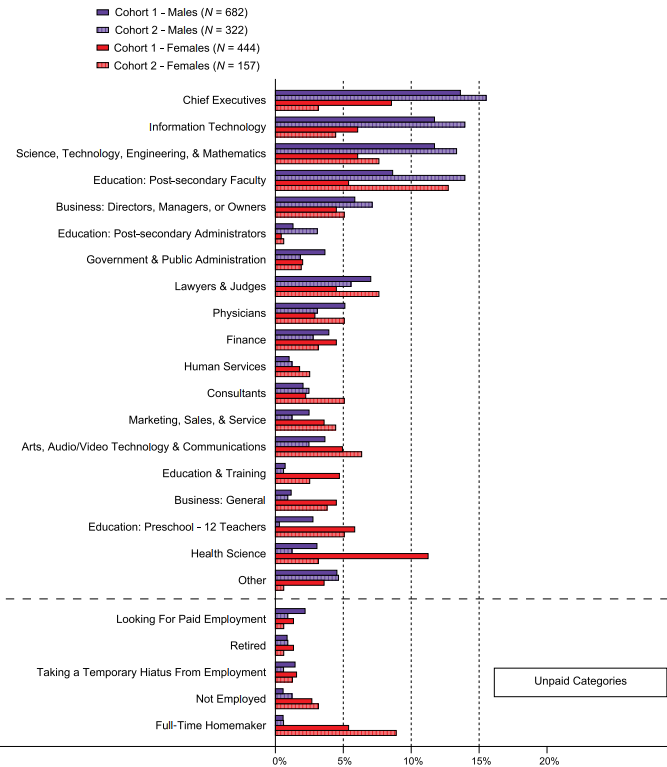
Occupations of Men and Women who scored in the top 1% of the math section of the SAT in the 1970s:
[Source & more data](https://twitter.com/lefineder/status/1785762736627929493)