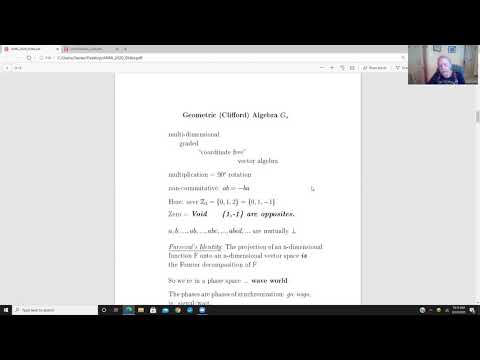
Here is a talk on the pre-history of ANPA and future directions spawned by the original questions regarding the Combinatorial Hierarchy.
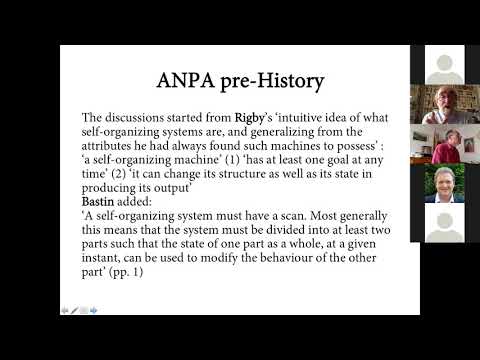
Note three things in particular, beyond the intriguing “numerology” pointed out above regarding the proton and the gravitational coupling constant:
- Michael Manthey (manthey@acm.org) was (and remains), to the best of my knowledge, the person most qualified to pursue the computational implications of the Combinatorial Hierarchy. He ended up patenting a qualitatively different computing paradigm to the Turing machine which he believes is necessary to generate true self-organization hence AGI.*
- The person that introduced me to the Combinatorial Hierarchy, the late Tom Etter, was not only the editor of the ANPA West Journal, but attended the 1956 Dartmouth Summer Workshop, apparently arriving with Ray Solomonoff. (I didn’t know about Tom’s history here until recently as he never mentioned it while we worked together on the foundation of programming languages at HP’s “Internet Chapter 2” project: eSpeak.)
- The Combinatorial Hierarchy was conceived as an outgrowth of Cambridge University’s “Language Research Unit” that was studying the theory of language. (I suspect this was, in turn, an outgrowth of Bletchley Park.)
* Manthey’s most recent presentation (corrected slides here) on his approach to what he calls “spatial computing”, in terms of Geometric Algebra, as qualitatively distinct from Turing machine computation that operationally defines “awareness” thence operationally defines “consciousness” as “awareness of awareness”: