After volunteering for several weeks at a local food bank, I have made the following observation concerning the clientele:
- Most arrive in late model cars, some in luxury vehicles (Mercedes, Lexus).
- Many (most?) are overweight or obese.
- Almost all have nice iPhones/Android (i.e., at least two rear cameras).
- Some also receive pet food.
These are all markers of relative affluence or, at least, not indicative of poverty requiring food assistance unless some very poor life choices have been made. In particular, items 1, 3 & 4 indicate prioritizing nonessential items over food; item 2 suggests poor use of a limited food budget.
A few more tangentially-relevant facts:
- The contributions are overwhelmingly from grocery stores; individual/church contributions are negligible.
- The bar codes have to be defaced so that recipients will not be able to return items to stores for money.
- The median household income for my zip code, county, and state are roughly within 10% or 15% of the national average: some higher, some lower.
All of this came as a shock since I was expecting a very different picture. My purpose in joining this effort was to help people who were truly in distress. There were some clear exceptions but that didn’t seem to be the norm. Sure, these observations are anecdotal but I have seen hundreds of recipients. The plural of anecdote is data.
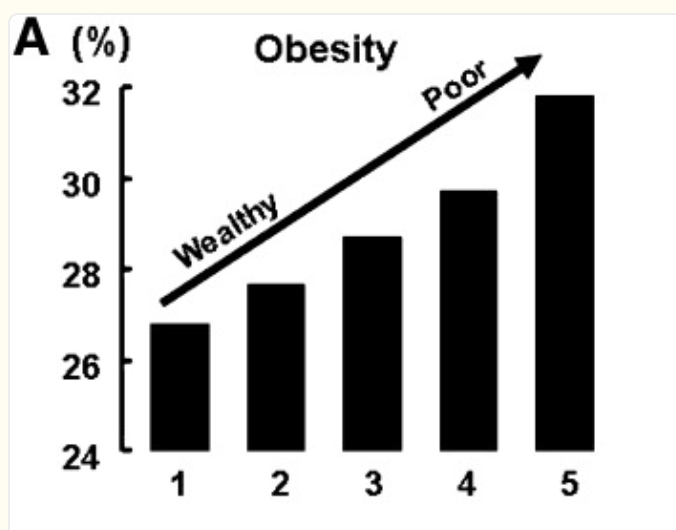
There is a well-known correlation between obesity and poverty in First World countries as illustrated by this graph of obesity rate versus wealth quintiles, taken from this paper:
The issue of hunger, or food security as is its current fashionable name, has a long history. Almost 60 years ago, CBS produced a documentary with the same title as this post:
Putting aside the usual caveats about the dishonest of journalism, it is of some value in putting the problem in context: the good, the bad, and the ugly.
The good: nobody was obese.
The bad: the documentary consisted mostly of anecdotal human interest stories and very little objective data.
The ugly: quote from a doctor in Loudon County (VA):
These people … seek immediate forms of enjoyment. This is why we frequently see a late-model television set in the living room of a family that has not tasted meat for six weeks. This is why we frequently see a late-model baby in the crib. This is why we often see empty pint bottles in the yard.
In the over half-century since the documentary was produced, it seems the main change has been that the poor(?) get more calories so they’re no longer undernourished but they’re probably still malnourished. The documentary closes on this note, foreshadowing the expansion of the concept of rights from negative rights to positive ones:
In this country, the most basic human need must become a human right.