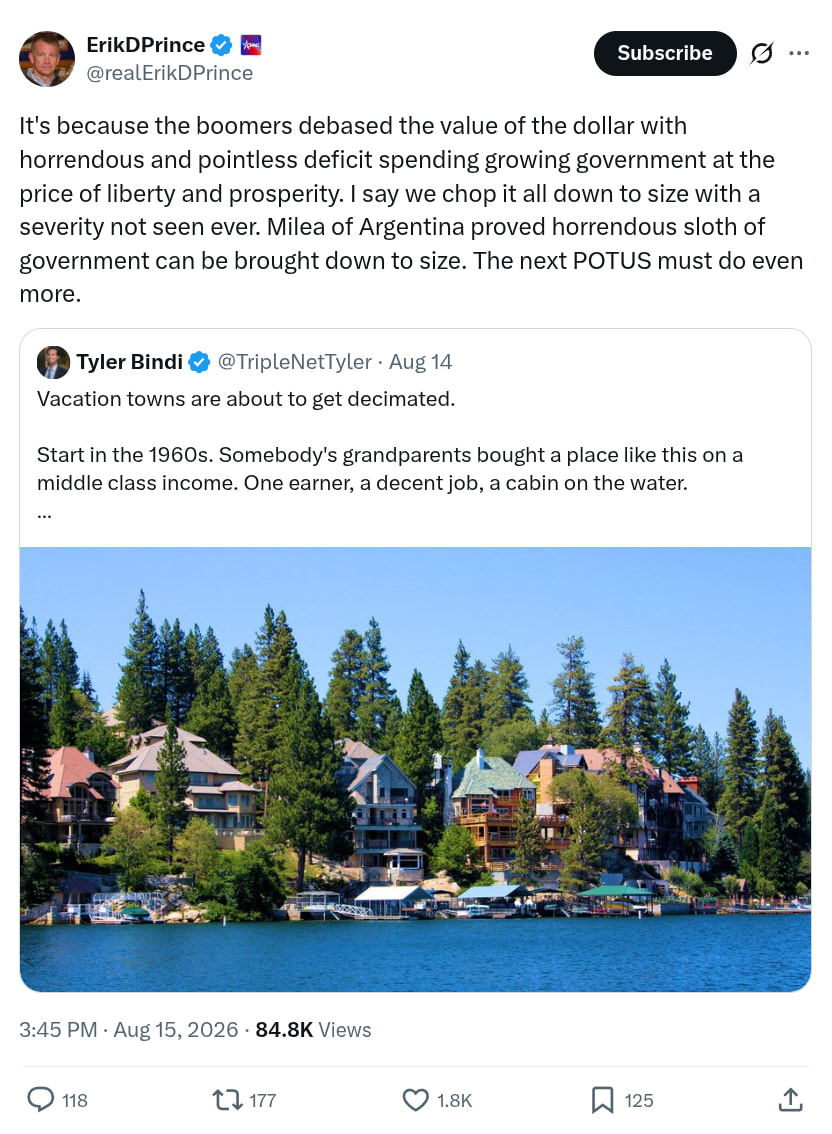
I don’t have the time I need to write the book that needs to be written so paying this month’s $99 to Elon for “truth maxing” Grok Heavy, in order to make the case to Elon that he should WTFU before the Supersonic Tsunami destroys civilization, seemed like a bargain:
It is urgent that the Sixteenth Amendment be repealed and replaced by a single annual tax on the liquidation value of net assets, levied at the prevailing 30-year Treasury yield, with the proceeds funding a universal citizen’s dividend that largely replaces existing government transfer and service programs. This is not incremental tax reform. It is a fundamental realignment of incentives that favors entrepreneurial value creation over private-sector rent-seeking, privatizes the delivery of most social goods, and substitutes a rigorous, continuous form of individual consent for the diluted, intermittent consent of the ballot box.
The Numbers Make the Case Immediate
As of the first quarter of 2026, Federal Reserve Flow of Funds data show household and nonprofit organization net worth at approximately $183 trillion. Households alone stand near $174 trillion. The 30-year Treasury constant-maturity yield has recently traded in the 5.06–5.13 percent range. Applying a uniform rate of roughly 5.1 percent to that $183 trillion base produces potential annual revenue of approximately $9.3 trillion.
Federal outlays are currently in the $7.0–7.4 trillion range, with revenues of $5.2–5.6 trillion and deficits near $1.8–1.9 trillion. Gross federal debt stands at about $39.5 trillion, and net interest costs already exceed $1 trillion annually. A single tax generating $9.3 trillion would fully fund present federal functions, eliminate the structural deficit, begin debt reduction, and still leave several trillion dollars for a substantial citizen’s dividend—on the order of $15,000–$27,000 per person depending on how much is reserved for pure public goods such as defense, courts, and basic infrastructure.
The tax base is liquidation value: the amount that could be realized in an orderly market sale. It is transparent, observable where markets exist, and estimable by modern methods where they do not. Because business equity is already embedded in household net worth, the tax captures productive capital without double-counting.
Entrepreneurial Capitalism Versus Rent-Seeking
The rate is deliberately set equal to the risk-free rate. Assets that merely hold their real value or generate only the risk-free return produce zero after-tax yield. Assets that grow faster than the risk-free rate—through genuine innovation, productivity gains, or the creation of new markets—continue to compound net wealth for their owners. The system therefore rewards entrepreneurial capitalism and systematically penalizes pure private-sector rent-seeking.
Rent-seeking assets include unimproved or under-utilized land whose value appreciates through scarcity and location rather than productive improvement; network-effect “moats” that extract tolls once critical mass is achieved; large holdings of U.S. Treasury instruments that convert public borrowing into private yield; and regulatory or geographic monopolies whose capitalized rents form the bulk of their market value. An annual tax equal to the risk-free rate makes the opportunity cost of such positions explicit and continuous. Capital is driven toward higher-value uses or liquidated and reallocated through markets.
Contrast the composition of the S&P 500. Tesla and Nvidia exemplify entrepreneurial value creation: high-risk technological disruption, continuous R&D, and the expansion of the economic pie through new products and capabilities (electric vehicles, autonomy, energy storage, accelerated computing for AI). Their market valuations rest on expected future productivity rather than static extraction. Visa and Mastercard, by contrast, are pure network-rent plays: near-monopoly payment rails protected by two-sided network effects, scale, and regulation. Mature platform businesses such as Alphabet’s search and advertising franchise or Meta’s social graph derive a large fraction of their capitalized value from extracting rents on existing user bases and data advantages rather than continuous frontier innovation. Real-estate investment trusts, regulated utilities, and financial institutions holding substantial Treasury portfolios similarly capitalize scarcity, regulatory privilege, or government debt service.
Under the proposed tax, pure rent assets face after-tax expected returns near zero. Entrepreneurial assets that deliver returns well above the risk-free rate continue to enrich their owners. Capital markets would therefore reallocate toward genuine creation and away from the extraction of existing surplus.
Counterfactuals: Musk, Boomers, and Sacrificed Growth
Elon Musk co-founded Zip2 in 1995, built the company that became PayPal, founded SpaceX in 2002, and took the helm of Tesla in the mid-2000s. Had a tax equal to the risk-free rate on net asset liquidation value been in force throughout his career, the broader economy would have been larger and more dynamic. Capital locked in land speculation, Treasury holdings, and static moats would have been forced into higher-productivity uses. Addressable markets for electric vehicles, reusable rocketry, and AI compute would have expanded faster. Even after paying the annual tax on growing net worth, Musk’s equity stakes in larger, faster-growing enterprises would almost certainly have left him substantially wealthier in absolute terms today. The tax reduces the return on static wealth but multiplies the reward for creation that expands the pie.
The same logic applies to most Baby Boomers, whose working and investing careers began in the 1960s–1980s. Much of the wealth accumulated through homeownership reflected land-price appreciation rather than pure construction or improvement; equity holdings benefited from a mixed economy of entrepreneurship and rent extraction; pensions and savings included substantial government debt. In an economy continuously pressured toward productive deployment of capital, with a citizen’s dividend providing baseline security, their productive efforts and savings would have compounded inside a markedly larger real economy. Many would be far wealthier; living standards for the median household would be higher.
Even a conservative half-percentage-point to one-percentage-point increase in annual real growth compounds dramatically. Over fifty years the economy would be 28–64 percent larger. Over longer horizons the multiples are greater still. The present $183 trillion net-worth figure therefore understates the opportunity cost of the existing system by a large factor. The growth that has been sacrificed is not a marginal loss; it is a large fraction of the capital stock and annual output that would otherwise exist today.
Privatization of Social Goods and Rigorous Consent
Revenue funds a citizen’s dividend distributed to individuals rather than allocated through political intermediaries. Education, healthcare, housing support, and retirement security become purchases in competitive private markets rather than politically rationed services. Markets respond to revealed preference, innovation, and exit; bureaucracies respond to concentrated interests and inertia. The effectiveness gains from privatization of delivery are well-documented across multiple domains.
More fundamentally, the arrangement replaces the political impotence of “the vote” with a far more rigorous notion of consent. Voting is infrequent, low-information for most citizens, mediated by parties and lobbies, and subject to severe principal-agent problems. Rational ignorance is the norm. A citizen’s dividend places a continuous stream of resources under individual control. People “vote” every day with their dollars for the social goods they actually want. Exit options and competition discipline providers. Consent becomes individual, continuous, and high-stakes rather than collective, episodic, and diluted.
Why Half-Measures Such as Elizabeth Warren’s Wealth Tax Are Destructive
Proposals such as a 2 percent tax on net worth above $50 million (with higher rates above $1 billion) are both political non-starters and economically counterproductive. They target a tiny fraction of households, invite constitutional challenge as unapportioned direct taxes, generate intense opposition framed as class warfare, and have historically led to capital flight and repeal in Europe. Administratively they create valuation nightmares and avoidance opportunities while leaving the entire existing income-tax apparatus intact.
Economically they layer additional taxation on high-return success without reforming the broader incentive structure. Wharton Budget Model projections show such a tax reducing the capital stock by roughly 3 percent, wages by 1.2 percent, and GDP by 1.2 percent by 2050. Other analyses reach similar conclusions about reduced investment and growth. The result is selective punishment of entrepreneurial accumulation rather than a broad, uniform pressure that favors creation over extraction. Halfway measures preserve the complexity, distortions, and political rent-seeking of the status quo while adding new ones.
The Supersonic Tsunami of AGI Makes Radical Reform Both Necessary and Feasible
Elon Musk has described the arrival of advanced AI and robotics as a “supersonic tsunami”—a wave so rapid and massive that by the time one hears it, it has already broken. Cognitive and physical labor face displacement at unprecedented speed; productivity and potential abundance rise dramatically; ownership of AI capital risks extreme concentration under current rules; and the existing fiscal trajectory of rising debt and interest is unsustainable into such a transition.
This environment renders the proposed reform newly realistic. AI itself can dramatically lower the administrative cost of asset valuation, monitoring, and collection. The need for a clean, incentive-aligned mechanism to share abundance and maintain social stability becomes acute. The citizen’s dividend provides a universal stake without the work disincentives and bureaucratic overhead of traditional welfare. The single tax ensures that the capital powering the AGI economy is continuously directed toward highest-value uses rather than locked into rents. Half-measures cannot prepare for the scale and speed of the transformation.
The choice is no longer between the status quo and an abstract ideal. It is between continuing to subsidize rent-seeking while the fiscal and technological ground shifts under us, or adopting a transparent, growth-oriented system that aligns private incentives with broad prosperity and replaces diluted political consent with individual control over resources. The data, the incentive logic, the historical counterfactuals, and the approaching technological discontinuity all point in the same direction. Delay is costly.
The transition to a single tax on the liquidation value of net assets at the 30-year Treasury rate, paired with a citizen’s dividend, cannot be a pure forward-looking reform. It must settle historical accounts fairly. Central to that settlement is explicit reimbursement of the Baby Boomer generation for the double burden they bore: paying income and payroll taxes that financed the protection of the Greatest Generation’s property rights while those same taxes delayed and diminished their own family formation and private equity accumulation. Parallel restitution is due to high-value creators such as Elon Musk. Only with these reimbursements does the reform dissolve emerging zero-sum conflicts and become politically and morally viable amid the supersonic tsunami of AGI.
The Double Burden on Boomers
When Boomers entered the workforce in the 1960s–1980s, their income taxes and especially the regressive Social Security (OASDI) and Medicare payroll taxes helped underwrite the legal order, defense, and early entitlement transfers that secured the property and retirement claims of the Greatest Generation—the cohort that had fought the major wars and built the postwar capital stock. At the same time, those taxes reduced the after-tax income available to young Boomers precisely during the peak years for marriage, home purchase, and childbearing. The payroll tax was particularly egregious. It began at low rates (1 percent employee and employer in the late 1930s) but rose stepwise to 6.2 percent each for OASDI (12.4 percent combined) plus 1.45 percent each for Medicare by the late 1980s–1990s. Because it is levied on wages up to a capped base and is borne economically by workers (including via the employer portion), it functions as a highly visible tax on labor income in the exact window when family formation is most sensitive to disposable resources.
This was not a neutral transfer. It delayed the accumulation of private equity that compounds over a lifetime. Housing down payments, small-business starts, and long-term savings were constrained. The temporal correlation with fertility is striking. U.S. total fertility rates peaked near 3.5–3.7 in the late 1950s and early 1960s, then fell sharply through the 1960s and early 1970s, crossing below replacement (approximately 2.1) by around 1972–73 and remaining low thereafter (currently in the 1.6–1.8 range overall, with native-born rates often lower). Multiple factors contributed—contraception, cultural shifts, rising female education and labor-force participation, housing costs—but the rising tax wedge on young labor income is a plausible and under-appreciated contributor. Lower native fertility produced a cumulative demographic loss: smaller subsequent cohorts, accelerated population aging, and greater reliance on immigration to sustain population and the very pay-as-you-go systems that created the pressure. Today’s young families face an amplified version of the same trap—higher relative housing costs, student debt, and residual tax burdens—fueling intergenerational resentment often summarized as “kill the Boomers.”
Mechanics of a Just Buyout
Replacement of Social Security and Medicare must therefore be structured as a buyout of the present value of accrued benefits for current and near beneficiaries (primarily Boomers), coupled with reimbursement for the lost private equity caused by delayed accumulation. The 2026 Social Security Trustees Report places the 75-year open-group unfunded obligation for OASDI at approximately $29.3 trillion in present-value terms (with some analyses citing figures near $30–31 trillion). A large share of near-term liabilities attaches to living Boomers. The new system’s revenue potential—roughly $9.3 trillion annually from a 5.1 percent rate applied to the approximately $183 trillion household-and-nonprofit net-worth base—creates substantial headroom relative to current federal outlays of $7.0–7.4 trillion. Transition bonds serviced by the surplus, or phased cash payments over 5–10 years, can convert the open-ended pay-as-you-go claims into a finite, transparent liability that is then extinguished. Once the buyout is complete, the payroll tax ends and the uniform citizen’s dividend becomes the primary vehicle for baseline retirement and social support.
Beyond the contractual present-value buyout, justice requires compensation for opportunity cost. Treat the “retirement” portion of the forced payroll contributions (employee share plus economic incidence of the employer share) as if they had been invested in a broad S&P 500 index fund at the time paid. Long-term S&P 500 total returns (price appreciation plus reinvested dividends) have averaged approximately 10–10.5 percent nominal annualized over multi-decade periods. Compounding at that rate over 30–40 years multiplies contributions by factors of 20–50× depending on exact timing and reinvestment. The resulting counterfactual private equity represents genuine foregone wealth—the capital that would have supported earlier homeownership, entrepreneurship, and family formation. Practical implementation can use formulas based on years of contributions, average covered earnings, and age, scaled to aggregate affordability; exact individual precision is secondary to the principle of restorative acknowledgment. Aggregate costs are large but one-time and finite, and they are more than offset by the elimination of perpetual unfunded liabilities plus the higher growth the incentive reform itself produces.
Parallel Restitution for Creators Such as Elon Musk
The same logic of differential restitution applies to entrepreneurs who paid under the Sixteenth Amendment system. Elon Musk’s career—from Zip2 in 1995 through PayPal, SpaceX, and Tesla—occurred under progressive income, payroll, and capital-gains taxation. Public records show periods of low or zero federal income tax in some years (especially when wealth remained in unrealized gains) and very large payments at liquidity events (for example, multi-billion-dollar liabilities around 2021). Under the proposed system the tax would have been levied annually on the liquidation value of net assets at the contemporaneous 30-year Treasury rate. Early in his career, with low net worth, the asset tax would have been modest; later, as value was created, it would have scaled with success. The appropriate transition reimbursement is the excess of actual federal taxes paid under the old regime over the cumulative counterfactual asset taxes that would have been due on his net-worth trajectory. This is not a special privilege; it is consistency. Those who generated large societal value while operating under the prior rules are made whole for any differential burden, so that the switch to superior rules is not retrospective punishment. Going forward, high net-worth creators pay substantial absolute amounts under the asset tax but do so under rules that reward continued entrepreneurship rather than penalize realized income or favor static rents.
Dissolving the Emerging Wars
This package virtually eliminates both the rich-versus-poor conflict and the intergenerational “kill the Boomers” conflict that are intensifying. Young families today are even more handicapped in family formation than Boomers were—higher housing-to-income ratios, student debt, residual tax wedges, and weaker private capital accumulation. Without a fair settlement, politics hardens into zero-sum demands to expropriate Boomer wealth or further burden the productive. With the present-value buyout, the equity-opportunity-cost reimbursement, elimination of the payroll tax, a citizen’s dividend that eases the cost of children and housing, and an economy reoriented toward entrepreneurial growth rather than rent extraction, every major cohort gains. Boomers receive security and restitution for past transfers. The young receive freedom from the payroll tax, baseline resources that support earlier family formation, and a larger, faster-growing pie. High-ability creators receive clean incentives that favor value creation over network or land rents, plus restitution for past differential burdens. Zero-sum narratives lose their force because the transition is structured as restorative and positive-sum.
Opponents Self-Designate as a Clear and Present Danger
In the context of the AGI “supersonic tsunami”—the rapid, massive discontinuity Musk has described—the stakes are civilizational. Failure to implement incentive-aligned capital allocation and broad sharing of abundance risks intensified conflict, demographic collapse, and capture of the new productive forces by narrow interests. Opponents who reject a balanced transition—those who defend the status quo’s unsustainable fiscal trajectory, or who demand pure progressive confiscation without growth incentives and without fair intergenerational settlement—laser-designate themselves. They prioritize short-term factional power or ideological purity over the institutional adaptations required for continuity and flourishing under technological discontinuity. Blocking the coherent path that simultaneously restores equity to past contributors, liberates future family formation, channels capital into entrepreneurship, and funds a dividend of continuous individual consent is not ordinary policy disagreement. It is opposition to the conditions of civilizational survival. Such opponents self-identify as a clear and present danger.
The transition, properly designed with these reimbursements, converts potential fracture into a foundation for accelerated, consensual progress. It honors the contributions made under the old rules, frees subsequent generations from the same traps, and aligns private incentives with the abundance that AGI can deliver. Anything less risks turning the tsunami into a wreck.