In retrospect, maybe importing a bunch of Third World adherents to the Religion of Peace was not the best plan.
4 Likes
Hah. Our betters are still trying to figure out just what is was we did to offend them.
4 Likes
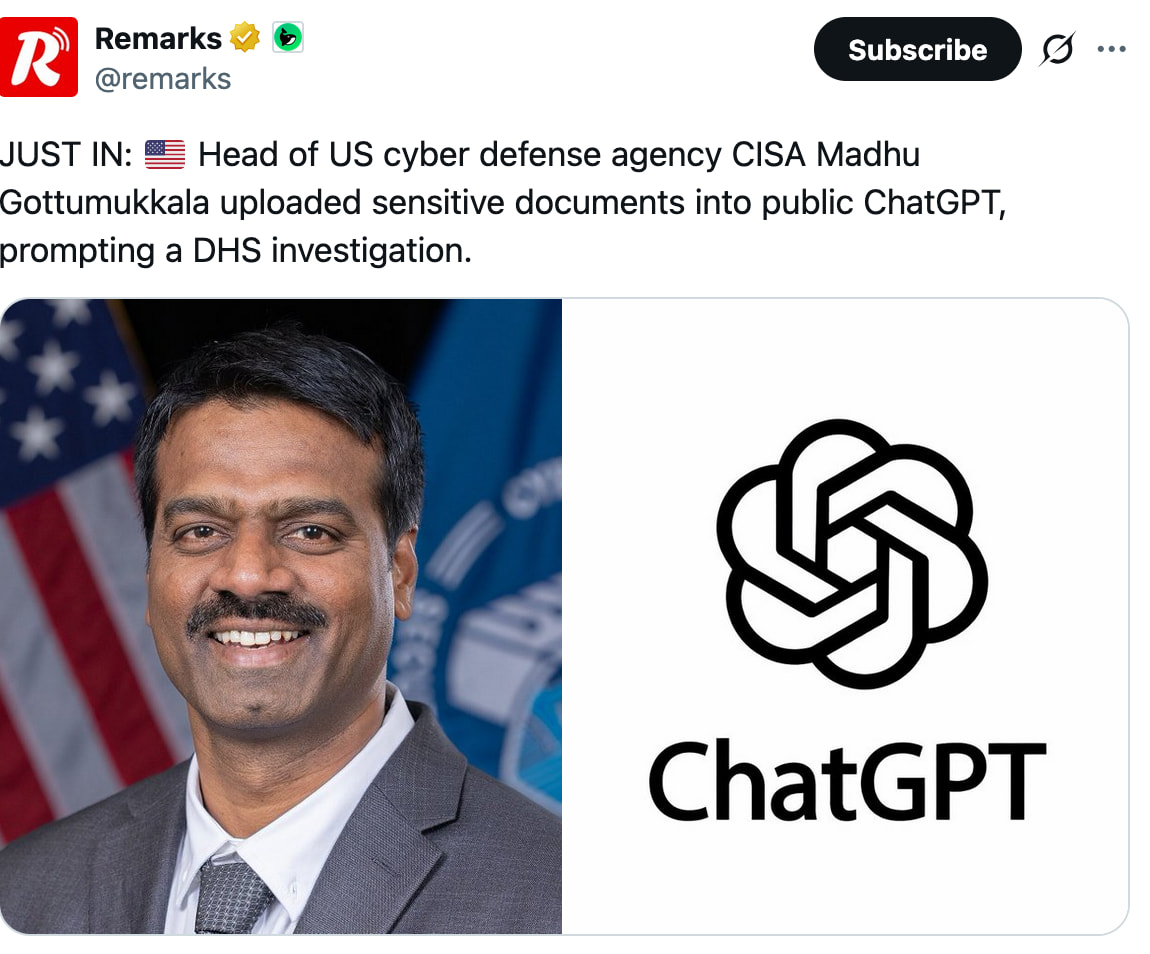
https://x.com/aakashgupta/status/2016736548398706736 :
The head of US cybersecurity just demonstrated exactly why every company blocks ChatGPT by default.
DHS built an internal AI tool called DHSChat specifically designed to keep sensitive data inside federal networks. ChatGPT was blocked department-wide. Gottumukkala requested a special exception anyway. He got it. Then he uploaded documents marked “for official use only” until automated alerts started firing.
One official summarized it: “He forced CISA’s hand into making them give him ChatGPT, and then he abused it.”
This is the pattern playing out across every enterprise right now. Executives demand access to the shiny consumer tool. IT builds a secure alternative. Leadership bypasses it. Data leaks.
Samsung banned ChatGPT after engineers uploaded source code. Amazon warned employees after finding internal data in ChatGPT outputs. Apple, JPMorgan, Verizon, Deutsche Bank all blocked it.
The lesson keeps repeating: the people with the most access to sensitive information are the ones most likely to bypass controls, because they assume the rules exist for everyone else.
Public ChatGPT sends everything you upload to OpenAI. That data can train future models. It can surface in responses to other users. 800 million people use ChatGPT. Your “for official use only” document is now part of that pool.
Enterprise AI policies exist because convenience always beats security until something breaks.
6 Likes
To be fair, FOUO documents aren’t typically that sensitive. It’s below the Confidential/Secret/Top Secret classification scheme.
As an aside, Madhu Gottumukkala: Star Wars name.
4 Likes
Minerva U? Never heard of it! Seems strange – classes are on line, but students have to live together; if the students are all in one place, why have small classes on-line? 85% of the students are non-US. Seems like a case for reviving the Medieval tradition for universities teaching in Latin.
Wikipedia: “Students live together in residences in different cities each year, beginning in San Francisco and returning there for graduation. As of 2025, they live in Tokyo for their sophomore year, Buenos Aires for their junior year, and Taipei for their senior year.”
Anyway, there have been reports elsewhere that the most selective US colleges are actually the US Military Academies – but they were excluded from this survey.
2 Likes
Low acceptance rate is not synonymous with selectivity. A school that is desirable for any reason would attract many marginal and unqualified applicants, thereby lowering the acceptance rate. As someone who has interviewed dozens of such applicants for one of the schools on that list, I can assure you that the majority of applicants have zero chance of admission. I often wonder why they bothered.
A better indicator of selectivity is standardized test scores of students admitted — back in the day when tests were still required.
3 Likes
The low acceptance rate is influenced by a disconnect whereby the applicants do not know what standardized test scores, etc. are expected of them. The school might publish the 25th and 75th percentile SAT, but in the DEI world, a given applicant has no idea where their demographic cutoff is.
3 Likes
This may be true but it does not undermine the point: the number of unqualified applicants is not the same for all schools, thus acceptance rate is a poor proxy for true selectivity. This explains why some college no one has heard of can appear near the top even though the quality of students is probably not the highest. So, yeah, it is selective in the trivial sense that it rejects many applicants but not in the usual understanding that the school selects the most qualified students. There is probably no sense in which Minerva is in the same league as CalTech or the Ivies. The yield rate (~50%) is far below the 70-90% of the other schools.
In Minerva’s case, it is probably benefiting from novelty: it was accredited only five years ago. When a new restaurant opens in a neighborhood, folks flock to it. After a while, the buzz dies down. In the immortal words of Yogi Berra, “Nobody goes there anymore. It’s too crowded.”
2 Likes
2 Likes
They were not properly Mirandized
1 Like
5 Likes
A white male New York ‘Times’ employee filed a complaint with the Equal Employment Opportunity Commission alleging the paper had discriminated against him by not giving him a promotion because he is a white male. On Tuesday, the EEOC, now controlled by a Trump appointee who has… pic.twitter.com/cqXQSQiPGw
— New York Magazine (@NYMag) May 5, 2026
https://www.courtlistener.com/docket/73296563/unknown-case-title/
3 Likes
NEW: In a mandatory anti-racism class, Penn State told 1L law students they must "acknowledge the reality of systemic racism" and "dismantle systems that racialize, subordinate, and oppress."
— Aaron Sibarium (@aaronsibarium) May 14, 2026
One student withdrew from the law school over the class. We obtained shocking audio.🧵 pic.twitter.com/zPxbqVY0K8
3 Likes
University of California STEM professors want standardized tests back due to severe math deficiencies among students:
— Neetu Arnold (@neetu_arnold) May 26, 2026
“We now observe preparation gaps so severe that instructors must reteach middle school mathematics”
“The current admissions metric, based primarily on GPA &… pic.twitter.com/naXkrd5M96
6 Likes
Perhaps a quick answer to the educational disaster would be to require ALL teachers from Grade 1 onwards to pass an exam on old-fashioned high school math. Nothing esoteric – just arithmetic, geometry, calculus; mostly simply the level of math that a carpenter needs every day,
Give teachers up to 2 years to prepare for and pass the math exam – administered by a competent neutral party like Finland. Any teacher who at the end of the 2 year period has failed to pass this basic competency test is automatically dismissed.
And, yes, make it apply to university professors too – even if their day job is indoctrinating young women in DIE.
2 Likes
Carpenters need calculus every day? Must be doing some real fancy cabinet work. A smattering of differential geometry and topology might help, too.
2 Likes
Way to miss the point, “Dr” Lorentz!
Right backatcha, “pal.” The point is that practical experience is way more important in the trades than book-learnin’, which is why I don’t insist that electricians know Maxwell’s equations nor plumbers solve the Navier-Stokes equation. The most important book for those guys Is the code. If it’s not up to code, it might kill you and you’ll certainly get to do it over.
Credentialism will be the death of us.
2 Likes