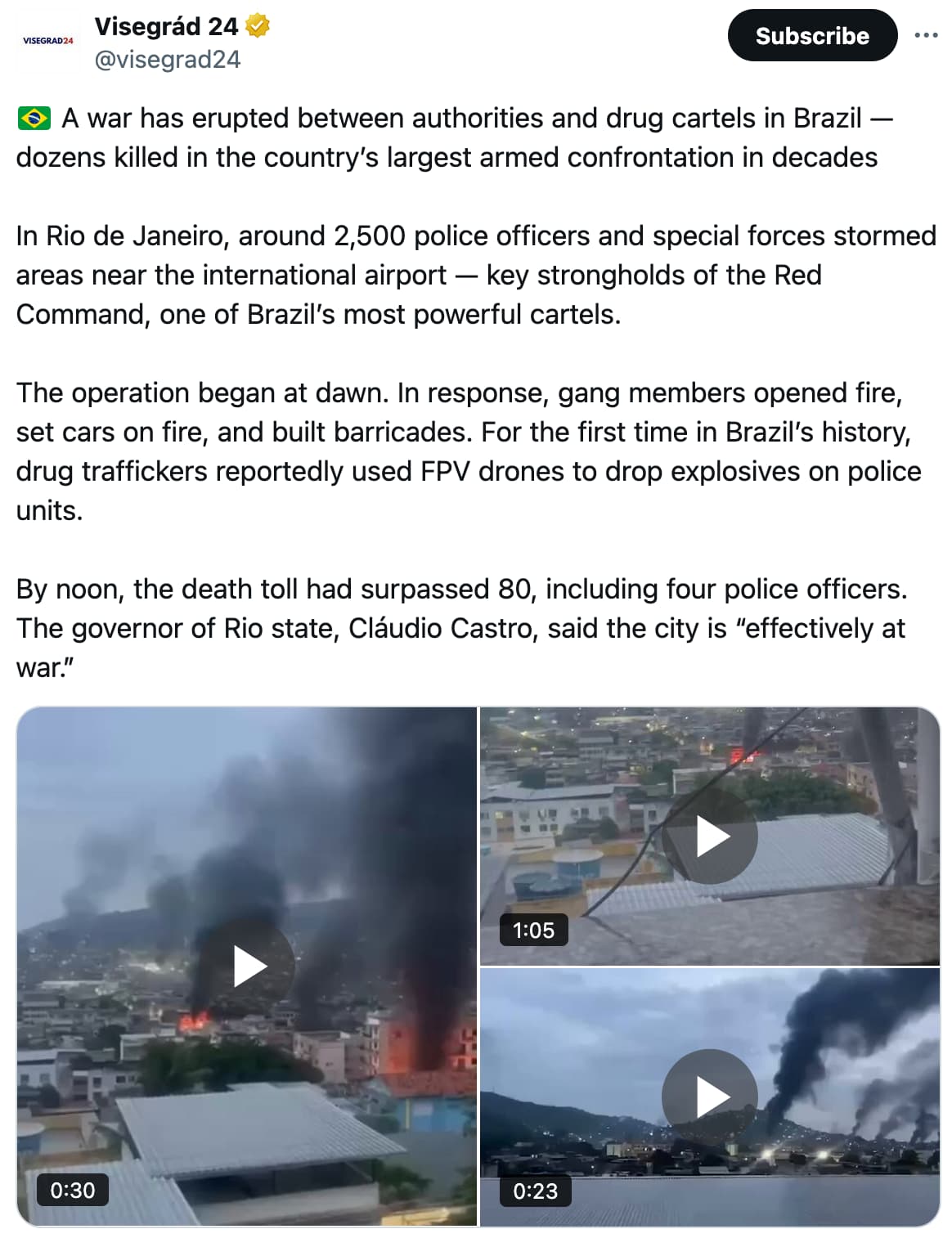
For the first time in Brazil’s history, drug traffickers reportedly used FPV drones to drop explosives on police units.
4 Likes
Now here is something that could potentially change everything – not just war!
Putin reveals details about Burevestnik missile’s nuclear engine — RT Russia & Former Soviet Union
“… The missile’s reactor “is comparable in output with a reactor of a nuclear-propelled submarine, but it’s 1,000 times smaller,” Putin said. “But the key thing is that where a regular reactor needs hours, days or weeks to go online, this one launches in minutes or seconds.” …“
It is very rare to see claims about technologies which yield order-of-magnitude improvements, let alone 3 orders of magnitude. There does not appear to be any serious information about the technology (some have speculated on pebble bed designs), but it clearly has the capacity to generate large amounts of heat very quickly.
Could we (the human race) be within sight of nuclear-powered aircraft, trucks, industrial equipment, emergency power back-up? And if this technology gets used in peaceful applications, might that lead to the demise of the Far Left’s so-far successful war against baseline nuclear electric generation?
4 Likes
First, it’s single use. Second, being uncrewed, shielding and other safety burdens are moot.
Those probably account for a factor of 500 and Russian lies for a factor of 5. Thus, any “new” technology might account for a factor of 4.
8 Likes
Here’s an archived version:
2 Likes
It is not clear about the “single use”. Some reports talk about the test cruise missile being flown back to its launch point.
Also not clear about the no-shielding issue. If the reactor is shooting out high energy particles, it would be a no-brainer to design an anti-missile system to track & destroy it, undermining the main point of a cruise missile which can loiter for months.
You are probably right about lies/misrepresentations from the Other Side – after all, look at what Our Guys said about the F35. Still, even a factor of 4 improvement could be very significant, especially for non-military use.
Personally, I am more excited about the possible civilian uses of this power source – if it turns out to be more than moonshine. However, as far as military use, remember the lesson from the School of Hard Knocks: Never ever under-estimate the other side!
2 Likes

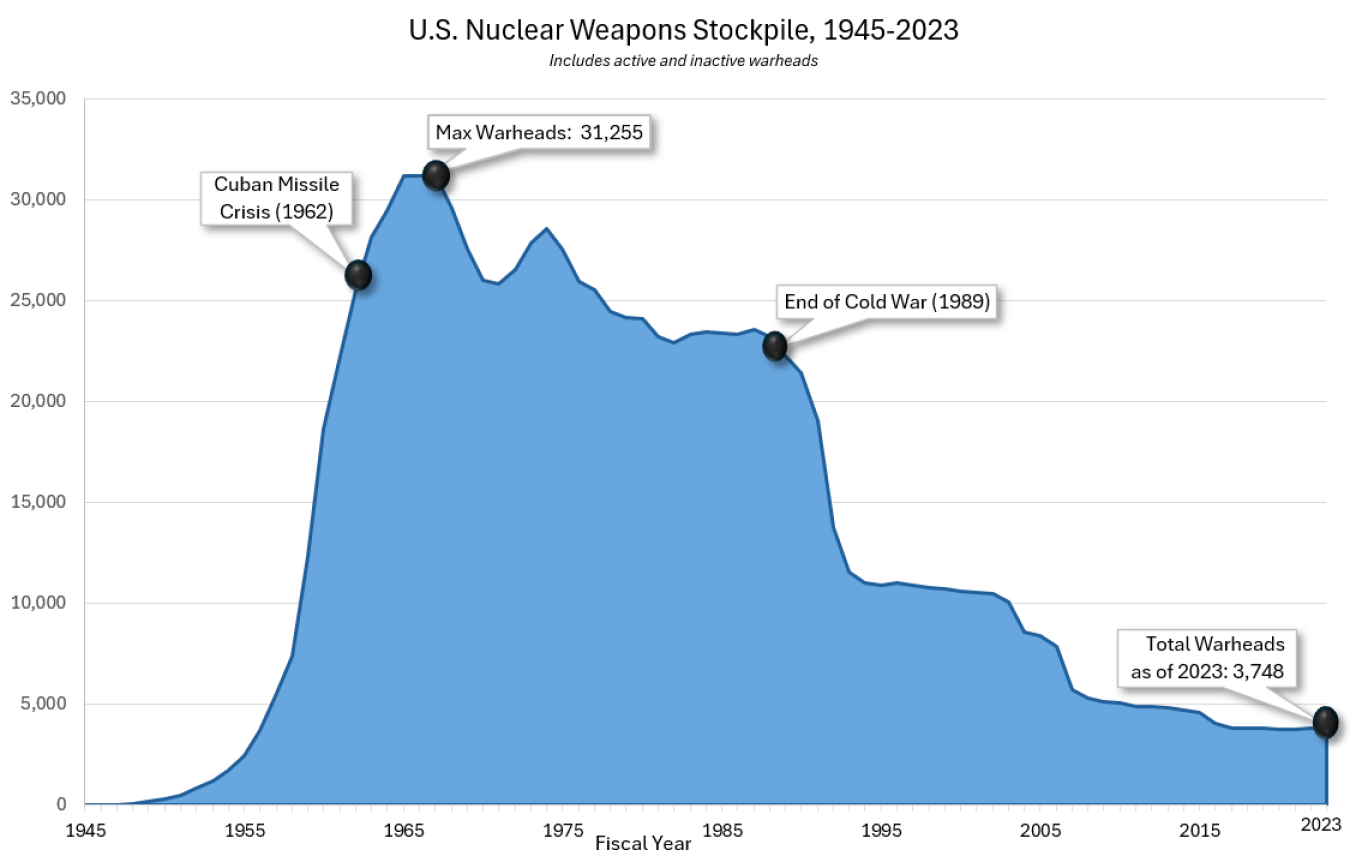
The PRC has likely bribed a lot of people to perpetrate the hoax that they do not have a larger arsenal than the US.
Their visible inventory of delivery systems and the footprint of their nuclear infrastructure suggest a number at least ten times that.
Plus, they have the so-called Underground Great Wall.
Yet they would have us believe their arsenal is like ours circa 1950
6 Likes
That is undoubtedly not the only issue on which the CCP has found many Swamp-dwellers ready & willing to be bribed. But part of the concept of Deterrence is that the other side should know the damage you are capable of inflicting upon them. At an appropriate point in time, presumably the CCP will take the wraps off.
What I wonder about is how many of those nuclear weapons would actually work? These are extremely sensitive devices, continually exposed to damaging radiation and reliant on Tritium with a half-life of about 13 years. A gentleman I knew got a job running computer simulations to check that the weapons would still work – using the same super-computers as the Global Warming models, if that makes us feel more confident.
Last US test was in 1992; last Chinese test in 1996; Russia has never tested a nuclear weapon, while the last USSR test was in 1990. 30+ years is a long time for a delicate piece of equipment to sit on a shelf, even with continual maintenance. And newer designs, like these Chinese weapons, may never have been tested.
And then there are the delivery systems – also complex but occasionally tested. The last two English attempts to launch missiles from their submarines failed.
5 Likes
This must be a recurrence of the well-known pattern “Palm Thatch to Packard, or a Formula for Success”. It was first investigated and reported by C. Northcote Parkinson, a British businessman living in Singapore in 1950s:
In the American log cabin story the point is soon reached at which the future millionaire must wear a tie. He explains that he cannot otherwise inspire confidence. He must also acquire a better address, purely (he says) to gain prestige. In point of fact, the tie is to please his wife and the address to satisfy his daughter. The Chinese have their womenfolk under better control. So the prosperous coolie sticks to his hovel and his rice. This is a known fact and admits of two explanations. In the first place his home (whatever its other disadvantages) has undeniably brought him luck. In the second place, a better house would unquestionably attract the notice of the tax collector. So he wisely stays where he is. He will often keep the original hovel – at any rate as an office – for the rest of his life. He quits it so reluctantly that his decision to move marks a major crisis in his career.
When he moves it is primarily to evade the exactions of secret societies, blackmailers, and gangs.
Our task was to ascertain the figure the first sum will have reached (on an average) at the moment when migration takes place from the original hovel to a well-fenced house guarded by an Alsatian hound. It is this move that has been termed “Breaking the Hound Barrier.” Social scientists believe that it will tend to occur as soon as the ransom to be exacted comes to exceed the overhead costs of the “snatch.”
5 Likes
3 Likes

An interesting article from a person who actually volunteered to fight for the Zelensky regime – what he saw, and what it means for the future of Taiwan.
The next war we already saw: Taiwan - Asia Times
“… Should Taipei stand and Washington hold, the world will face a new and costly reality: wars of the future will be fought by economies, assembly lines and algorithms as much as by troops. The only question is whether the US will rearm its industries before Beijing tests the strait—or whether Ukraine’s slow grind will replay itself in Taiwan.”
2 Likes
Gemini:
Anduril Industries has a total of 82 patents globally.
Here are some key statistics about their patent portfolio:
- Total Patents: 82
- Active Patents: 67 (more than 81% of the total)
- Granted Patents: 18
- Primary Filing Country: The United States of America
The company has filed the majority of its patents in the United States, which is its origin country and primary R&D center.
Anduril’s patents cover a wide range of technologies focused on autonomous defense systems and the integration of Artificial Intelligence (AI) into military and security applications.
Their patent portfolio generally focuses on three main areas:
1.  Unmanned Aerial, Ground, and Sea Systems
This covers the hardware and physical design of their robotic platforms:
- Unmanned Aerial Vehicles (UAVs/Drones): Patents often relate to the specific mechanics of their drones, such as:
- Deployable Components: Systems for wings or other parts that are stowed for launch and then deployed for flight (like their ALTIUS family).
- Counter-UAS (CUAS) Systems: Technology for detecting, tracking, and physically interdicting hostile drones (e.g., using their Anvil interceptor drone).
- Specialized Aircraft: Designs for vertical take-off and landing (VTOL) aircraft.
- Autonomous Underwater Vehicles (AUVs): This includes technology for persistent deep-water survey, inspection, and Intelligence, Surveillance, and Reconnaissance (ISR) missions (e.g., their Dive-LD platform).
2.  AI and Command & Control Software
This is the core of their “software-first” approach and revolves around their Lattice OS platform:
- Lattice Mesh Networking: Patents on secure, resilient, self-organizing mesh networks used to connect all their sensors and autonomous systems in the field.
- Interactive Virtual Interfaces: Technology for combining data from multiple sensors (like radar, cameras, and LiDAR) into a common synthetic data space that operators can view and interact with in real-time, often using augmented/virtual reality (AR/VR) tools.
- AI-Assisted Decision Support: Systems for real-time target detection, tracking, classification (e.g., distinguishing a drone from a bird), and automated course-of-action recommendations.
3.  Advanced Sensors and Surveillance
- Sensor Fusion: Patented methods for taking raw data from different types of sensors (like radar, LiDAR, and electro-optical/infrared cameras) and fusing it into one cohesive, accurate picture.
- Surveillance Towers (Sentry Towers): Systems for combining various long-range sensors with edge computing to autonomously monitor vast areas for threats, such as along border or perimeter security applications.
In essence, Anduril is patenting the entire “system of systems”—from the mechanical design of the drone to the software that enables it to operate autonomously, and the network that connects it all to a human operator.
To see where those patents become real-world capabilities, we can look at some of Anduril’s core products.
Their family of systems is essentially a combination of sophisticated hardware (drones, sensors, etc.) all linked together by their patented software core, Lattice OS.
Here are some of their most notable products:
1. Lattice OS (The AI Software Brain)
This is the central operating system that powers all their hardware, and it is the key focus of their software patents.
- Function: It is an AI-powered command and control platform that acts as the “brain” for all connected assets.
- What it does:
- Sensor Fusion: Ingests and fuses data from thousands of disparate sources (cameras, radar, drones, satellites) into a single, unified, real-time 3D common operating picture.
- Autonomous Sensemaking: Uses machine learning and computer vision to automatically detect, classify (e.g., “human,” “vehicle,” “Group 1 drone”), and track objects of interest, filtering out noise.
- C2 (Command and Control): Allows a single human operator to manage multiple autonomous assets simultaneously and provides recommended actions to close the “kill chain” (identify-decide-act) in seconds.
 2. Autonomous Air Systems (AAVs)
These products put the Lattice AI into action, often fulfilling Intelligence, Surveillance, Reconnaissance (ISR) and kinetic roles.
| Product | Type | Primary Role | Key Feature |
|---|---|---|---|
| Roadrunner / Roadrunner-M | Twin-jet AAV | High-Speed Interceptor | Reusable Vertical Take-Off and Landing (VTOL) drone. Roadrunner-M is a high-explosive variant built for ground-based air defense that can safely return and be relaunched if it doesn’t intercept a target, drastically lowering cost per-engagement. |
| ALTIUS (Agile Launched, Tactically-Integrated Unmanned System) | Tube-Launched UAV/Loitering Munition | ISR, Electronic Warfare, Kinetic Strike | Extremely versatile, can be launched from the ground, sea, or air (including from larger aircraft). It is autonomous and designed to operate in collaborative swarms. |
| Anvil / Anvil-M | Counter-UAS Interceptor | Kinetic Interception | A quadcopter interceptor drone. The original Anvil used kinetic energy (ramming) to disable small hostile drones. Anvil-M is a newer variant with a munitions payload for more reliable defeats. |
| Ghost-X | sUAS | Persistent ISR/Reconnaissance | Designed for extended range and multi-payload capacity, capable of being deployed quickly by a single operator. |
 3. Maritime and Fixed Systems
These products provide persistent security and awareness across large, remote areas.
- Dive-LD (Autonomous Underwater Vehicle): A flexible AUV designed for deep-water survey, inspection, and persistent Intelligence, Surveillance, and Reconnaissance (ISR) missions.
- Sentry Towers: Modular, scalable, and self-contained sensor platforms that combine various long-range sensors (radar, EO/IR cameras) and an edge-computing module running Lattice OS to provide 360-degree, persistent surveillance for perimeter and border security.
The patents you mentioned (82 total, 67 active) are foundational to ensuring that Anduril has exclusive rights to the unique combination of the Lattice AI orchestrating this array of physical and kinetic systems.
Add:
Anduril has secured significant contracts across multiple defense sectors by focusing on critical, modern threats, primarily the proliferation of cheap, autonomous systems like drones.
Here are the primary defense sectors and US military branches where Anduril is currently securing major contracts:
1.  Counter-Unmanned Aerial Systems (C-UAS)
This is perhaps Anduril’s most successful and visible area. Modern conflicts have shown that small, cheap drones pose a massive threat, and Anduril’s AI-driven systems are designed to counter them at scale.
- U.S. Marine Corps (USMC): Anduril was awarded a $642 million, 10-year Program of Record to deliver, install, and sustain Installation-Counter sUAS (I-CsUAS) systems for Marine Corps bases globally. They are also developing a C-UAS Engagement System (CES) for the Marine Air Defense Integrated System (MADIS).
- Department of Defense (DoD): A significant $250 million contract was awarded to deliver over 500 of their Roadrunner-M interceptor AAVs and Pulsar electronic warfare systems to enhance air defense capabilities across all services against UAS threats.
- U.S. Army: Anduril is providing a modernized fire control system for C-UAS operations, poised to replace a legacy system used for managing defenses against drone threats.
2.  Command, Control, & Software Integration
This is where their core Lattice OS platform is being integrated to connect disparate systems and enable rapid, AI-assisted decision-making.
- U.S. Army (C2 Ecosystem): Anduril was awarded a nearly $100 million contract to lead the development of the Next Generation Command and Control (NGC2) prototype. This effort aims to overhaul the Army’s C2 ecosystem by creating a singular, modular architecture built on their Lattice software.
- U.S. Air Force (Thunderdome): They secured a $99 million contract for the Thunderdome project, which involves rapid prototyping leveraging the Lattice core software capability for Air Force applications. This is tied to efforts like the Advanced Battle Management System (ABMS).
3.  Warfighter Augmentation & Mixed Reality
This sector focuses on giving individual soldiers better situational awareness through advanced heads-up displays and data fusion.
- U.S. Army (Soldier Borne Mission Command - SBMC): Anduril won a $159 million contract to develop a prototype for the SBMC program (formerly IVAS Next). This system is a night vision and mixed reality platform that fuses day, night, and thermal imagery with real-time battlefield intelligence, giving soldiers a unified picture and allowing them to control robotic teammates directly from their display.
4.  Border Security and Surveillance
This was one of Anduril’s earliest successes and continues to be a key sector.
- U.S. Customs and Border Protection (CBP): They have a long-standing relationship with CBP, deploying their Sentry Towers (autonomous surveillance systems powered by Lattice) along the U.S.-Mexico border for autonomous detection and tracking of intrusions.
In short, Anduril has positioned itself not just as a drone company, but as the company providing the AI and software layer that connects the entire spectrum of modern defense—from a soldier’s helmet to an interceptor missile—under a unified, rapidly updatable operating system.
That’s an important area of growth for Anduril. The company explicitly states that its mission is to transform the capabilities of the U.S. and allied military forces.
Anduril’s international expansion focuses heavily on countries considered strategic allies, particularly in the Indo-Pacific and Europe, as they seek to build a global, interoperable network of autonomous defense systems.
Here are their key non-US international partnerships and footprints:
 Australia (Indo-Pacific Hub)
Australia is one of Anduril’s most significant international markets, with a dedicated local subsidiary.
- Ghost Shark AUV: Anduril is partnering with the Royal Australian Navy (RAN) to build the Ghost Shark Autonomous Underwater Vehicle (AUV). This is a multi-million-dollar program to develop an extra-large AUV for persistent undersea warfare and surveillance. The first vehicle has already come off the production line in Sydney, demonstrating rapid prototyping capabilities.
- Anduril Australia: The company established Anduril Australia to support the Australian Defence Force (ADF) and build a local defense ecosystem.
 United Kingdom (European Anchor)
The UK has been an early and committed international customer for Anduril.
- UK Ministry of Defence (MOD): Anduril UK has secured contracts with the MOD, providing capabilities like its Ghost autonomous uncrewed air system.
- Dual-Use Systems: They are collaborating on testing dual-use (civilian and military) electric Vertical Take-Off and Landing (eVTOL) cargo aircraft, reflecting their focus on leveraging commercial technology for defense.
- Border Security: Anduril’s AI-powered surveillance tools (Sentry Towers) have been used by the UK Home Office for monitoring small vessel crossings in the English Channel.
 Taiwan (Loitering Munitions and AI)
This is a critical, high-speed delivery partnership focusing on asymmetric warfare capabilities.
- Rapid Delivery of Munitions: Anduril delivered the first tranche of its ALTIUS loitering munitions (drones designed for surveillance and precision strike) to Taiwan within six months of the contract being signed—a speed highly unusual in the defense world.
- Local R&D: They established Anduril Taiwan, a new office to support engineering and supply chain, and are expanding collaboration with Taiwan’s state-owned defense research institute, NCSIST.
 South Korea (Co-Development)
Anduril is building a manufacturing and development relationship in Northeast Asia.
- Korean Air Partnership: They signed a contract with Korean Air’s Aerospace Business Division to co-develop unmanned aircraft products. This includes exploring the potential for local manufacturing and for Korean Air to license and produce Anduril products for the Indo-Pacific region.
 Germany (European Expansion)
- Rheinmetall Partnership: Anduril is partnering with the German defense firm Rheinmetall to explore jointly developing European versions of their Fury drone and Barracuda cruise missiles using local suppliers, aiming to tailor their products to European requirements.
In summary, Anduril’s international strategy is to focus on key allies and quickly deliver modern, AI-enabled, and easily updatable capabilities, often through local subsidiaries and co-development partnerships to meet sovereign needs.
3 Likes

13 minute video
Edit:

2 Likes
The Drone Constructor is a pioneering feature of Ukraine’s DOT-Chain Defense marketplace, allowing military units to customize drones for specific combat roles. Soldiers use this tool to select precise technical specifications, such as frequencies, flight altitude, camera types and operational range, tailoring drones to mission-critical needs. Once parameters are set, units submit their requests, allowing manufacturers to provide offers. If the offer follows the requirements set by the unit, the order is confirmed, and customized drones are produced. This functionality allows frontline personnel to design mission-specific drones, creating better conditions for success in the battlefield.
1 Like
4 Likes
3 Likes
Realpolitik
One would hope that 100% of the officials in the White House are pro-US, not pro-Ukraine!
One would also hope that any White House officials who are pro-Ukraine rather than pro-US would be tried for treason and shot.
7 Likes