A feature of the modern world has been the emptying of the countryside in many nations as people have moved into the cities.
But Nature Abhors a Vacuum – as students were once taught. Fewer annoying people leaves more room for wildlife – which can then test the boundaries of mankind’s cities. As often happens, Japan is in the lead.
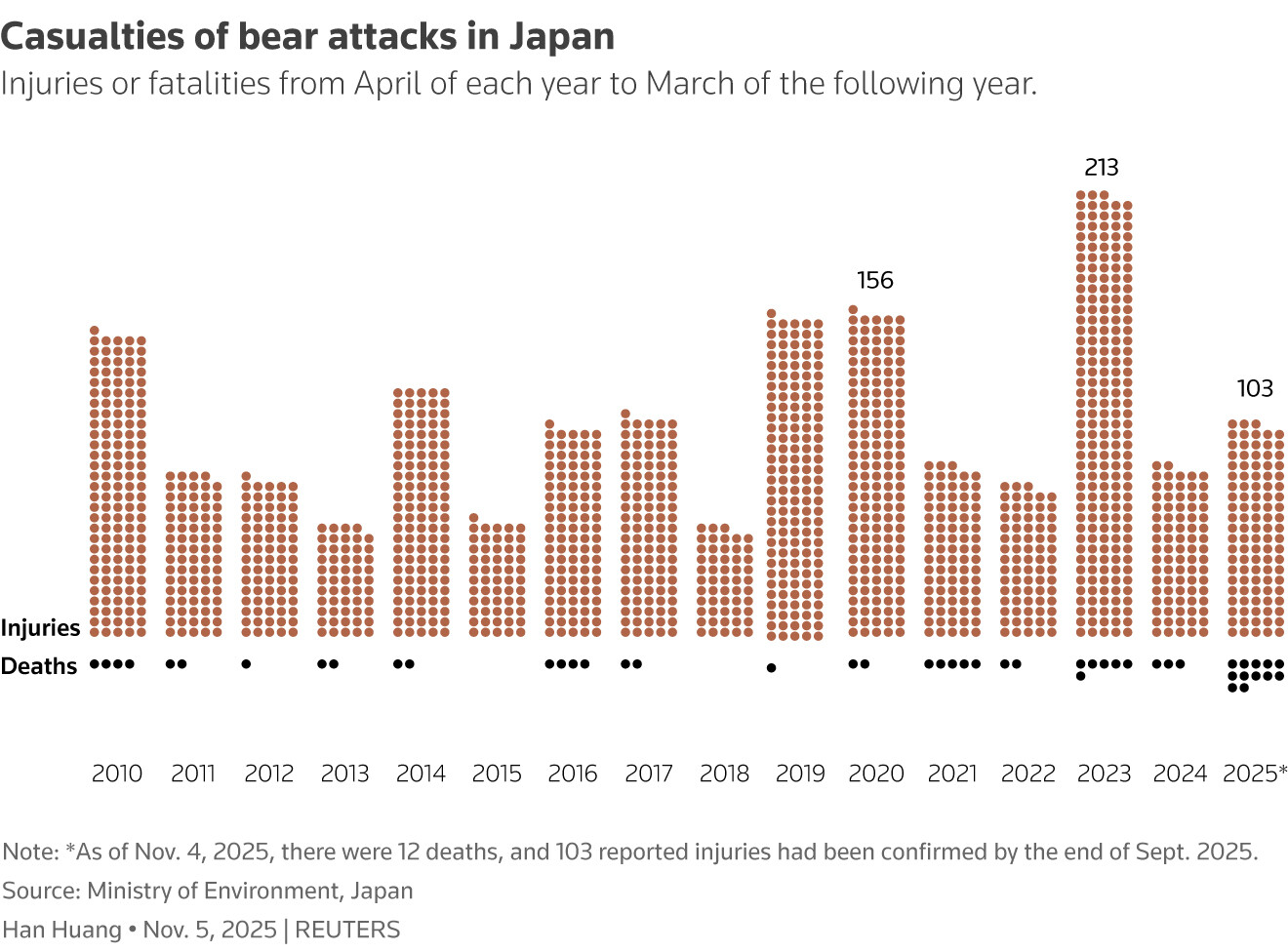
“According to Japanese media, at least 12 people have been killed and more than 100 injured in bear attacks this year, with incidents occurring not only in mountain forests but also in residential areas. Wild boars have also appeared in urban districts of Tokyo and Chiba, according to the embassy.”
Everyone I’ve talked to that has eaten bear meat says it’s very “gamey” and not very tasty. Salami or not, I suspect it wouldn’t sell well. Venison sausage is quite tasty, OTOH.
Indeed, I’ve previously had bear salami that was indeed very gamey. But the salami I linked to isn’t: I’ve tried it, and can vouch for the quality. I think this manufacturer’s process works considerably better, using a long period of aging and fermentation.
Twelve people killed in one year among a population of 125 M people. How many were killed last year? How about ten years ago? As it turns out that injuries from bear attacks have been fairly constant over the last 15 years, though 2025 was an unusually bad year for fatalities. It’s hardly a trend.
Great job of missing the point, Dr.L! From the Reuters article you linked:
“Rising bear numbers, climate change-driven shifts in natural food sources and depopulation of rural areas are increasingly bringing people into contact with bears, while an ageing cohort of hunters who authorities once relied on find themselves overwhelmed.”
Yeah, I read the article. Trouble is, the headline and quoted passage are contradicted by the data presented in the article. This is par for the course for contemporary journalism, or should I say ‘journalism.’ But, hey, it’s all good if it generates clicks from the clueless. Feel good about having made your modest contribution.
drlorentz – you are better than this. Read the Reuter’s reports to which you linked:
“In recent weeks, bears have attacked customers inside a supermarket …”
Not that long ago, environmentalists were telling us that humans were driving animals into extinction by expanding into their natural territories. Now we have Japanese bears expanding into the natural territory of Japanese humans!
The emptying of the countryside is a real issue. Unfortunately, we live at a time in the civilizational cycle where smart people choose to ignore real issues.
We had a bear break into a house we own here in the Poconos in September. There were no blueberries and no apples here this year, so I thought the poor critter was just desperate because they have an instinct to bulk up before they hibernate.
The only thing I’d wonder about is: if people desert the rural areas for the cities, in general that’s good for wildlife. I don’t know that they’d follow into cities, unless they were like the famous bears in our national parks, accustomed to associating humans with accessible food.
I can hardly wait to see the results of “free” public transportation. I must add that my view of it will be remote. As I foreswore ever again spending any of my tourist money in the UK (and antisemitic Ireland), never will NYC (or even the “Empire State” [can you still say that??]) receive any of my discretionary dollars. Frankly, I’m already afraid of daylight random violence.
Even the most superficial look at my prior comment would have alerted you to the fact that I did read the Reuters (no apostrophe) piece. I’ll leave it to others to decide if you are “better than this” or not.
On the other hand, you do not seem to have captured the essence of my prior comment, viz.
the headline and quoted passage are contradicted by the data presented in the article.
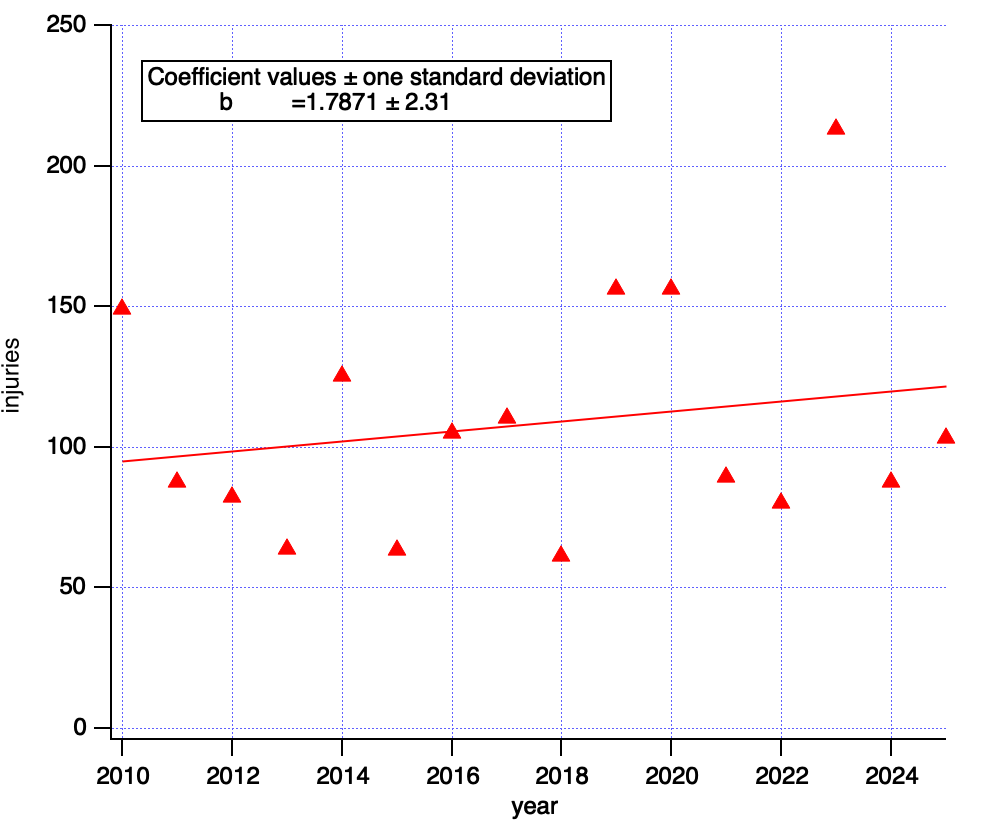
The claims about climate change and depopulation of rural areas are merely conjectures for which there is no data given or causal link to increased bear attacks is demonstrated. The contradiction arises inasmuch as there is no significant increase† in bear injuries over a 15-year period. While the most recent year has shows the most fatalities, the numbers are so small that the change is not statistically significant.‡ To summarize, there’s no significant change to explain and there’s no reasoning linking these purported causes to the nonexistent change. In my experience, bear/human interactions increase when humans encroach on bear habitat, not when humans retreat.
†A linear fit to the injuries data versus year yields slope 1.7871 ± 2.31, which means the slope is consistent with zero.
‡A quick-and-dirty rule for estimating the variance (σ^2) of a single measurement of a small number of cases, n, is σ=sqrt(n). Thus, σ^2≈12 for 2025 and σ^2≈4 for 2010. Thus, the two data are within a couple of standard deviations of each other, which is below significance according to usual criteria. Be advised this is only quick-and-dirty.
I am reminded of the old joke about the balloonist travelling above low clouds who got lost. For safety, the balloonist decided to come down, and landed in the middle of a plowed field.
He saw a pedestrian walking along the lane beside the field, and called out “Where am I”. The pedestrian responded “You are standing in a wicker basket in the middle of a plowed field”.
“Ah!”, said the balloonist to the pedestrian, “you must be an academic”. “That’s right”, the pedestrian responded, “How did you guess?”. “Well”, said the balloonist, “your information is completely correct, and totally misses the key issue.”