Looking for a good read? Here is a recommendation. I have an unusual approach to reviewing books. I review books I feel merit a review. Each review is an opportunity to recommend a book. If I do not think a book is worth reading, I find another book to review. You do not have to agree with everything every author has written (I do not), but the fiction I review is entertaining (and often thought-provoking) and the non-fiction contain ideas worth reading.
Book Review
The Man and the Myth Behind Alexander’s Legend
Reviewed by Mark Lardas
September 27, 2026
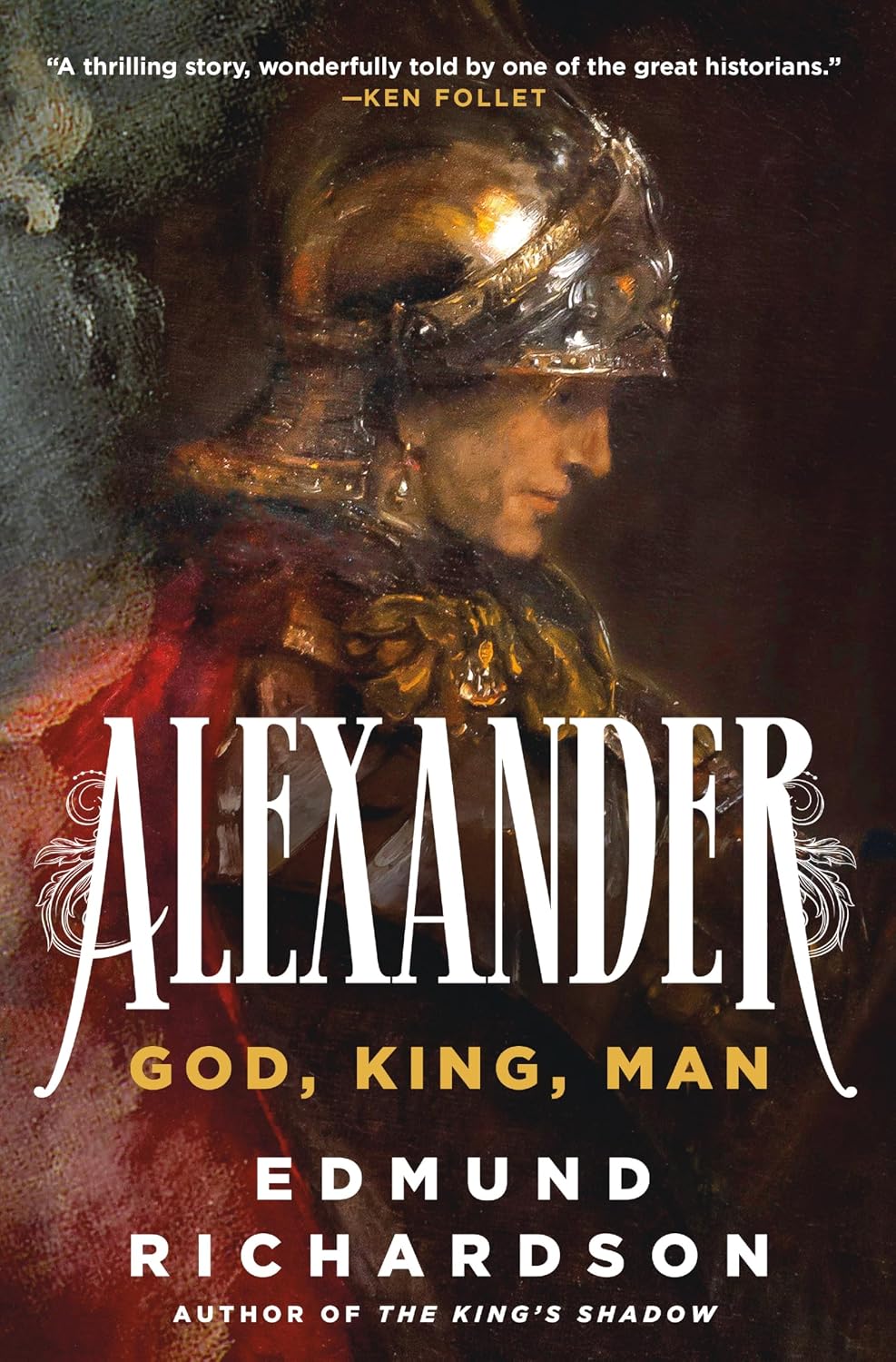
“Alexander: God, King, Man,” by Edmund Richardson, St. Martin’s Press, September 2026, 480 pages, $33.00 (Hardcover), $16.99 (E-book), $20.50 (Audiobook)
Alexander the Great is one of history’s most storied men. There may be more myths about him than any other historical figure, including Julius Ceasar and Genghis Khan. But what about the man himself?
“Alexander: God, King, Man,” by Edmund Richardson is a new biography of Alexander the Great. Using recent archaeological discoveries, it provides an intimate and revealing look at this conqueror from Macedonia.
Richardson starts at the Battle of Issus, Alexander’s first great victory against Darius. Next, he presents Alexander’s early life, showing how he rose to be king of Macedonia and conquered Greece.
Richardson then follows Alexander’s subsequent conquests. Many seem ad hoc. Having conquered “x,” Alexander moves to “y” because he has nothing better to do. Richardson also shows how the successive conquests changed Alexander. Tell an impressionable young man he is a god often enough, in enough different places and he begins to believe it.
Richardson peels away the layers of myth surrounding Alexander, revealing the actual man underneath those myths. Richardson uses many fresh first-person accounts in this book. An Egyptian priest, who fought against Alexander at Issus as part of a levy raised by Darius, wrote an account of the battle. Babylonian astronomers recorded their impressions of Alexander on recently translated clay tablets before and after he took Babylon. Unearthed Egyptian papyri record the impact Alexander had on Egypt after his conquest.
He examines folklore about Alexander who proved the ancient counterpart to King Arthur. Any good story about a king doing something unusual became part of Alexander’s legend. Richardson shows where myth provide insight into the actual Alexander.
This book excels at showing how ancient times, especially pre-Christian times, differ from today. Mercy as a concept was unknown. Glory was all. Frightfulness was a virtue. On several occasions Alexander ordered massacres of a city’s entire population to burnish his reputation as a conqueror.
Once he ordered a march across a desert leading to 10,000 dying, half his army. There was no military purpose to the march. However, Semiramis and Cyrus had ordered similar marches across the same desert and lost nearly all their army. In losing only half Alexander felt he demonstrated he was the better general.
For anyone with more than a passing interest in Alexander, “Alexander: God, King, Man” is a book that should not be missed. It offers immersion into Alexander’s life and the times in which he lived.
Mark Lardas, an engineer, freelance writer, historian, and model-maker, lives in League City. His website is marklardas.com.