Looking for a good read? Here is a recommendation. I have an unusual approach to reviewing books. I review books I feel merit a review. Each review is an opportunity to recommend a book. If I do not think a book is worth reading, I find another book to review. You do not have to agree with everything every author has written (I do not), but the fiction I review is entertaining (and often thought-provoking) and the non-fiction contain ideas worth reading.
Book Review
The Sharp End of the Wire War
Reviewed by Mark Lardas
September 21, 2025
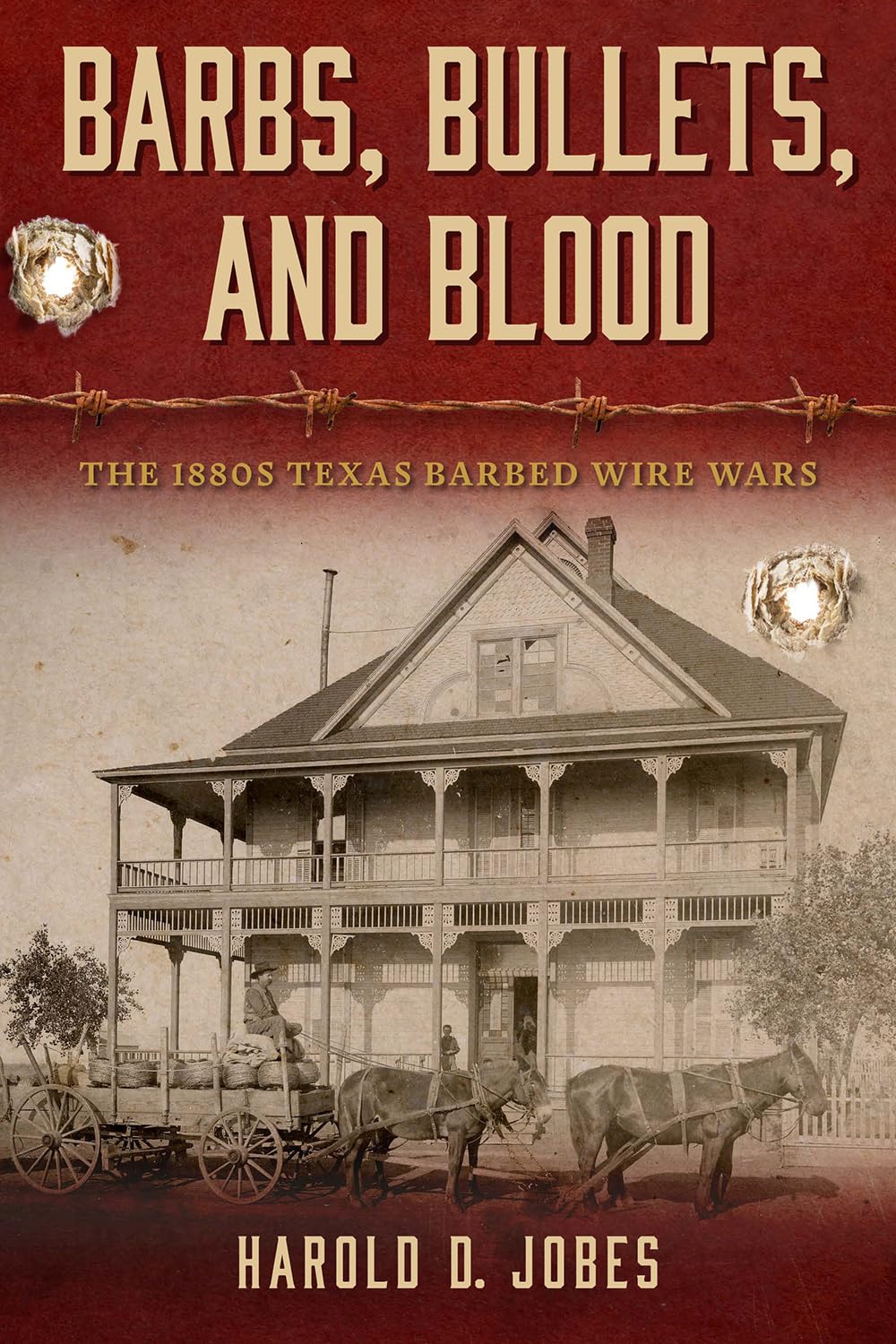
“Barbs, Bullets, and Blood: The 1880s Texas Barbed Wire Wars,” by Harold D Jobes, University of North Texas Press, 2025, 448 pages, $34.95 (Hardcover), $27.96 (E-book)
Barbed wire, patented by Joseph Glidden in 1874, has been a big part of the Texas scene since. Barbed wire fenced in the open range, part of the Texas legend, transforming Texas’s stock-raising industries. Yet transformation rarely goes smoothly.
“Barbs, Bullets, and Blood: The 1880s Texas Barbed Wire Wars,” by Harold D Jobes, shows how rough a transformation can go. It tells the story of how barbed wire came to Texas, and the fence-cutting wars erupting in the wake of its arrival.
In the book’s opening chapters Jobes offers a high-level overview. He discusses the history of barbed wire, and presents its precursors in Texas. This includes a chapter on John Grinninger’s 1839 spiked-wire fence in Austin. He also discusses the fence problem. Before barbed wire only stone, wood picket and rail, briar or bois d’arc were available to build fences.
Wood and stone fences were expensive. Living fences, hedges, briars, or tightly planted bois d’arc too long times to grow. Only small plots could be fenced. Most of Texas remained open range. Barbed wire was cheap, and could be installed quickly. Suddenly large swaths of Texas became fenced.
Jobes present problems caused by both sides. Large corporations run by absentee owners created massive ranches. These corporate ranches and ranchers from Texas both blocked roads, fencing lands they neither owned nor leased. This denied access to legitimate owners. Even responsible fence-building ranchers raised the ire of free-range ranchers. Free-rangers would cut fences (occasionally even long-established fences) to keep the range open. The law was inadequate for these problems.
The result was wire-cutting “wars” over much of prairie Texas. The turmoil crashed cattle prices and slowed investment in Texas, hurting Texas’s economy. Legal reforms passed in the 1880s, especially in the 1884 special session, corrected the worst abuses. It reined in the fence wars.
Jobes then dives in at the local level, examining individual fence wars in individual counties. He takes readers into each war, showing the wide-ranging nature of the conflicts. While there are common themes, each possesses its own set of occasionally eccentric characters and sometimes odd outcomes.
“Barbs, Bullets, and Blood” is for those interested in Texas history or the history of the 19th century Old West. The research is comprehensive, and the book’s reach is broad. Jobes’s story is enhanced by fifty photographs, both period and modern, illustrating the people, places, and items associated with the barbed wire wars.
Mark Lardas, an engineer, freelance writer, historian, and model-maker, lives in League City. His website is marklardas.com.