Looking for a good read? Here is a recommendation. I have an unusual approach to reviewing books. I review books I feel merit a review. Each review is an opportunity to recommend a book. If I do not think a book is worth reading, I find another book to review. You do not have to agree with everything every author has written (I do not), but the fiction I review is entertaining (and often thought-provoking) and the non-fiction contain ideas worth reading.
Book Review
Battle in Southern European Skies
Reviewed by Mark Lardas
March 22, 2026
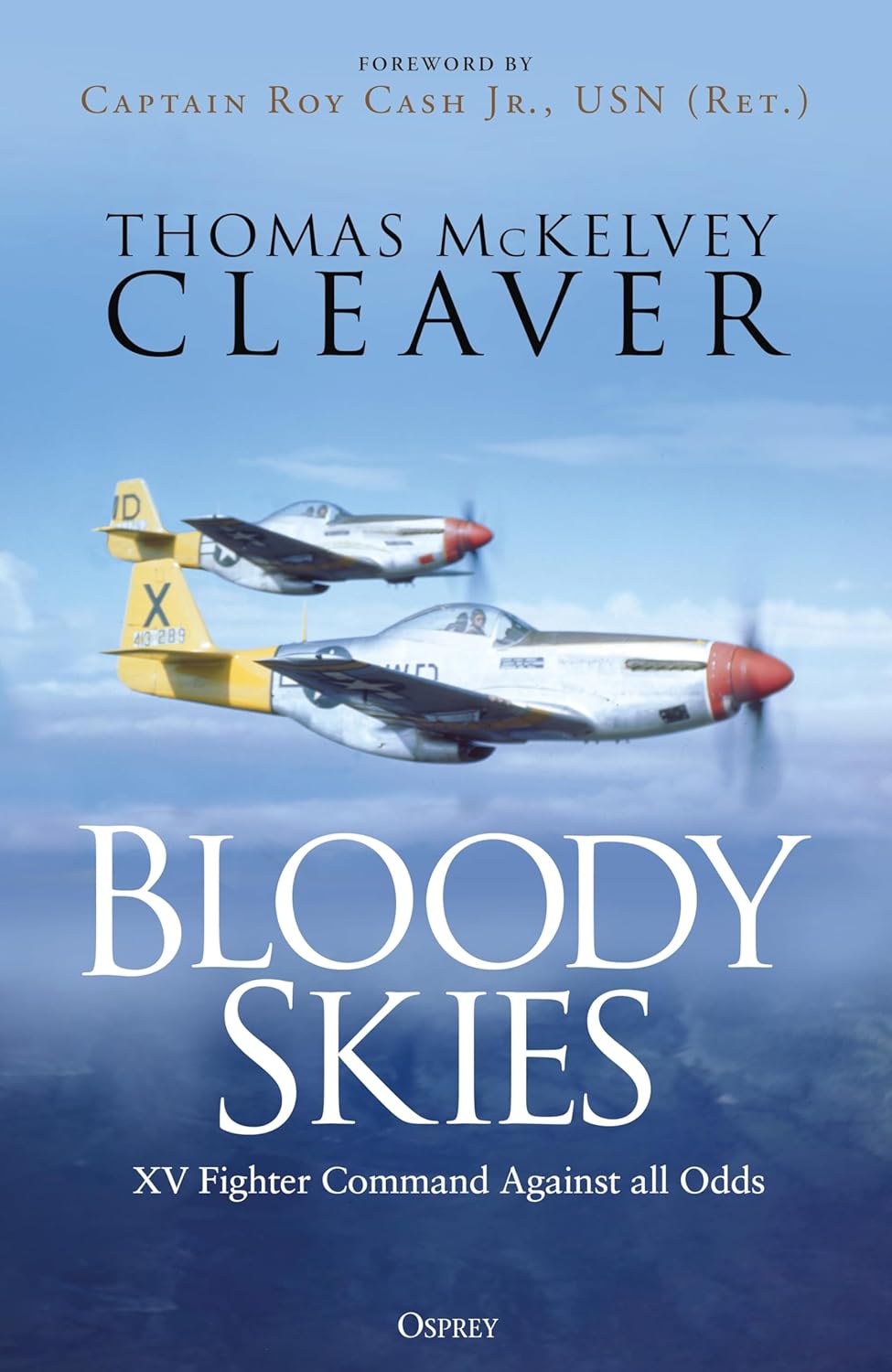
“Bloody Skies: XV Fighter Command Against all Odds,” by Thomas McKelvey Cleaver, Osprey Publishing, March 10, 2026, 320 pages, $32.00 (Hardcover), $22.40 (E-book), $23.44 (Audiobook)
The “Forgotten Fifteenth,” the XV Air Force, fought in the Mediterranean Theater. It was the European Theater’s southern counterpart to the more glamorous VIII Air Force. Its contribution to the European air war was largely forgotten. Thomas McKelvey Cleaver is rectifying that.
“Bloody Skies: XV Fighter Command Against all Odds,” by Thomas McKelvey Cleaver tells the history of the XV Air Force. Its focus is the XV Fighter Command. It follows the XV from its formation in the fall of 1943 through the end of the war in Europe.
Cleaver includes a study of the XV Air Force’s two-year campaign against the Ploesti oil fields and refineries in Romania. This was Nazi Germany’s most important source of petroleum products. Cleaver describes the campaign starting with the famous Black Sunday low-level mission in August 1943 through its successful completion in late 1944.
The area of XV Air Force responsibility was phenomenal. Its aircraft ranged from Southern France as far as the Spanish border, Southern Germany Czechoslovakia, Austria, Hungary. The Balkan States and east to Romania. Its pilots flew shuttle missions between Italy and Russia on several occasions.
While the bombers are not ignored, Cleaver spends most of the book describing the fighters’ action. These included the P-38s of the 82nd Fighter Group, and the P-47s, and P-51s of the 332nd and 325th Fighter Groups. They were among the most storied fighter groups in the World War II US Army Air Forces. Today, the Red Tails of the 332nd are best known. They were the all-black Tuskegee Airmen. Yet the 82nd and the “Checkertail Clan” of 325th equaled them in performance.
Much of the book is taken up describing the fighter battles between these units and their Axis foes. While the VIII Fighter Command faced only the Luftwaffe, as Cleaver shows the XV Fighter Command faced a more mixed bag. In addition to the Luftwaffe, the XV fought aircraft from the Italian Social Republic, Romanian, Bulgarian, and Hungarian air forces. By 1944 these pilots were often more experienced and dangerous than the new generation of Luftwaffe pilots. They also flew native-built fighters as formidable as the early FW-190s.
The result is a fast-paced account of World War II aerial combat. Much of it is drawn from the personal accounts of the participants. As with all of Cleaver’s work, “Bloody Skies” is well-researched, and written in a style that keeps readers engaged in the action.
Mark Lardas, an engineer, freelance writer, historian, and model-maker, lives in League City. His website is marklardas.com.