Looking for a good read? Here is a recommendation. I have an unusual approach to reviewing books. I review books I feel merit a review. Each review is an opportunity to recommend a book. If I do not think a book is worth reading, I find another book to review. You do not have to agree with everything every author has written (I do not), but the fiction I review is entertaining (and often thought-provoking) and the non-fiction contain ideas worth reading.
Book Review
A Life At Sea
Reviewed by Mark Lardas
August 23, 2026
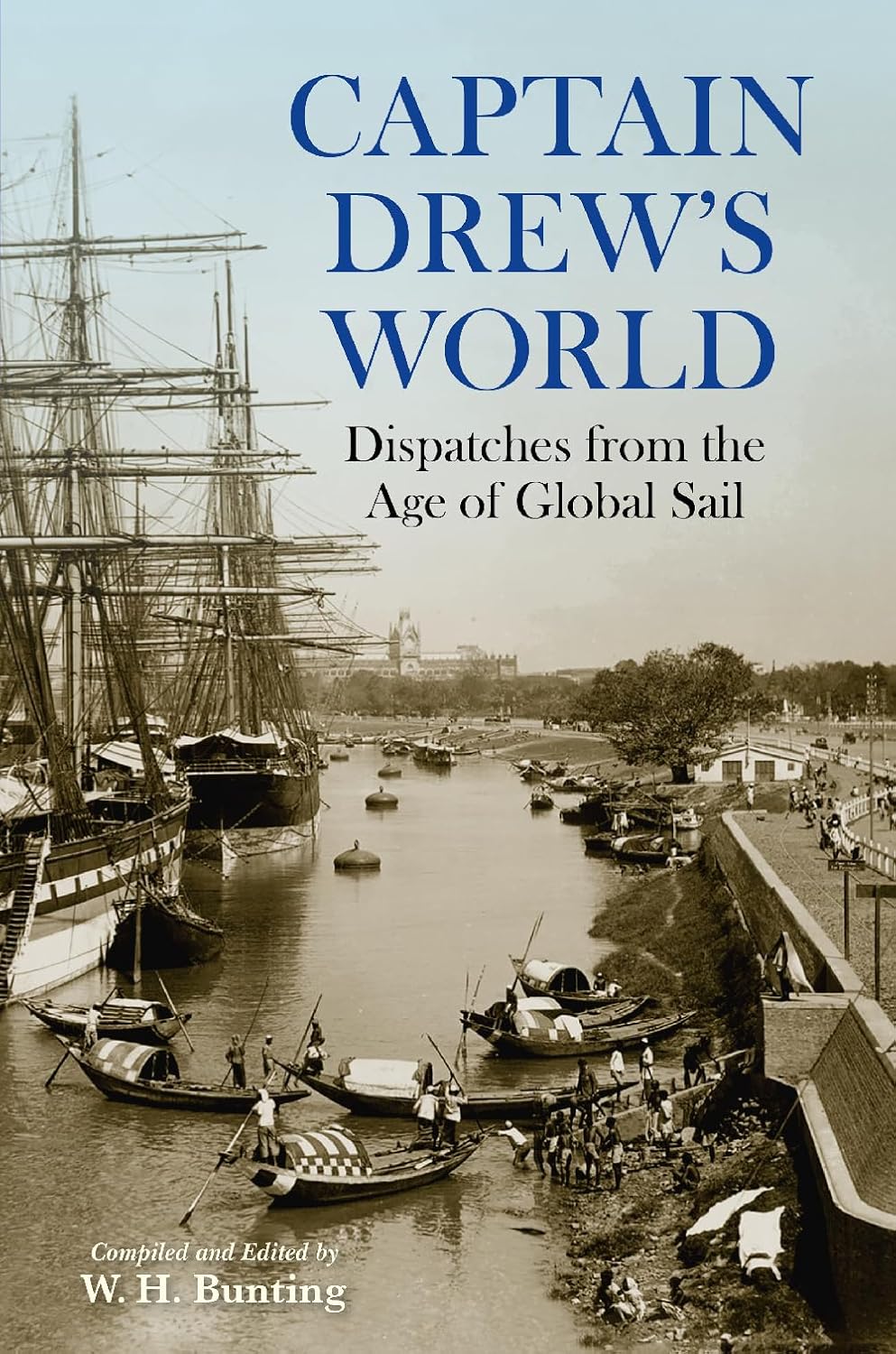
Captain Drew’s World: Dispatches from the Age of Global Sail,” W. H. Bunting (Editor), Texas A&M University Press, July 2026, 704 pages, $50.00 (Hardcover), $30.00 (e-book)
Captain John H. Drew was a sailor, serving aboard sailing vessels during the nineteenth century. From 1877 through 1889 he was captain of the fabled Sea Witch, a full-rigged ship out of Boston. During his 40-plus year career he sailed over a million miles – and wrote almost as many words about his travels.
“Captain Drew’s World: Dispatches from the Age of Global Sail,” edited by marine historian W. H. Bunting, republishes a selection of Drew’s writings. It extracts the most interesting of the various newspaper and magazine accounts he sent home about his travels.
The book opens giving a history of John Drew’s youth and an account of his early life and first voyages. It ends with a summation of his life and the fate of the ships he voyaged on. The heart of the book are Drew’s extensive writings about the trips he made as captain of Sea Witch, from 1877 through 1889.
Each section contains a description of the voyage, often interspersed with memories of earlier voyages before he became a captain. He also takes time to extensively describe each location he arrives at, and his experiences ashore at each stop.
Bunting pruned Drew’s words, and updated the spelling. The result is still a hefty tome, over 700 pages. Unless you are a real maritime buff, reading it in a single sitting would be a challenge, possibly a chore. Yet Drew’s exploits are episodic. They were written to inform and amuse periodical readers of his day. His writing style is similar to that of Twain (a contemporary, and also a mariner), especially Twain’s travel writings.
Dipped in one voyage at a time, Drew’s accounts offer charming insight to the nineteenth-century world. It explores more than the maritime world. Drew also offers incisive looks at each of his stops, the differences between Britain, China, the Philippines, the Caribbean and other foreign places he visits. He also provides extensive examination of the different parts of the United States he visits, his home state of Maine, Boston and New York City, New Orleans and the Mississippi Basin, and California among others.
Whether an armchair explorer or a serious history of nineteenth century maritime history, “Captain Drew’s World” offers much. It is an accessible portal to a bygone age for those who know little about it, while offering rich detail about the time to serious students. It is well worth reading.
Mark Lardas, an engineer, freelance writer, historian, and model-maker, lives in League City. His website is marklardas.com.