Looking for a good read? Here is a recommendation. I have an unusual approach to reviewing books. I review books I feel merit a review. Each review is an opportunity to recommend a book. If I do not think a book is worth reading, I find another book to review. You do not have to agree with everything every author has written (I do not), but the fiction I review is entertaining (and often thought-provoking) and the non-fiction contain ideas worth reading.
Book Review
Golden Talons in Action
Reviewed by Mark Lardas
August 9, 2026
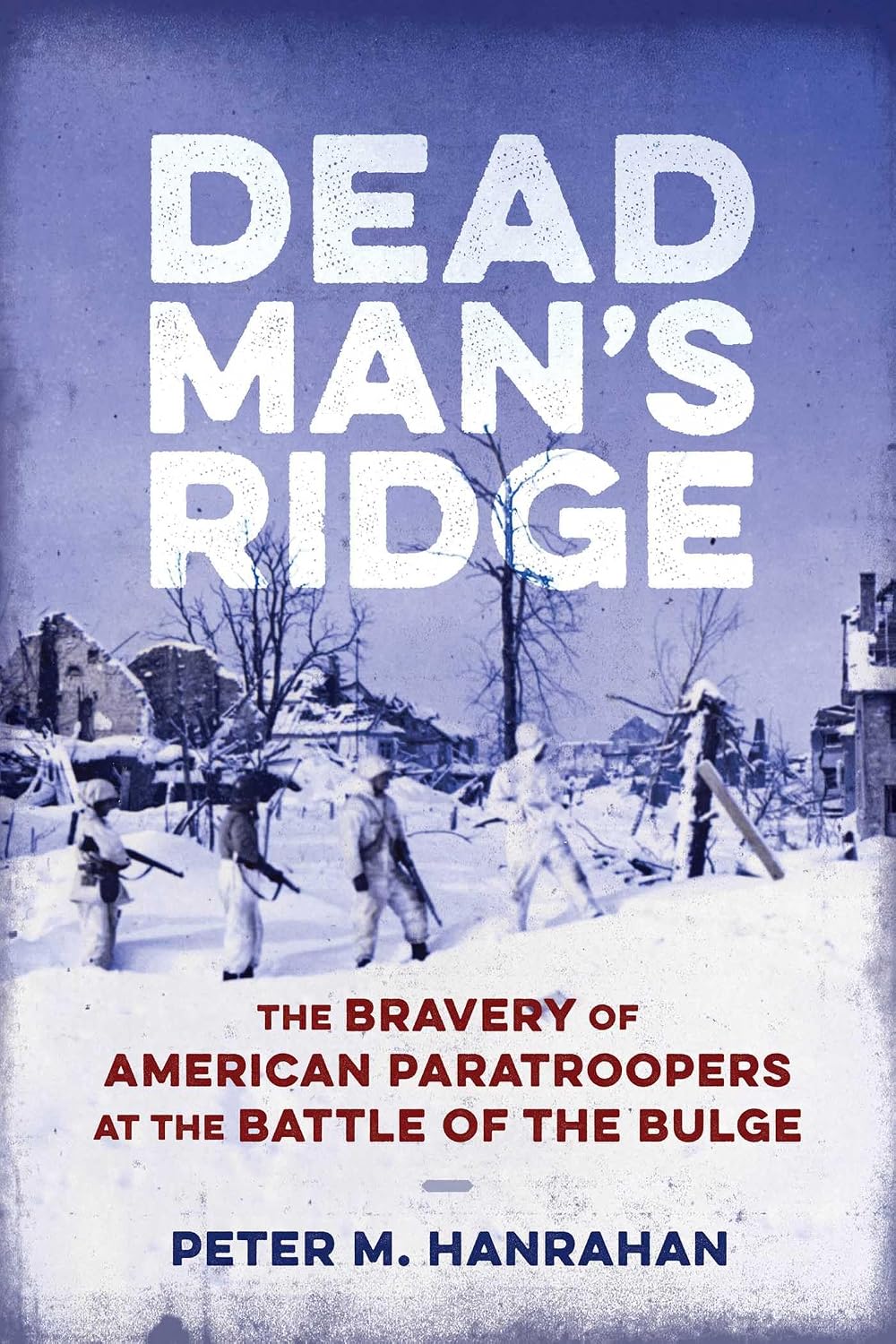
“Dead Man’s Ridge: The Bravery of American Paratroopers at the Battle of the Bulge,” by Peter M. Hanrahan, Stackpole Books, August 2026, 240 pages, $24.95 (Paperback), $17.99 (E-book)
The roles played by the 101st and 82nd Airborne during the Battle of the Bulge are well-known. The 101st achieved legendary status at Bastogne; the 82nd played a less-heralded, but acknowledged role at St. Vith. Almost forgotten are the accomplishments of third US airborne division at the Battle of the Bulge, the 17th Airborne.
“Dead Man’s Ridge: The Bravery of American Paratroopers at the Battle of the Bulge,” by Peter M. Hanrahan, tells that story. It redresses part of the memory gap of the battle.
Activated in April 1943, the 17th is America’s forgotten airborne division. It arrived in Britain in August 1944, too late to participate in the airdrops in Sicily, Normandy or Operation Market Garden in September 1944. By November it was in France, part of the Allied Army’s theater reserve. The Battle of the Bulge which started December 16, 1944, saw it committed to combat for the first time.
This book follows the 17th from its inception through the postwar fates of its veterans. Its focus is the Battle of Flamierge, a three-day battle fought in January 1945, late in the Battle of the Bulge. The division, light infantry, was committed against what General George Patton thought was retreating German infantry.
Instead, they encountered German armor, launching an attack to once more isolate Bastogne. The 17th Airborne stopped that effort, but at great cost. To hold what division histories called “Dead Man’s Ridge,” it took over 1000 casualties, including 50 percent of the fighting strength of its 513th Parachute Regiment.
It was a fight as heroic at the stand of the 101st Airborne, during the siege of Bastogne. It was overlooked because it took place late in the Battle of the Bulge, after the tide had turned against the Germans. Attention, especially postwar, shifted away from the battle once Patton relieved Bastogne, and the Germans began retreating in the north. While there are many histories of the opening weeks of the battle, few cover its end phase, when the 17th Airborne was committed.
“Dead Man’s Ridge” fills that gap. While it offers a comprehensive account of the Battle of the Bulge, its focus is on the last half of the battle, when Germany launched a set of major attacks to again cut off Bastogne. It also brings richly deserved attention on the 17th Airborne, showing readers its history through the eyes of those who served in it.
Mark Lardas, an engineer, freelance writer, historian, and model-maker, lives in League City. His website is marklardas.com.