Looking for a good read? Here is a recommendation. I have an unusual approach to reviewing books. I review books I feel merit a review. Each review is an opportunity to recommend a book. If I do not think a book is worth reading, I find another book to review. You do not have to agree with everything every author has written (I do not), but the fiction I review is entertaining (and often thought-provoking) and the non-fiction contain ideas worth reading.
Book Review
War on the Frontier
Reviewed by Mark Lardas
August 30, 2026
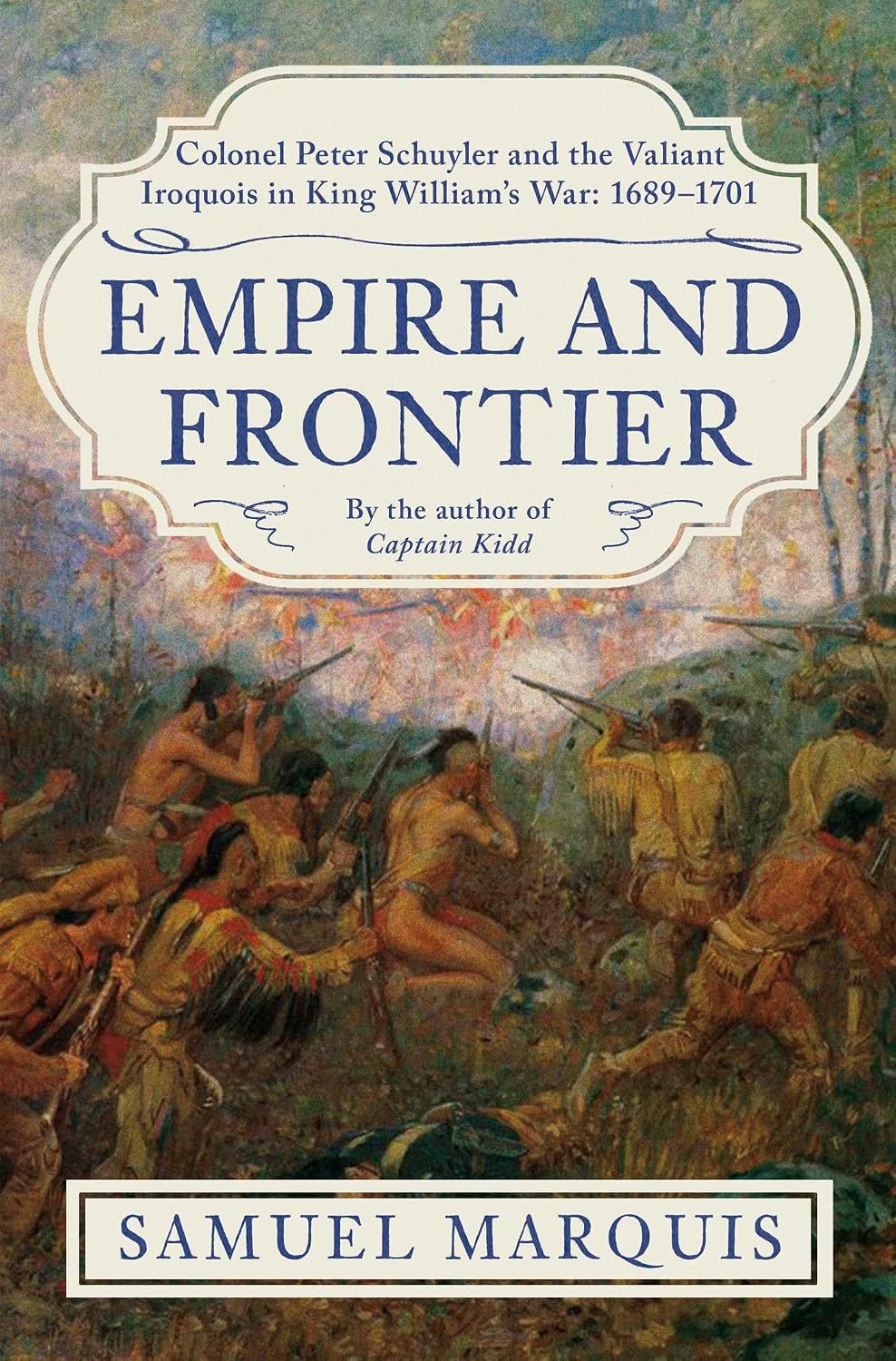
“Empire and Frontier: Colonel Peter Schuyler and the Valiant Iroquois in King William’s War: 1689-1701,” by Samuel Marquis, Pegasus Books, August 2026, 368 pages, $29.95 (Hardcover), $19.99 (E-book)
In 1688 the Glorious Revolution in Britain, replaced King James II with William and Mary. It triggered King William’s War, a multi-continent conflict and a Puritan coup in the British colony of New York.
“Empire and Frontier: Colonel Peter Schuyler and the Valiant Iroquois in King William’s War: 1689-1701, by Samuel Marquis, follows King William’s War in upstate New York. It uses the lens of three of its most important participants for this: Peter Schuyler, the Dutch-American mayor of Albany, Lawrence, a Mohawk war captain, and Hilletie van Olinda, a Mohawk-Dutch woman, who served as the colony’s official translator.
Marquis presents nine years of conflict in the frontier between New York and Canada. It was a three-cornered war with France on one side, European New Yorkers on the other and the native tribes in the area aligning by tribe with these powers.
He begins with the cooperative Covenant Chain, an alliance with European New Yorkers and the powerful Haundenosaunee (The Five Tribes of the Iroquois Nation). Two decades old when war broke out in 1689, it had grown into a mutually-beneficial association, one bringing wealth and peace to both sides, and a deep friendship between the two nations.
Intermixing resulted, creating many like the book’s three principals. Lawrence and Schuyler were friends and collaborators, borrowing the best aspects of each man’s society for use in his own. Hilletie forged a role as an in-between for the two societies, a virtually unique position of authority for a seventeenth-century woman.
Into this, the Glorious Revolution brought unwanted disruptions. There was a coup in New York City. The King James-appointed Royal Governor was chased out by a faction led by Jacob Leister, a fanatic anti-Catholic who established a dictatorship. Then, the French governor of Quebec launched a surprise attack on Schenectady massacring the inhabitants.
This massacre opened nine years of frontier war. Divided internally, New York’s initial response was feeble, even as its Iroquois allies provided retribution for Schenectady. In subsequent years, the Iroquois were ground down by the French. The war devolved into bloody stalemate.
“Empire and Frontier” is a fascinating book, offering insight into multicultural Seventeenth-century New York, a blend of Dutch, English, German and Indian society. It shows of the different groups worked together. It also exposes the divisions present, particularly the different Protestant factions. It contains a vast cast of fascinating and colorful participants, from all walks of life.
Mark Lardas, an engineer, freelance writer, historian, and model-maker, lives in League City. His website is marklardas.com.