Looking for a good read? Here is a recommendation. I have an unusual approach to reviewing books. I review books I feel merit a review. Each review is an opportunity to recommend a book. If I do not think a book is worth reading, I find another book to review. You do not have to agree with everything every author has written (I do not), but the fiction I review is entertaining (and often thought-provoking) and the non-fiction contain ideas worth reading.
Book Review
At Night Over Occupied France
Reviewed by Mark Lardas
November, 21, 2025
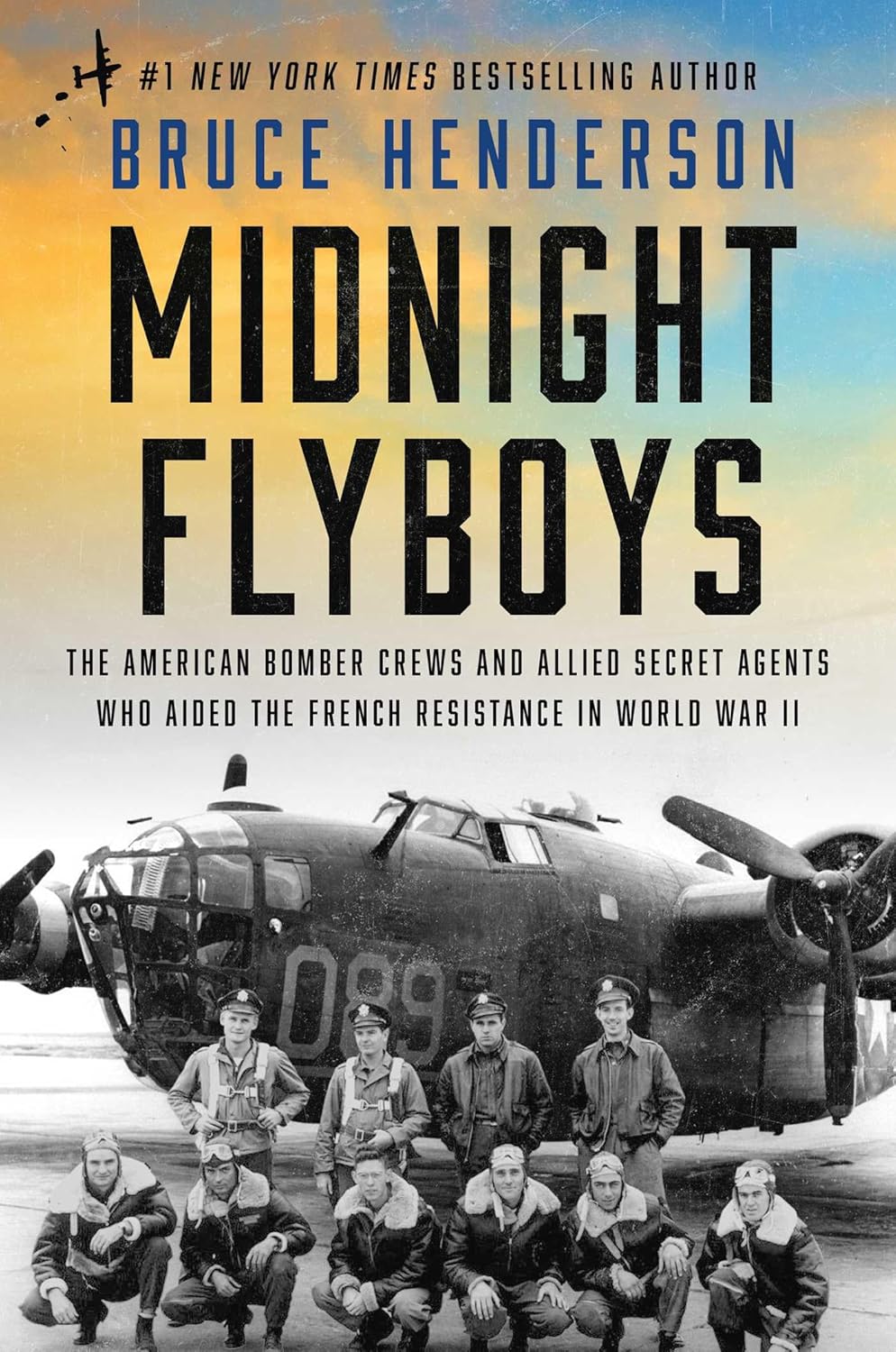
“Midnight Flyboys: The American Bomber Crews and Allied Secret Agents Who Aided the French Resistance in World War II,” by Bruce Henderson, Gallery Books, November 2025, 336 pages, $30.00 (Hardcover), $14.99 (E-book), $19.24 (audiobook), $39.99 (Audio CD)
In fall 1943 the United States Army Air Forces turned over the mission of maritime patrol, to the US Navy. Just then, a new mission appeared; increasing supply drops to the Resistance in Occupied France. It was part of the buildup for D-Day. Two USAAF squadrons which had been conducting antisubmarine patrols from Britain were converted to fly these missions as part of Operation Carpetbagger.
“Midnight Flyboys: The American Bomber Crews and Allied Secret Agents Who Aided the French Resistance in World War II,” by Bruce Henderson, tells their story.
The missions required flying B -24 Liberators across the English Channel to drop zones in Occupied France. Once located, the Carpetbaggers dropped steel containers filled with weapons, supplies, and radios. They also dropped agents into France, up to three on each mission. These agents were known to the crews only as Joes (for men) or Josephines (for women) to protect the agents’ identity, if the aircrew were captured.
The missions, flown at night, were flown individually. They required low-level flying at slow speeds over the drop zone. The B-24 was designed for high-altitude, high-speed flying. It flew sluggishly at low speeds. To increase the danger, radar-guided night fighters patrolled the sky and massive belts of antiaircraft guns blanketed France. The drop zones were ill-lit, hard to find, and occasionally traps, if the Germans captured and turned the partisans for whom the drop was intended.
Henderson follows the Carpetbaggers over the nine-month period in which they were operational, January to September 1944. He describes the two-month conversion and training period preceding operational activation and follows the men and airplanes flying the missions. He also follows the agents dropped on Carpetbagger missions.
Henderson related the frightening events affecting both aircrew and resisters. He what happened with many of the 33 B-24s lost during the period, including the consequences to the survivors. Some became POWs. Others, escaped to Spain aided by the Resistance they had been supporting. One was seconded to the Resistance, ending up commanding a Resistance network. He shows what happened with the Joes and Josephines after they dropped. In a final chapter he traces their ultimate fates, either during the war or postwar.
“Midnight Flyboys” contains minor historical errors, none of which touch the main tale Henderson relates. It accurately relates the story of the Carpetbaggers, revealing a part of World War II that is often overlooked. It is worth reading.
Mark Lardas, an engineer, freelance writer, historian, and model-maker, lives in League City. His website is marklardas.com.