Looking for a good read? Here is a recommendation. I have an unusual approach to reviewing books. I review books I feel merit a review. Each review is an opportunity to recommend a book. If I do not think a book is worth reading, I find another book to review. You do not have to agree with everything every author has written (I do not), but the fiction I review is entertaining (and often thought-provoking) and the non-fiction contain ideas worth reading.
Book Review
Science and its Origins
Reviewed by Mark Lardas
November 22, 2026
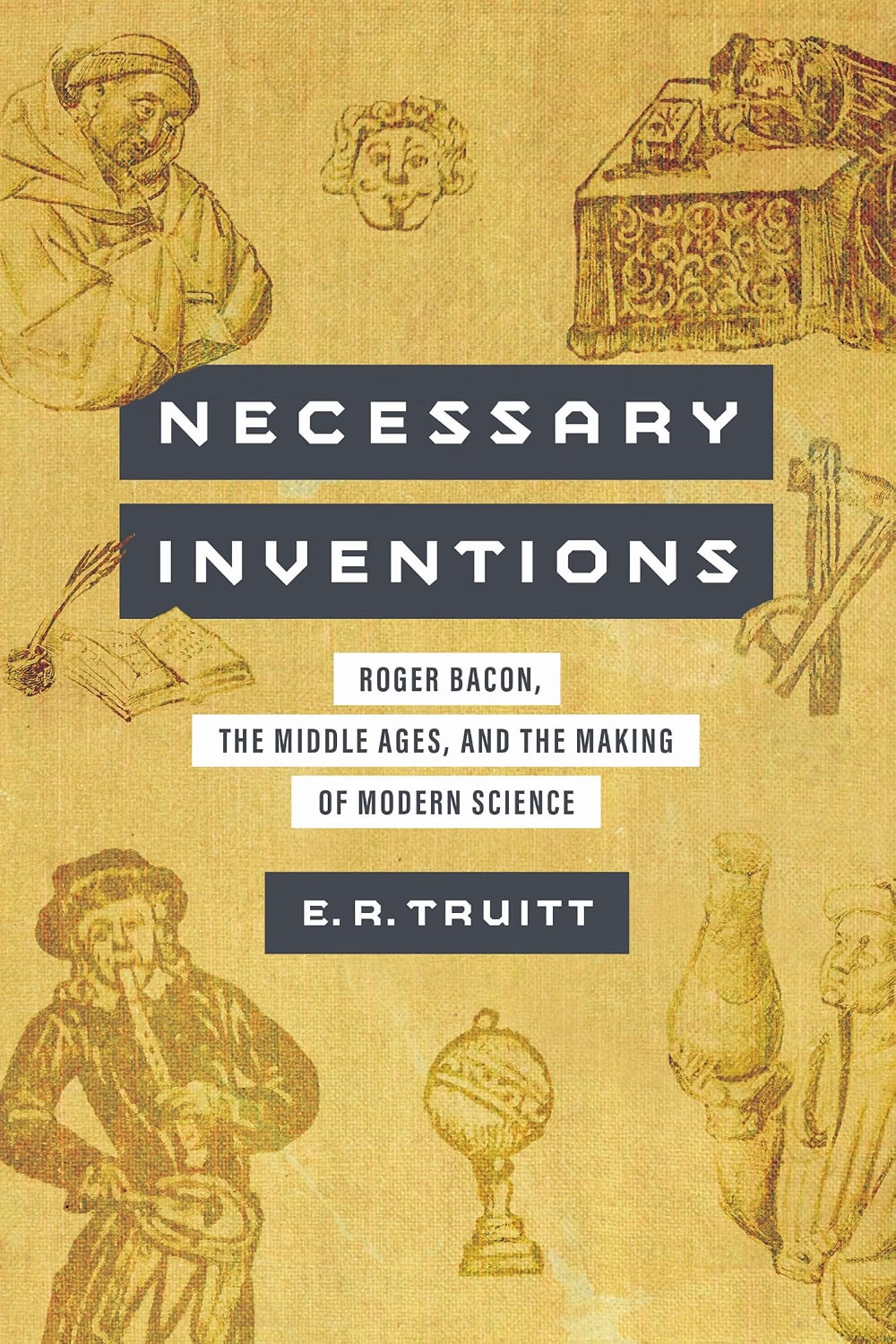
“Necessary Inventions: Roger Bacon, the Middle Ages, and the Making of Modern Science,” by E. R. Truitt, University of Pennsylvania Press, October 2026, 232 pages, $55.00 (Hardcover), $55.00 (E-book)
Roger Bacon. a 13th century polymath was born in England. He spent most of his career in Paris at its university. He is often haled as the first modern scientist. A Franciscan friar and a devoted Christian, he worked closely with Pope Clement IV to categorize science. Yet his modern legacy holds he was at war with the church, his discoveries suppressed by superstitious leaders.
“Necessary Inventions: Roger Bacon, the Middle Ages, and the Making of Modern Science,” by E. R. Truitt, is a new biography of Roger Bacon. It also examines the historiography of science. It explains how the orthodox and very Christian Bacon ended up as a poster child of the opposition of the church to enlightenment for scientists hostile to religion.
Truitt opens looking a Bacon’s life and academic accomplishments. It reveals Bacon was a leading scholar of his day, the 13th century’s Newton or Einstein. It shows Bacon as part of an active and fertile academic community, who borrowed heavily from other scholars of the era, including Arabic scholars.
He pioneered and championed scientia experimentalis, using experiments to validate theory and to rely upon observed results when theory differed from observation. A leader in the field of optics, he made important discoveries in chemistry and other fields. Bacon was advocated on relying on original texts, rather than translations.
He was also a devote and orthodox Christian. His major published works, including “Opus Magnus” (frequently cited today as evidence of Bacon’s heterodoxy) was written at the request of Pope Clement IV. Truitt shows Bacon’s writings were accepted positively by the curia. Both believed science was a way to get closer to God, and technology offered a way for Christianity to triumph over Islam.
Truitt examines how Bacon’s became Doctor Mirabilis in the popular view, a sorcerer rather than a scientist. He was transformed into the standard-bearer for British scientific exceptionalism, a skeptical rebel of his age. The change lies in 17th Century English nationalism and hostility to the Catholic church, and in late 19th Century hostility to Christianity by many scientists.
“Necessary Inventions” is pedantic at points, perhaps inevitable in a book examining pedants. It is also a richly rewarding read, for its reexamination of Bacon’s life and accomplishments. But, also as a cautionary tale of how history gets twisted to serve the message its authors wish to send, rather than reveal the truth about what actually occurred.
Mark Lardas, an engineer, freelance writer, historian, and model-maker, lives in League City. His website is marklardas.com.