Looking for a good read? Here is a recommendation. I have an unusual approach to reviewing books. I review books I feel merit a review. Each review is an opportunity to recommend a book. If I do not think a book is worth reading, I find another book to review. You do not have to agree with everything every author has written (I do not), but the fiction I review is entertaining (and often thought-provoking) and the non-fiction contain ideas worth reading.
Book Review
The World’s Most Valuable Fabric
Reviewed by Mark Lardas
July 28, 2024
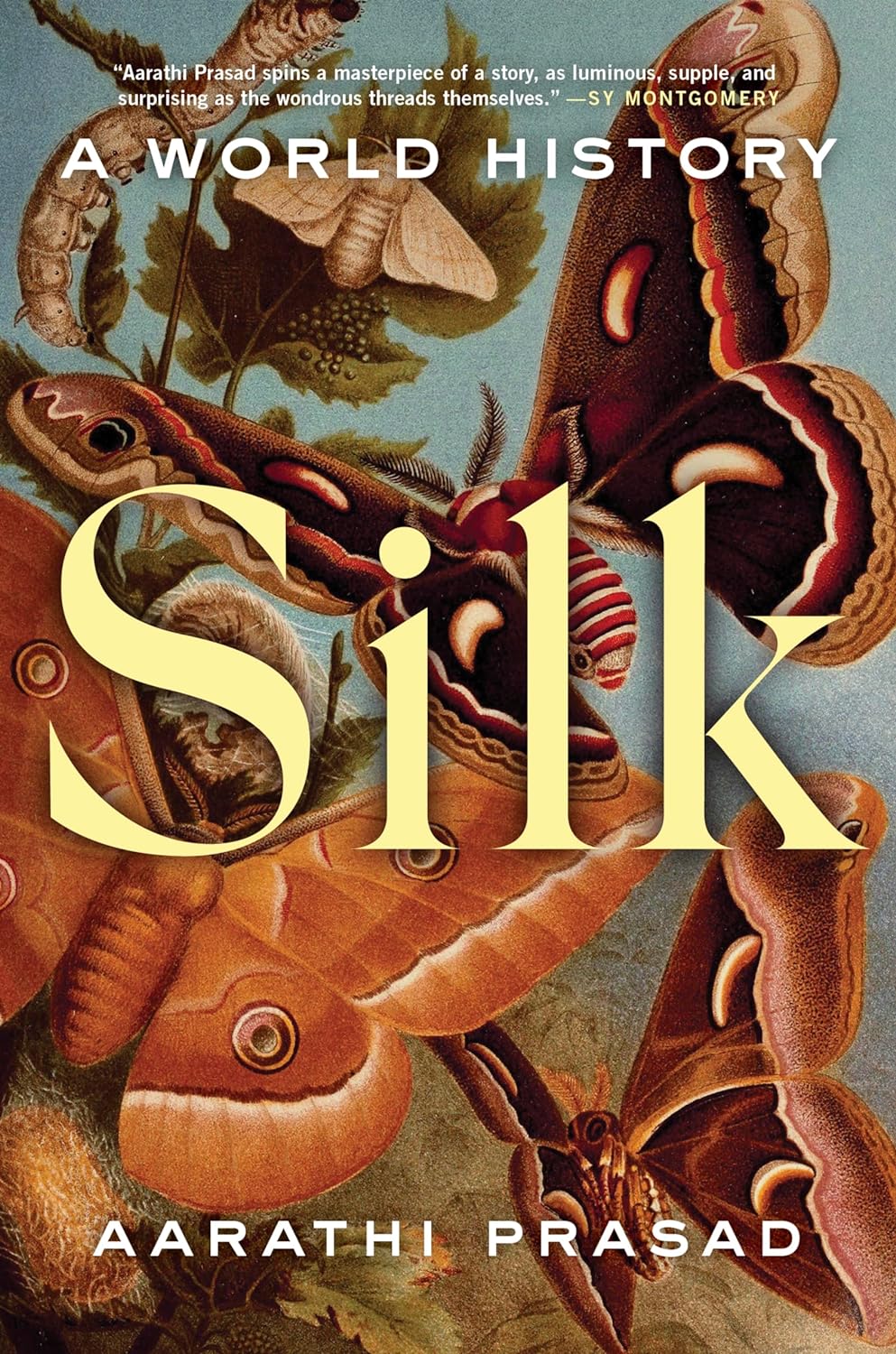
“Silk: A World History,” by Aarathi Prasad, William Morrow, April, 2024, 304 pages, $32.50 (Hardcover), $15.99 (e-book)
Silk. There are few fabrics with a greater reputation for luxury or a more storied past. Produced for thousands of years, the Silk Road brought silk from China to Europe during Roman times. It is one of the most beautiful and strongest fibers in the world.
“Silk: A World History,” by Aarathi Prasad, tells the story of silk. It explains its origins, discusses its production and shows its impact throughout history in three parts. The first discusses silk produced by moths. The second examines other sources of natural silk. The third takes the story through the late 19th century to the present, including its uses and synthesis attempts.
The oldest forms of silk come from moths. Prasad examines the history of the silkworm, starting before its domestication 4000 years ago. She shows how Chinese farmers harvested wild silkworm cocoons 7500 to 5000 years ago and wove their silk into cloth. She shows how this moth, now known as the Bombyx, was domesticated, and how an industry that eventually spread worldwide grew around them.
The Bombyx is not the only moth discussed in this section. She also examines silks produced by wild (and semi-domesticated) moths native to India and Africa. Along the way she introduces individuals prominent in the study of silk, and the insects that produce them.
The book goes beyond moths. In the second section Prasad reveals other historic sources of silk. The pinna nobilis, a now nearly-extinct mollusk, had been the source of “byssus” silk since at least Roman times. It also shows how spider silk was harvested starting in the 16th century, and the various attempts to create a spider silk industry from the extremely strong fabric it yields.
Finally, she examines the various uses of silk beyond simple clothing. Silk has a unique combination of strength and lightness. She shows how the Mongols used silk undergarments as armor and how the first bullet proof vest was created from silk in the early 20th century. It is used in sutures and to stop bleeding. Spider silk proved invaluable in crosshairs for astronomical telescopes and gunsights. It also presents modern attempts to create synthetic spider silk through gene splicing.
“Silk” is a fascinating book on many levels. While a comprehensive scientific look at silk, it is also an adventure story. It tells as much about the explorers seeking to unravel silk’s mysteries as it does about silk itself.
Mark Lardas, an engineer, freelance writer, historian, and model-maker, lives in League City, TX. His website is marklardas.com. This review appeared in a different form in Epoch Times.