Looking for a good read? Here is a recommendation. I have an unusual approach to reviewing books. I review books I feel merit a review. Each review is an opportunity to recommend a book. If I do not think a book is worth reading, I find another book to review. You do not have to agree with everything every author has written (I do not), but the fiction I review is entertaining (and often thought-provoking) and the non-fiction contain ideas worth reading.
Book Review
The Custom of the Sea
Reviewed by Mark Lardas
December, 14, 2025
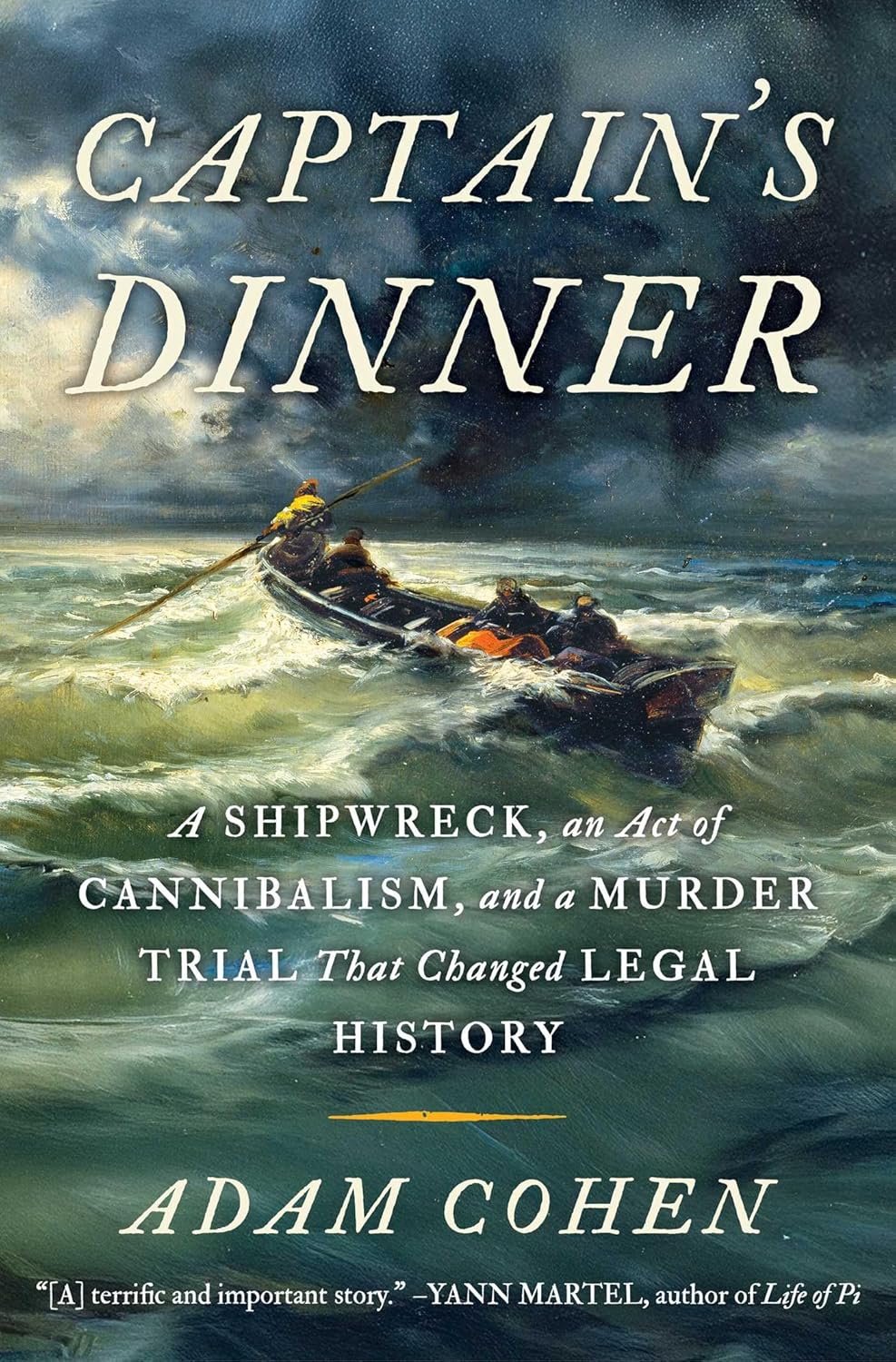
“Captain’s Dinner: A Shipwreck, An Act of Cannibalism, and a Murder Trial That Changed Legal History,” by Adam Cohen, Authors Equity, November 2025, 384 pages, $32.00 (Hardcover), $16.99 (E-book), $22.00 (Audiobook)
In 1884 four men sailed to Australia in a small yacht, Mignionette. It sank in the South Atlantic, stranding its crew in a small ship’s boat with no water and two cans of turnips for food. After weeks without food, the captain, Thomas Dudley, and the mate, Edwin Stephens, killed the 17-year-old cabin boy, Richard Parker. Afterwards the three remaining survivors consumed Parker.
“Captain’s Dinner: A Shipwreck, An Act of Cannibalism, and a Murder Trial That Changed Legal History,” by Adam Cohen, relates what happened. It tells the story behind Regina v. Dudley and Stephens, a landmark legal decision which resonates today. Cohen examines the voyage, the subsequent wreck, the survivors return to England, the public reaction, the subsequent trial, and its ultimate aftermath.
When finally rescued, the survivors, Dudley, Stephens, and a third crewman who had not participated in the murder, able seaman Edward Brooks, claimed necessity. Expecting to be greeted at heroes when they returned to England, they were tried for murder instead.
Cohen shows why they expected to be hailed instead of arrested. Cannibalism in shipwreck situations was a “custom of the sea,” with the victim traditionally chosen by lot. (Interestingly, as Cohen shows, the “random” lot always fell to the weakest, the least liked, or most foreign among those aboard.) As late as the 1830s crews forced to this necessity were usually popularly acclaimed upon return. There were no direct legal precedents. The few existing ones, outside of English jurisprudence, indicated killing another for survival was acceptable.
By the 1880s times had changed in England. Victorian reform was the trend of the day, based on the belief Englishmen were morally superior. Englishmen killing another for a cannibalistic meal challenged that superiority. The Crown prosecuted because they wanted to establish firmly and forever the utilitarian argument of necessity did not justify taking a human life.
The trial was sensational. The public was firmly on the side of Dudley and Stephens. (Brooks was not prosecuted, but a prosecution witness. Cannibalism was not a crime in England, but murder was.) No one, including the prosecutors wanted the pair hanged, but they wanted the precedent set.
“Captain’s Dinner” is an absorbing and fascinating book. It looks at the clash between Christian morality and the social Darwinism and utilitarianism simultaneously in vogue in Victorian England. It explores the implications of the legal precedents set by this case, which echo to the present.
Mark Lardas, an engineer, freelance writer, historian, and model-maker, lives in League City. His website is marklardas.com.
https://us.amazon.com/Captains-Dinner-Shipwreck-Cannibalism-Changed/dp/B0DXD