Looking for a good read? Here is a recommendation. I have an unusual approach to reviewing books. I review books I feel merit a review. Each review is an opportunity to recommend a book. If I do not think a book is worth reading, I find another book to review. You do not have to agree with everything every author has written (I do not), but the fiction I review is entertaining (and often thought-provoking) and the non-fiction contain ideas worth reading.
Book Review
The Cousins’ Conflict
Reviewed by Mark Lardas
September 6, 2026
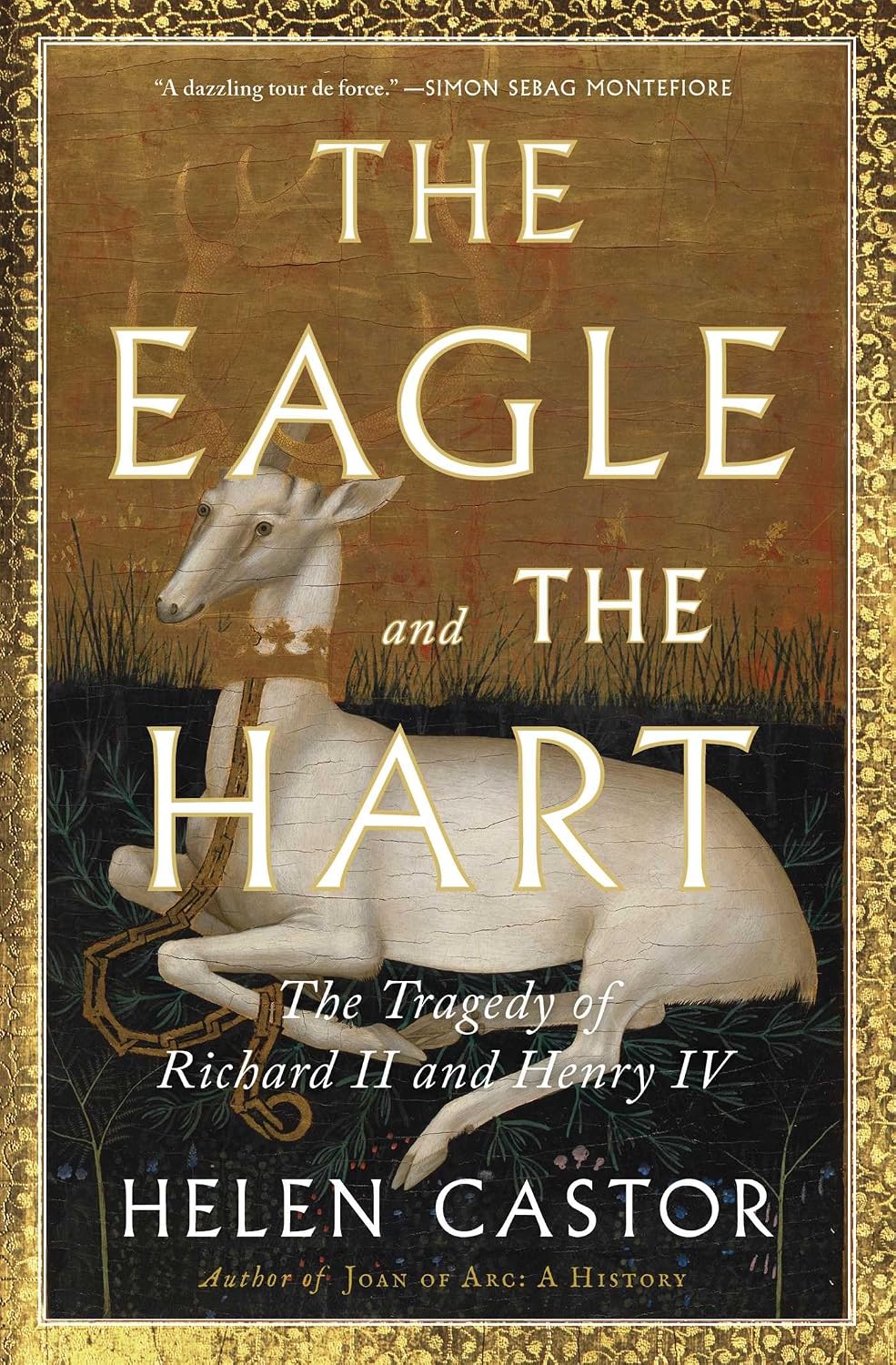
“The Eagle and the Hart: The Tragedy of Richard II and Henry IV,” by Helen Castor, Avid Reader Press / Simon & Schuster, October 2025, 576 pages, $35.00 (Hardcover), $22.00 (Paperback), $16.99 (E-book) $26.24 (audiobook)
Richard of Bordeaux and Henry of Bolingbrook were first cousins, grandsons of England’s Edward III. Both became King of England, Richard II and Henry IV, respectively, with Henry usurping Richard when both were 33.
“The Eagle and the Hart: The Tragedy of Richard II and Henry IV,” by Helen Castor is a joint biography of the two kings, exploring their reigns, and the influence their reigns had reigns on British constitutional law. She frames the story with the history of their family, showing their upbringings’ effect on both men.
Edward III reigned during the glorious English victories at Cressey and Poitiers, present at Cressey. His oldest son, Edward, the Black Prince, and Richard’s father, was present at Cressey, in command at Poitiers and was then England’s greatest war heroes, beloved by the people.
The Black Prince predeceased his father. Richard II inherited the throne while a child, at age 10. A regency council (which included John of Gaunt, Henry’s father) ran Richard’s kingdom during his youth. Prior to Richard’s accession England experienced difficulties, internal and external. The consequences were felt in Richard’s early reign. These included the Peasant’s Revolt. The blame for what went wrong fell on the regency council. including the loyal John of Gaunt.
When Richard became an adult, he dissolved the council, but proved a weak king. Castor shows the biggest problem was Richard’s belief his will was absolute, in a kingdom where the Magna Carta and an unwritten constitution limited its king.
Eventually Richard alienated everyone but a small circle of sycophants. Henry left England for his safety. Then Richard retroactively changed laws to get his way, and punish those who checked his desires earlier. The nobility supported Richard’s replacement with Henry.
Castor rightly describes what happened as tragedy. She shows how Richard’s belief that as God’s anointed, he could exercise his rights and privileges while disregarding everyone else’s was feckless. It left no one safe with Richard as king. She also shows how Henry was given a poisoned chalice. As Henry IV he spent as much time repairing the damage to the crown’s legitimacy as repairing the damage Richard had done to England.
“The Eagle and the Hart” is fascinating. This dual biography of Richard and Henry offers a compelling account, with a deeply textured look at leadership, masculinity, and identity is a turbulent time. It is a study of the limitations of power and ambition.
Mark Lardas, an engineer, freelance writer, historian, and model-maker, lives in League City. His website is marklardas.com.