Looking for a good read? Here is a recommendation. I have an unusual approach to reviewing books. I review books I feel merit a review. Each review is an opportunity to recommend a book. If I do not think a book is worth reading, I find another book to review. You do not have to agree with everything every author has written (I do not), but the fiction I review is entertaining (and often thought-provoking) and the non-fiction contain ideas worth reading.
Book Review
Ford’s Breakthrough Race
Reviewed by Mark Lardas
June 7, 2026
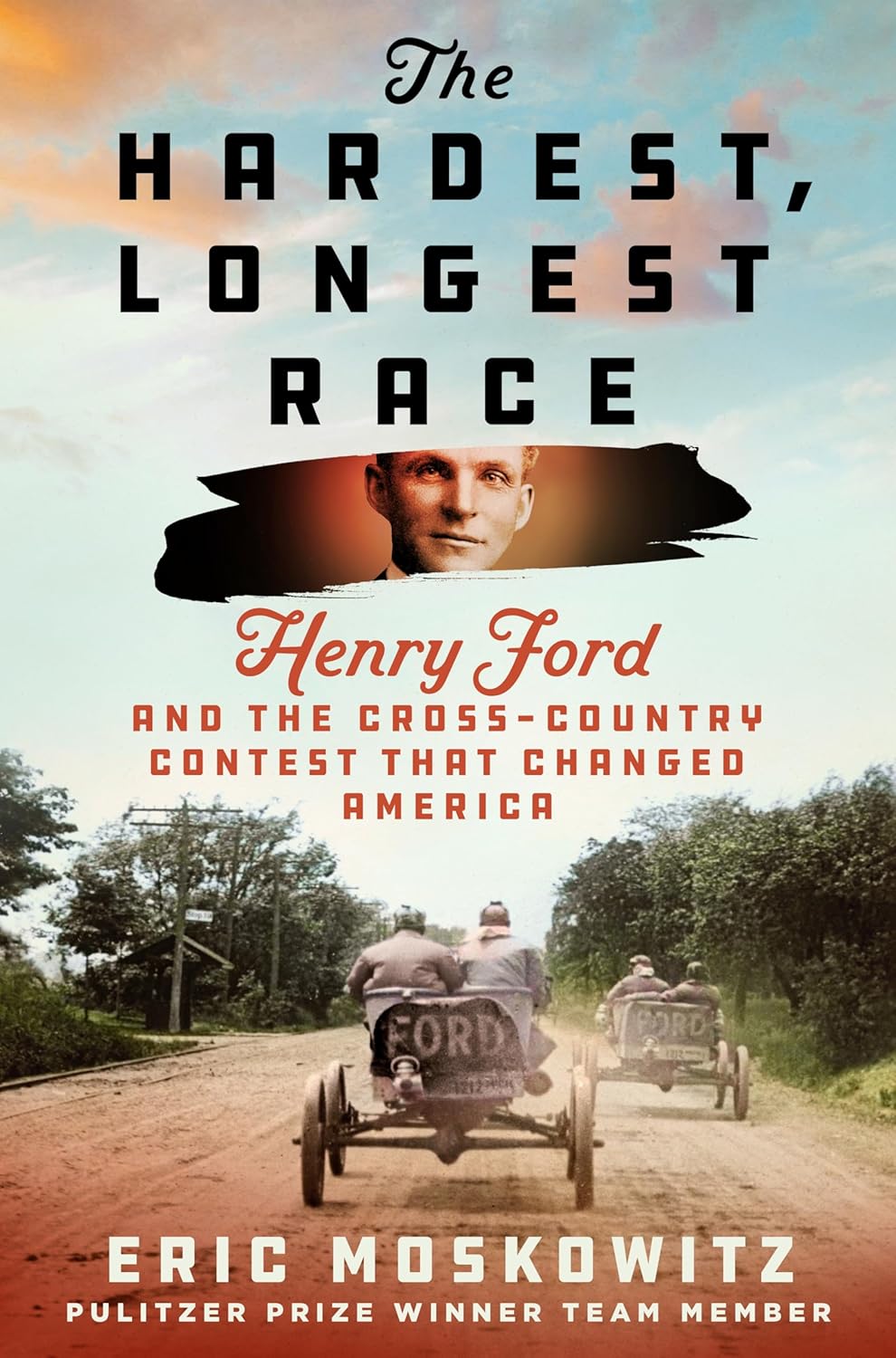
“The Hardest, Longest Race: Henry Ford and the Cross-Country Contest That Changed America,” by Eric Moskowitz, St. Martin’s Press, June 2026, 368 pages, $31.00 (Hardcover), $15.99 (E-book), $20.00 (Audiobook)
In 1909 the automobile had arrived, but still belonged to the world of the pioneer, dilettante, and visionaries. It was not viewed as something needed by everyone. One automobile dilettante was M. Robert Guggenheim, a scion of the Guggenheim mining magnates. That year he sponsored what is likely the most audacious auto race in history: the Ocean to Ocean Automobile Endurance Contest, from New York City to Seattle, Washington.
“The Hardest, Longest Race: Henry Ford and the Cross-Country Contest That Changed America,” by Eric Moskowitz, relates what happened. It tells the story of the race and the consequences that followed.
The existing road network was primitive. West of the Mississippi River there were no paved highways – and few roads graded for motor vehicles. Much of that route were wagon tracks, if that. Cross-country driving was required on sections.
When proposed, auto racing was out of favor. The American Automobile Association condemned the race, opposing street racing for safety. Guggenheim persisted, but only four automakers, Ford, Acme, Shawmut, and Italia, entered cars in the race. One company, Sterns, entered, but its entry arrived after the race started. The smart money was on the Acme and Italia entries. They were traditional cars of the period: sizable, powerful, and heavily constructed.
Only two manufacturers were all-in on the race. The Shawmut was a desperation entry. The factory burned down prior to the race, and Shawmut investors needed a win to raise capital to rebuild it.
Ford’s two entries differed. They were stripped-down Model-Ts. Ford saw the race as an opportunity to advertise the ruggedness and economy of his cars. The Model-T was affordable for the masses. Winning would underscore the vehicle’s durability. He swung his entire network of dealerships behind the cars to ensure they crossed the finish line first.
What resulted was a tale of endurance, perseverance, and skullduggery. Ford pulled out all the stops to get one of his two cars across the finish line first. The rules required cars to arrive without replacing major components or the crew. Through grit, occasional cheating, and bribing ferry operators to slow competitors’ crossings, Ford managed to cross the finish line first. The winning entry was eventually disqualified, awarding victory to the Shawmut, but that was forgotten by the public.
“The Hardest, Longest Race,” is a fascinating and entertaining book. It shows how Ford used it to propel Ford Motor Company to national prominence.
Mark Lardas, an engineer, freelance writer, historian, and model-maker, lives in League City. His website is marklardas.com.
https://www.amazon.com/Hardest-Longest-Race-Cross-Country-Contest/dp/1250282675/