Looking for a good read? Here is a recommendation. I have an unusual approach to reviewing books. I review books I feel merit a review. Each review is an opportunity to recommend a book. If I do not think a book is worth reading, I find another book to review. You do not have to agree with everything every author has written (I do not), but the fiction I review is entertaining (and often thought-provoking) and the non-fiction contain ideas worth reading.
Book Review
Why the Dinosaurs Really Died
Reviewed by Mark Lardas
October 12, 2025
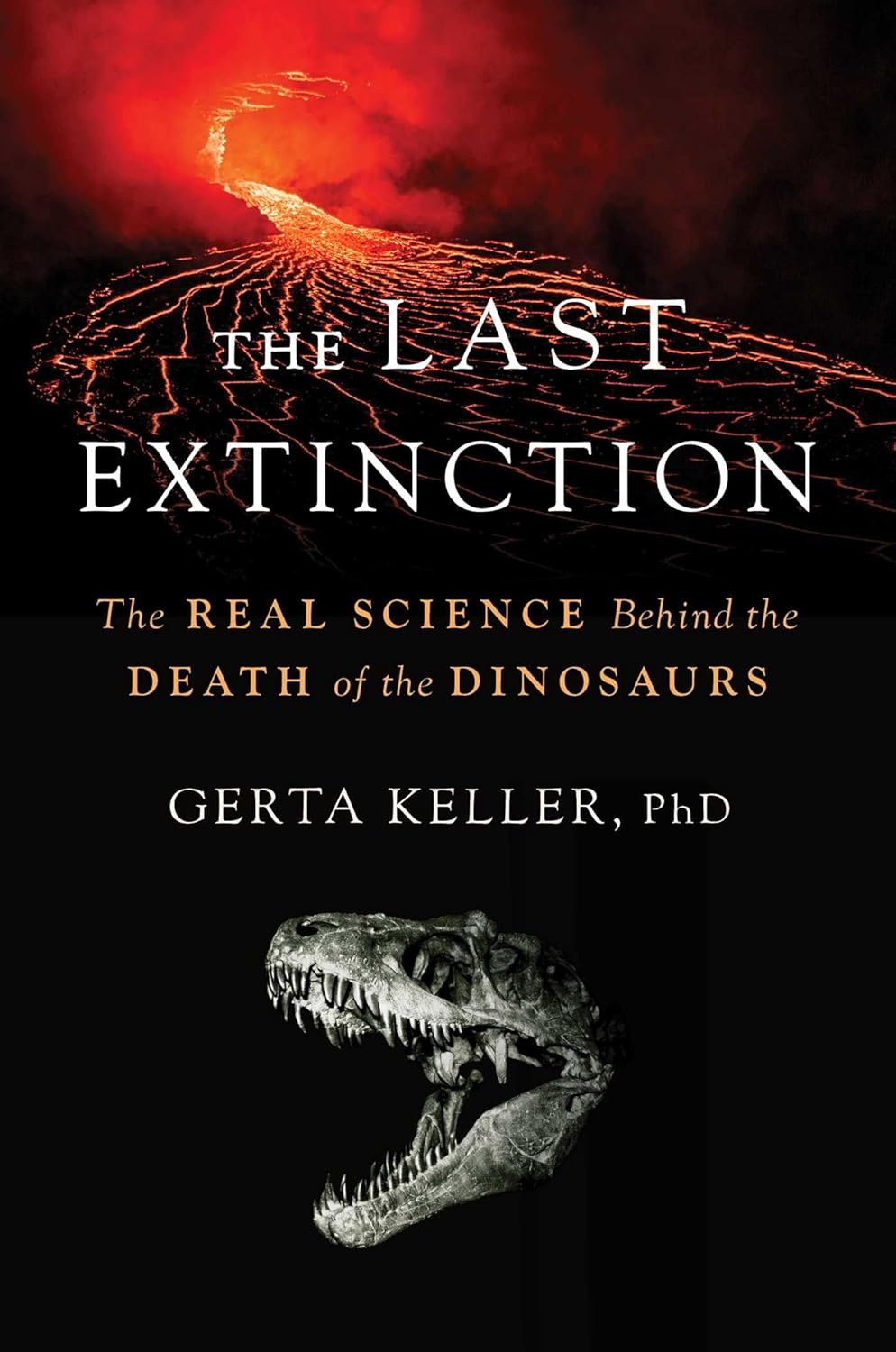
“The Last Extinction: The Real Science Behind the Death of the Dinosaurs,” by Dr. Gerta Keller, Diversion Books, September 2025, 320 pages, $32.00 (Hardcover), $19.99 (E-book), $26.08 (audiobook)
What killed the dinosaurs? Since the 1980s many believe an asteroid strike was caused the Cretaceous–Paleogene extinction, a theory originally posited in 1980 by Luis and Walter Alvarez.
“The Last Extinction: The Real Science Behind the Death of the Dinosaurs,” by Dr. Gerta Kelle asserts volcanic eruptions were the cause. Her findings upended the field and ignited a bitter feud, the “Dinosaur Wars.”
Keller is Professor Emeritus of Paleontology and Geology at Princeton University. Her research, presented here holds that Deccan volcanism, massive volcanic eruptions in India, triggered a long-term climate catastrophe and Earth’s fifth mass extinction.
This should not be considered extraordinary. Of five major extinctions, the first four are widely believed caused by volcanism. A major volcanic event preceded the fifth extinction at India’s Deccan Traps region, of a scale similar to previous events. That a single asteroid strike, with a smaller overall atmospheric impact was a novel idea, yet came to be the accepted explanation.
In this book Keller shows how and why the asteroid strike explanation dominated. She lays out the evidence showing the atmospheric effects of the Deccan volcanism, simultaneously demonstrating why the arguments for asteroid extinction were weak or flawed.
She asserts acceptance of asteroid extinction has more to do with politics than science. Asteroid extinction was attractive to NASA, justifying expanded spending, when NASA was under pressure to cut spending. Catastrophes also make exciting headlines. The press ran with it. Governmental study grants followed, as did fame and prestige for asteroid extinction advocates. Once they were in charge, the science was settled. Keller shows how evidence challenging asteroid extinction was suppressed.
This is one of the book’s most fascinating revelations. It echoes behavior seen in both climate science and medicine during the Covid crisis. Even eminent scientists (such as Jay Bhattacharya) had reputations blackened for holding contrarian positions. It reveals institutional science corrupted by governmental intrusion.
A major irony is the extent to which the Gell-Mann amnesia effect pervades modern science. Even Dr. Keller falls victim. She painstakingly details scientific shortcomings she sees with the asteroid-extinction advocates yet remains oblivious to the similar failings among climate scientists.
Whether you agree with Dr. Keller’s views or not, “The Last Extinction” should be read as a cautionary tale about modern science. If her claims are true, 21st-century science is deeply flawed by an addiction to government money and ambitions of individuals more interested in advancement than science.
Mark Lardas, an engineer, freelance writer, historian, and model-maker, lives in League City. His website is marklardas.com.