Looking for a good read? Here is a recommendation. I have an unusual approach to reviewing books. I review books I feel merit a review. Each review is an opportunity to recommend a book. If I do not think a book is worth reading, I find another book to review. You do not have to agree with everything every author has written (I do not), but the fiction I review is entertaining (and often thought-provoking) and the non-fiction contain ideas worth reading.
Book Review
When Even the Winners Lose
Reviewed by Mark Lardas
May 31, 2026
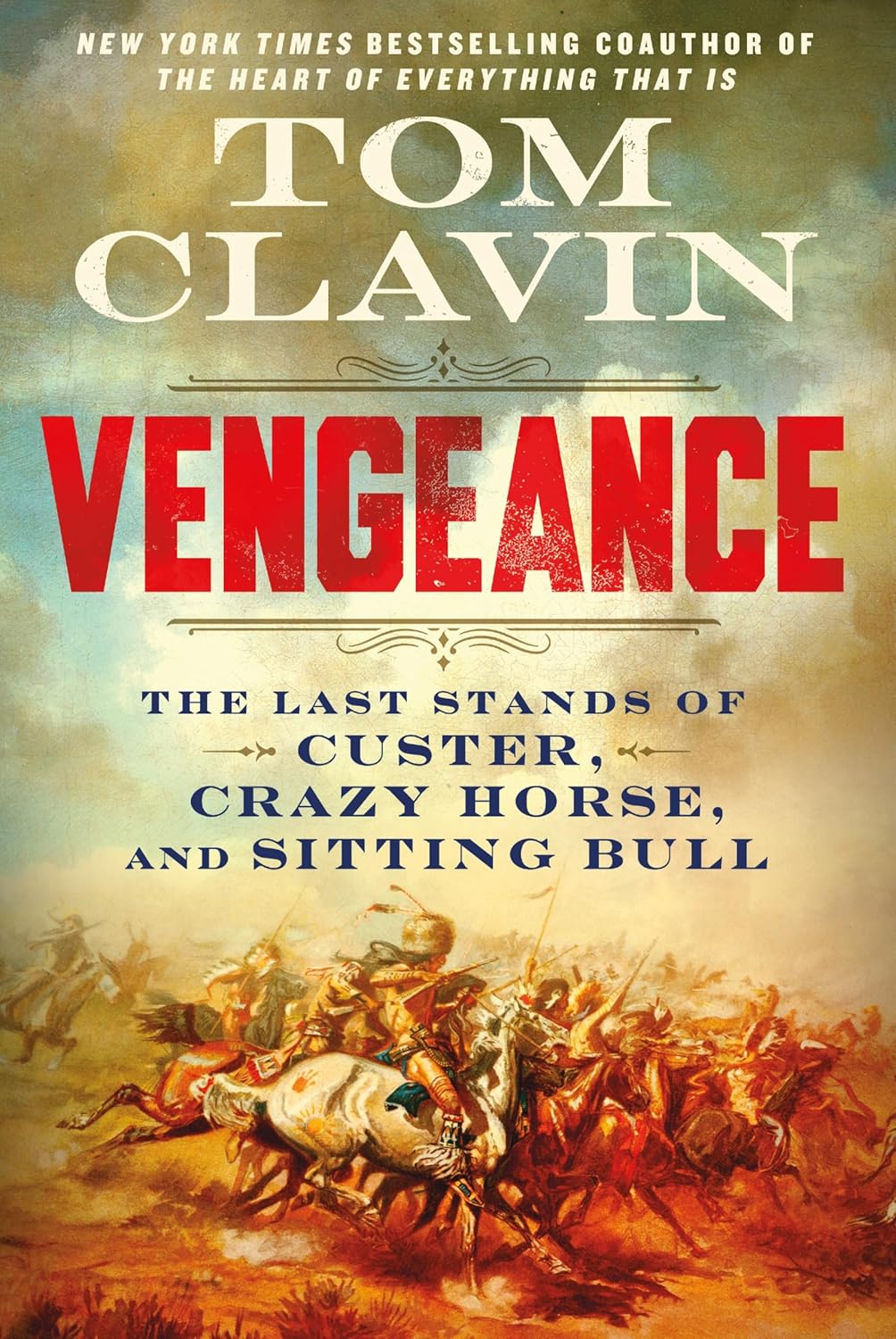
“Vengeance: The Last Stands of Custer, Crazy Horse, and Sitting Bull,” by Tom Clavin, St. Martin’s Press, May 2026, 352 pages, $32.00 (Hardcover), $16.99 (E-book), $20.00 (Audiobook)
The sesquicentennial of George Armstrong Custer’s campaign for the Democrat nomination for President in the 1876 election is upon us. It ended as successfully as Joe Biden’s 2024 run, with Custer and his command dead at Little Bighorn.
“Vengeance: The Last Stands of Custer, Crazy Horse, and Sitting Bull,” by Tom Clavin, reappraises the battle. It examines Little Bighorn in its totality, including its impact on all participants, white and Indian.
Fought June 25–27, 1876, the Battle of the Little Bighorn (also called Custer’s Last Stand) pitted the combined Lakota Sioux, Northern Cheyenne, and Arapaho tribes against the United States Army’s 7th Cavalry Regiment. It was the worst defeat the US Army suffered during its Indian Wars.
The battle has been written about, examined, reexamined, analyzed and over-analyzed ever since. Could anything new or worthwhile be written about it 150 years later?
Surprisingly, yes. Tom Clavin offers a fresh look at the battle reexamining Custer and the actions of the 7th Cavalry’s commander and those under his command. Clavin combines this with a reassessment of the battle’s impact on its victors. He examines the Indian point of view and shows why Little Big Horn proved a defeat for the Indians as for the 7th Cavalry.
He does this without romanticizing either Custer, the 7th Cavalry or the Indians. He shows Custer’s fault, while presenting his strengths. Similarly, he shows what the Indian’s weaknesses were in fighting incursions on their land and how they overcame those weaknesses for the first time to create an overwhelming victory at Little Bighorn.
Clavin puts everything in context, providing extensive background on all the participants in the battle, US and Indian. He shows the careers of men like George Custer, George Crook, Nelson Miles, Crazy Horse, Gall, and Sitting Bull up to the Sioux War of 1876 and follows what happened afterwards to the survivors.
He also examines the dynamics within the 7th Cavalry, exploring how the relations between Custer and his subordinate officers, particularly Reno and Benteen affected the outcome of the battle.
About everyone in the book comes off badly, Custer, the 7th Cavalry, the US Army and the Indians. Yet no one is a villain. Instead, readers are shown a series of poor decision and bad judgement that led to bad endings for almost everyone involved. “Vengeance” is worth reading as a cautionary tale of the consequences of not thinking things through.
Mark Lardas, an engineer, freelance writer, historian, and model-maker, lives in League City. His website is marklardas.com.