Looking for a good read? Here is a recommendation. I have an unusual approach to reviewing books. I review books I feel merit a review. Each review is an opportunity to recommend a book. If I do not think a book is worth reading, I find another book to review. You do not have to agree with everything every author has written (I do not), but the fiction I review is entertaining (and often thought-provoking) and the non-fiction contain ideas worth reading.
Book Review
The Irregulars During the Revolution
Reviewed by Mark Lardas
October 12, 2025
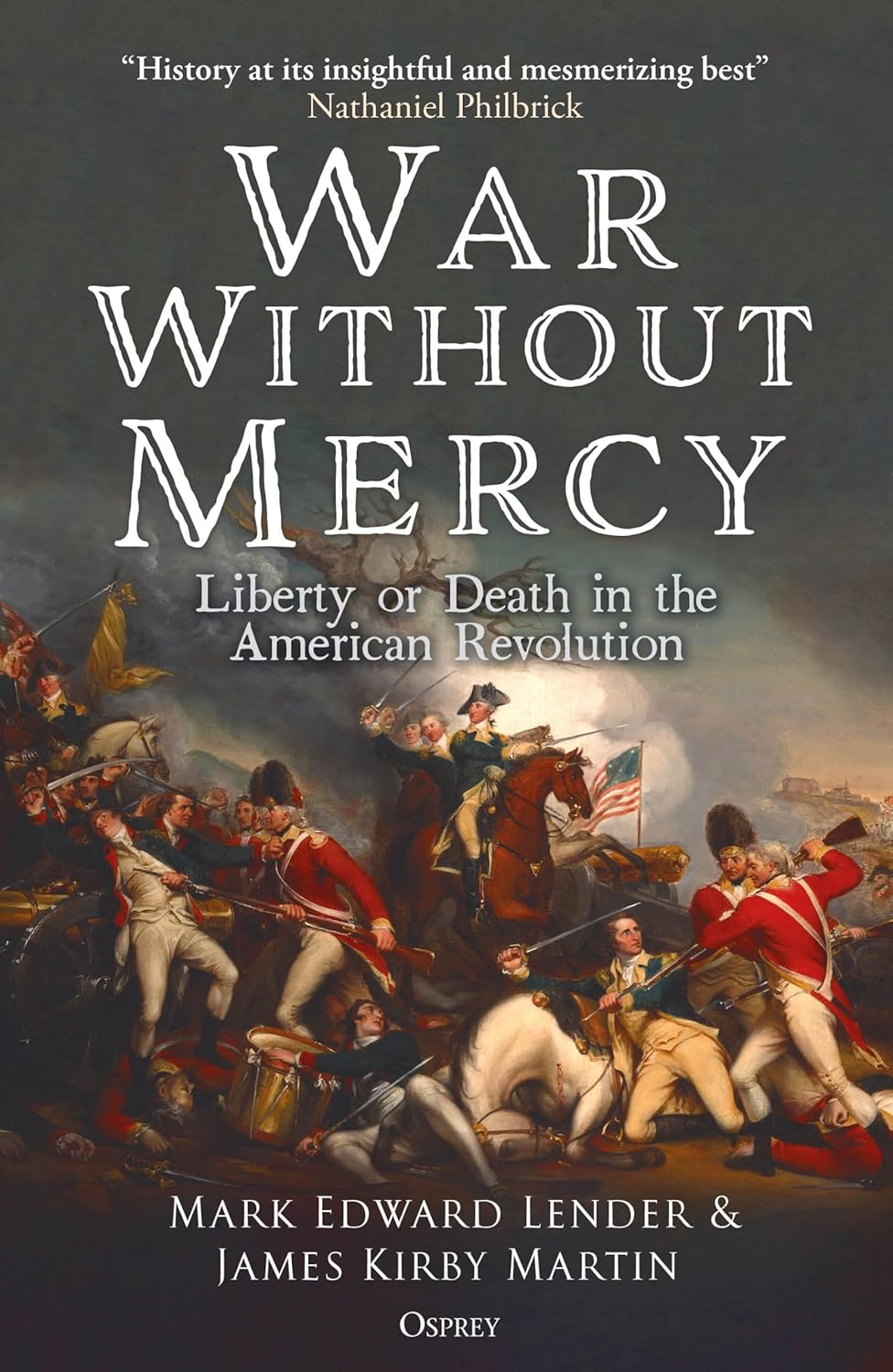
“War Without Mercy: Liberty or Death in the American Revolution,” by Mark Edward Lender and James Kirby Martin, October 2025, Osprey Publishing, 288 pages, $32.00 (Hardcover), $22.40 (E-book) $15.26 (Audiobook)
The American Revolution today is thought of a gentlemanly war, one generally following European rules of lawful warfare. On one level it was. The regular armies of both sides followed Jus in Bello (justice in war) concepts set out by Hugo Grotius and Emmer de Vattel after the Thirty Years War. Yet nine-tenths of the fighting was not done by regular armies. It was conducted by irregulars.
“War Without Mercy: Liberty or Death in the American Revolution,” by Mark Edward Lender and James Kirby Martin, tells of that other war, the fighting conducted by civilians, militias, Indians, and irregular groups.
That story is bloody, the tale of fighting an existential war, where the stakes are literally liberty or death. It shows how vicious warfare becomes fought by those unconstrained by anything except desire for survival.
The book opens by discussing the origins of the rules of war and their implications. A chapter looking at how the regular forces of both sides conducted their war within the confines of Jus in Bello rules follows, including its shortcomings when dealing with a rebellion. The next five chapters explore the war in different theaters showing irregular warfare’s role.
One chapter focuses on the British raid on New London. Led by Benedict Arnold, its aim was destroying the infrastructure used by revolutionary privateers. It showed how frightful warfare fought within Jus in Bello gets, in terms of civilian property used to support warfare destroyed and during fortress assaults.
The other four chapters focus on irregular warfare. Two examine the American frontier, in the Old Northwest Territory and Upstate New York. Two others look at irregular warfare between pro-independence Whig and loyalist Tory factions in New Jersey and the Southern colonies.
All share a dreary pattern. Suppression by one siide triggered retribution by the other. This led to more violent responses yielding more violent reaction. Irregular violence spiraled out of control, reducing the territory to a wasteland.
“War Without Mercy” demonstrates once existential war replaces Jus in Bello rules, war becomes war to the knife and the knife to the hilt, with desolation left in its wake. It also shows that civil wars – which is what the American revolution was for American Whigs and Tories – are most likely to devolve into existential war. A warning, it shows what can happen if today’s civil unrest in the United States grows into active warfare. No one will like the results.
Mark Lardas, an engineer, freelance writer, historian, and model-maker, lives in League City. His website is marklardas.com.