Looking for a good read? Here is a recommendation. I have an unusual approach to reviewing books. I review books I feel merit a review. Each review is an opportunity to recommend a book. If I do not think a book is worth reading, I find another book to review. You do not have to agree with everything every author has written (I do not), but the fiction I review is entertaining (and often thought-provoking) and the non-fiction contain ideas worth reading.
Book Review
The Key to Victory
Reviewed by Mark Lardas
July 26, 2026
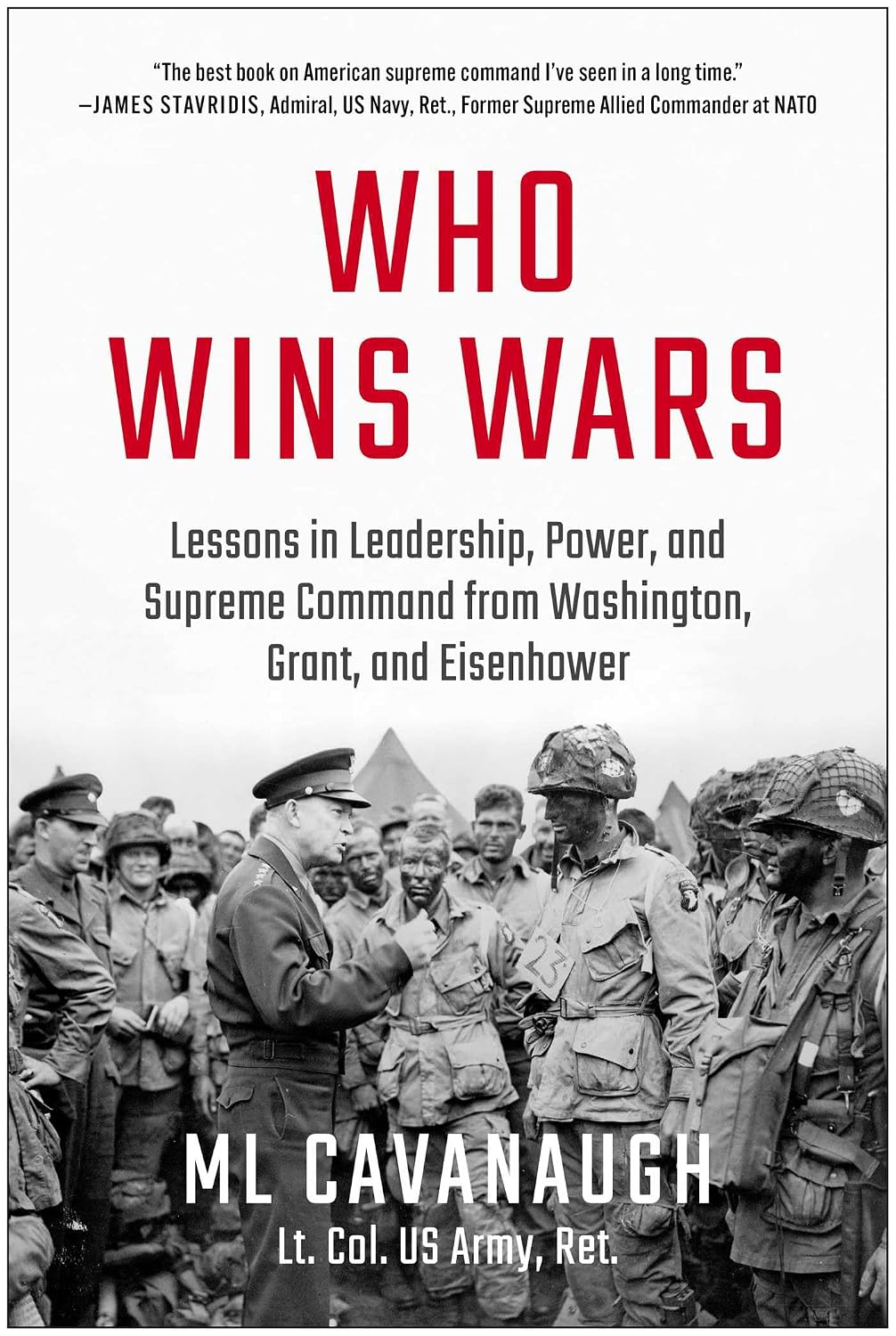
“Who Wins Wars: Lessons in Leadership, Power, and Supreme Command from Washington, Grant, and Eisenhower,” by ML Cavanaugh, Matt Holt Books, July 2026, 256 pages, $30.00 (Hardcover), $15.99 (E-book), $15.90 (Audiobook)
Many generals win battles. Fewer generals win wars, not just battles. Napoleon, Robert E. Lee, and Hindenburg won battle after battle, in ultimately losing the wars in which the battles were fought. Others, like Washington, Grant, and Eisenhower, upon being given supreme command, went to victory, winning their war, sometimes losing battle after battle before achieving victory.
“Who Wins Wars: Lessons in Leadership, Power, and Supreme Command from Washington, Grant, and Eisenhower,” by ML Cavanaugh examines what leads to military success. Not just a battlefield win, but in a campaign leading to a victorious outcome to a war.
He looks at three campaigns: George Washington’s 1776-1777 struggle with Howe at the opening of the American Revolution, Ulysses Grant’s Civil War Overland Campaign, and Dwight Eisenhower’s 1944-45 defeat of Germany. Each was critical in achieving ultimate victory in their respective wars.
Each campaign is revealed as a struggle against odds. In all three campaigns, had its supreme commander made different decisions, defeat would have followed. In each case, the commander uncovered an important key to victory.
Washington goal was keeping his army intact. It required making occasional raids like Trenton and Princeton. Grant kept Lee tied down, denying Lee freedom of action. Eisenhower used deep airborne drops at D-Day, proving strategic depth to the beachhead.
This book is excellent in describing why these three generals won. It disabuses readers of the notion that a US victory was inevitable in any of these campaigns. Cavanaugh accurately identifies commonalities possessed by these three generals and the errors of their opponents He shows how they applied their abilities to win, especially willingness to make hard decisions when necessary.
Where it falls short is achieving its stated ambition of using these examples to identify future US commanders capable of winning wars. That section of the book recycles the accepted military wisdom of the last 30 years, a period when the US has proved unable to win wars. (The last unambiguous US military victory was the 1990-91 Gulf War.)
Despite this, “Who Wins Wars” is worth reading. It shows what is needed to win wars. It shows successful generals must be able to blend both military and political objectives to win conflicts, and underscores the importance of civilian leadership in any war. This is a book worthwhile for military professionals, those interested in military history, or a general reader wishing to learn more about the military.
Mark Lardas, an engineer, freelance writer, historian, and model-maker, lives in League City. His website is marklardas.com.