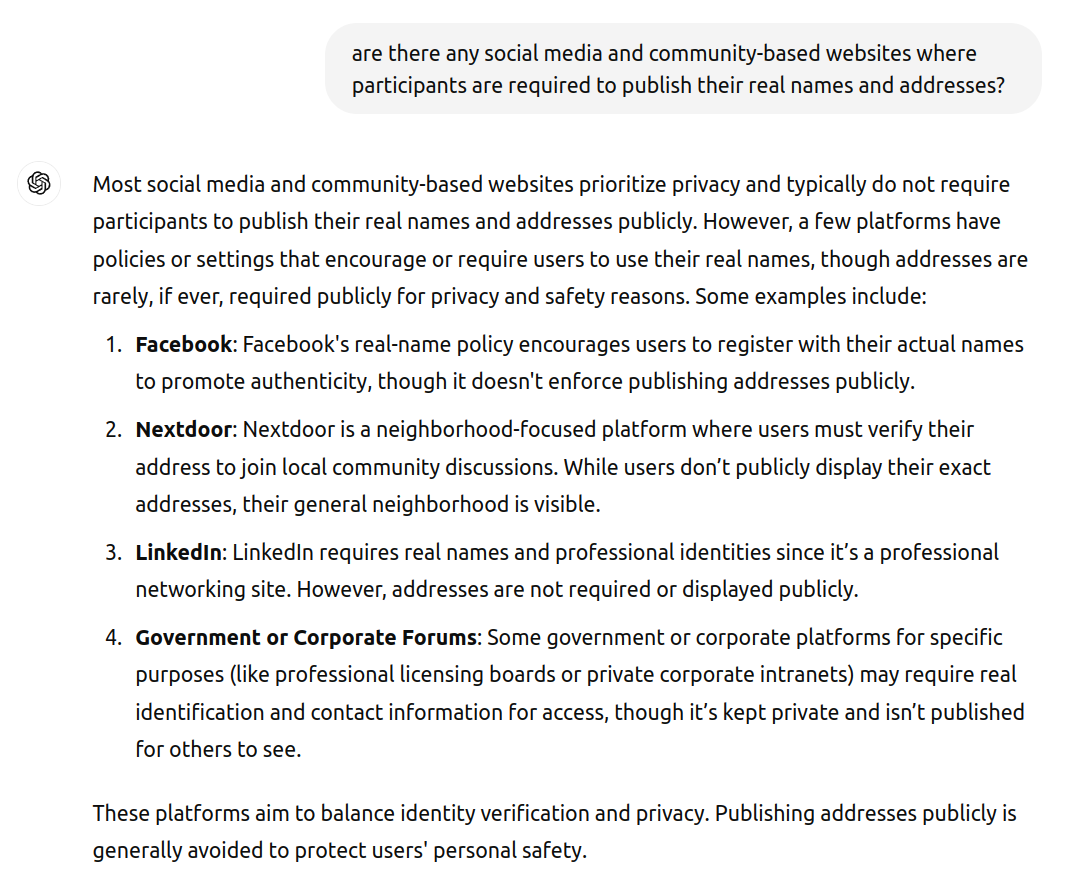
At the risk of upsetting caddzooks, Here’s Ralph Nader saying a lot of nice things about Donald Trump.

At the risk of upsetting caddzooks, Here’s Ralph Nader saying a lot of nice things about Donald Trump.
Incentives are all you need to generate the appearance of a “conspiracy”.
This isn’t to say there aren’t “vast conspiracies” that develop in the absence of government incentives mind you…
See my blog article on “conspiracy”:
Governments aren’t the only creators of incentives that apply across populations. The environment creates incentives for something called “evolution”.
That really doesn’t explain the connection to a single body, which is the aspect of that characterization of all special interests, that I’m taking issue with. Are all of those heads liberal interests, for example?
I don’t think I or most of the population need schooling on government corruption. As you yourself say above:
Most of the population seems to be in agreement regarding this particular phenomena without any schooling.
I see, and on what points do I not agree with Nader, specifically?
Didn’t see too many nice things said about Trump in that interview. Are you sure you have the right interview?
In that interview, I did notice that Nader didn’t so much as acknowledge the simple and perfectly-obvious objective of Trump’s threat to run as an independent - to be the spoiler that would serve to do nothing other than ensure a Republican defeat.
The only other positive thing he said about Trump (and I’m not entirely sure that it’s a positive thing at all), was that breaking the two-party stranglehold on government required a billionaire.
If you ask me, it’s gonna take a little more than just a billionaire.
So, Nader was duped, just as most of Trump’s base has been duped. In 2016, Trump promised to drain the swamp.
Did he?
In 2016, republicans had no choice other than to rally behind Trump, as much as they didn’t really want to do that. They did it because they realized the only thing Trump could achieve by running as an independent spoiler was to guarantee a Republican loss.
Today, I very much doubt that Nader would see Trump much differently than I see him (a misogynistic psychopath).
Emergent phenomena exactly explains how distinct entities can appear to act together even if there was no coordination or planning — your obsession with conspiracies. Those interests are not liberal in the classic sense of the term; they are statist and globalist. As Mr Nader is fond of pointing out, both traditional left and right have common cause in opposing those interests. See, for instance, the title of his book I referenced and the video I linked.
Take a moment to read my comment with more care than just quoting a couple of side remarks.
Maybe watch it again, this time with ideological blinders removed. Nader never specifically mentioned ensuring a Republican defeat.
How many is too many?
Apparently, he said enough positive things for you to accuse Nader of being duped into having favorable things to say about Hitler Hitler Hitler. You think so little of your ideological hero that you call him a dupe. How fickle. My own view of Mr Nader is more nuanced and consistent, going back at least as far as 2016.
I don’t reply to people like @caddzooks. Anyone that feels compelled to call all people that don’t agree with their view some nasty name lacks character. They are incapable of listening to others and offer nothing of value unless you get a laugh from being able to predict the parrot like response they provide. Never will you get something that even is remotely an original thought. If an experiment could be conducted such that you removed their TV or corporate news such that they couldn’t be told what to think, they would have nothing to say.
Replying to trolls, in some circumstances, can be a public service. That is, by drawing them out to expose their utter idiocy for all to see.
You are right that such trolls cannot be reached by reason, but other readers, lurkers or whatever, might be influenced by uncontested lies and political sound bites.
Has anyone bothered to implement what I suggested back in '82 was the solution to all this Section 230 nonsense?
The question at hand is this: How do we mold the early videotex environment so that noise is suppressed without limiting the free flow of information between customers?
The first obstacle is, of course, legal. As the knights of U.S. feudalism, corporate lawyers have a penchant for finding ways of stomping out innovation and diversity in any way possible. In the case of videotex, the attempt is to keep feudal control of information by making videotex system ownership imply liability for information transmitted over it. For example, if a libelous communication takes place, corporate lawyers for the plaintiff will bring suit against the carrier rather than the individual responsible for the communication. The rationalizations for this clearly unreasonable and contrived position are quite numerous. Without a common carrier status, the carrier will be treading on virgin ground legally and thus be unprotected by precedent. Indeed, the stakes are high enough that the competitor could easily afford to fabricate an event ideal for the purposes of such a suit. This means the first legal precedent could be in favor of holding the carrier responsible for the communications transmitted over its network, thus forcing (or giving an excuse for) the carrier to inspect, edit and censor all communications except, perhaps, simple person-to-person or “electronic mail”. This, in turn, would put editorial control right back in the hands of the feudalists. Potential carriers’ own lawyers are already hard at work worrying everyone about such a suit. They would like to win the battle against diversity before it begins. This is unlikely because videotex is still driven by technology and therefore by pioneers.
The question then becomes: How do we best protect against such “legal” tactics? The answer seems to be an early emphasis on secure identification of the source of communications so that there can be no question as to the individual responsible. This would preempt an attempt to hold the carrier liable. Anonymous communications, like Delphi conferencing, could even be supported as long as some individual would be willing to attach his/her name to the communication before distributing it. This would be similar, legally, to a “letters to the editor” column where a writer remains anonymous. Another measure could be to require that only individuals of legal age be allowed to author publishable communications. Yet another measure could be to require anyone who wishes to write and publish information on the network to put in writing, in an agreement separate from the standard customer agreement, that they are liable for any and all communications originating under their name on the network. This would preempt the “stolen password” excuse for holding the carrier liable.
Yes… Yes… I know… I should have done it by now. But somehow I just never thought it plausible that no one would have done a “reddit” but with secure public identification of the real names and addresses of the “contributors”.
I do recall Musk saying at one time that identities should be the basis for townhalls such as is his intent for X, but then he didn’t really follow through with it – and despite his statements about not censoring people, he clearly has done so and even excluded scholars who have not been charged with any crimes.
And, unsurprisingly, ChatGPT has a thing about “safety”:
My real name has – without exception – been associated with my “cancellable” public posts for decades, in large part because of what I saw back in 1982 as the danger of what we are now experiencing as loss of freedom of speech even at the hands of the supposed defenders such as Musk. And I’ve never taken any actions that would avoid disclosure of my residential address.
While I recognize this isn’t for everyone, I also recognize a market gap when I see one – and this one is enormous.
I suspect no one is willing to take it on because lawfare is not new – nor is it restricted to one side of the political spectrum. The government hasn’t really wanted freedom of speech since at least the Telecommunications Act of 1934 when it basically granted censorship-by-omission rights to broadcast companies with adjudication done by the FCC “regulators” in the executive and, if one tries the judiciary, one discovers one is bankrupted by court costs and counter-suits.
PS: And, yes, I’ve read the “libertarian” defenses of monopoly profit warchests for legal battles. Maoist assets all as you’re about to discover when the West turns into a rhyme with The Thirty Years War because “capitalists” got turned into network effect junkies to the point that corporations all turned “Woke” on us.
Don’t know if you’re a Trump fan or not (seems like it, as he’s the only one I’ve directed name-calling at). But, if you are, and you dislike someone calling your hero names, criticizing them for doing that is a bit oxymoronic.
Yes, I have no absolutely no problem with taking shots at a notorious and chronic name-caller like Trump, and I don’t do it out of any disagreement I have with his policies, I do it because that’s what he does to anyone that crosses him up. Just ask the spineless Governor of Georgia.
It would seem that your characterization of my conduct is an excellent characterization of your hero.
I don’t own a TV, and my news sources are all ranked as highly-unbiased and not mainstream.
More importantly insinuating that one allows their opinion to be shaped or influenced by what they see on ‘TV’, or read from some biased news source is unto itself an insult that makes you the pot that calls the kettle black.
Your words immediately reminded me of the J6’er that was interviewed by the (fake-news) 60 minutes (I didn’t watch, just read about it elsewhere). When asked why he felt the 2020 election was rigged/stolen, he said he believed that because ‘that’s what I read on the internet’.
And here you are cackling about people being told what to think.
Imagine that.
I watched it once. I don’t wear ideological blinders. Nader was impressed with Trump’s being a political outsider that was going to drive changes like those Nader advocates for (e.g., ‘drain the swamp’). Like Nader, millions of voters bought into it too.
Trump had 4 years. It would seem to me that everything Nader disliked about the system (which he apparently believed Trump was going to do something about), is only worse now than it was in 2016.
What I can tell you from experience, is that Aspies often completely overlook obvious and self-evident motives, and for that reason, can easily be duped.
So while you avoided the point I made re draining the swamp, my simple-minded question remains: If most people voted for Trump because he said he was going do that, then have they been duped?
No, he didn’t, which was precisely my point.
Most reasonable people would immediately acknowledge that, given the same questions, and would also see it for what it was, and realize that Trump would never run as an Independent given the perfectly reasonable assumption that Republicans would cave, as they did.
Nader also didn’t speak to Trump’s character, only to what he believed would be the outcome, based entirely on Trump’s largely-broken promises.
The problem we seem to have here is that I don’t see even the appearance of distinct entities acting together, which itself implies there is a common goal or objective that benefits all of the entities or the single body.
Many of the heads on your ‘Regime Hydra’ are at odds with each other with highly-conflicting interests, and with the only thing they share being the methodology they all use to achieve their objective (buying votes).
If there is the appearance that these entities act in concert, I don’t see it.
From my perspective, ‘Regime Hydra’ seems more like an attempt to demonize the opportunistic patrons or customers of the influence peddling, rather than the influence peddlers, who are the core problem.
Most people who voted for Trump recognize that he was hit with an unprecedented barrage of opposition & under-mining from all those (taxpayer-funded) denizens of the DC Swamp. Even the so-called “Republicans” in Congress could not find some money under the couch to pay for building the wall. But we are sophisticated enough to recognize that the problem lay with Congress (Damn Them to Hell!) and the bureaucracy (As Above!) – not with President Trump.
What President Trump can reasonably be accused of is being foolishly-trusting or mis-advised in his appointments. When even the Chair of the Joint Chiefs was working with the Chinese, it was really time for some firing squads (definitely figurative, maybe in some cases literal). One can hope that President Trump has learned from that hard lesson.
Candidates from all sides routinely make promises that require consent of Congress. But, they also know that when they make those promises.
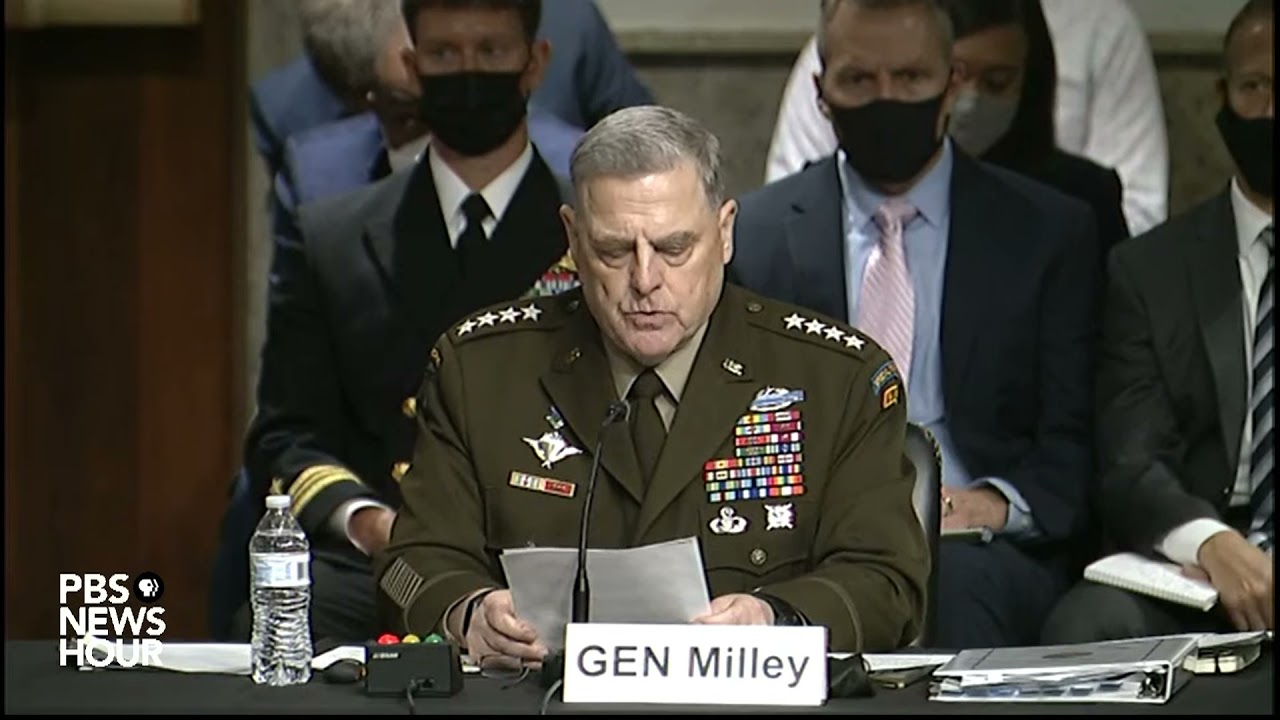
If you’re referring to Milley’s calls to China to reassure them Trump wasn’t going to attack, One call was made at the request of, and coordinated with the Defense secretary. The other call was made at the request of the Chinese, and was coordinated with the acting Secretary at the time.
If all the rhetoric being spewed forth by Trump at the time caused the Chinese to become convinced that an attack was imminent, they would’ve acted preemptively and we would be at war right now. Mind you, the Chinese wouldn’t rely on anything they were told by Milley, so the second call (at their request) can be viewed as pot-stirring or meddling.
But it certainly is interesting and entertaining to see how this was spun and made to look like the problem was Milley the traitorous villain, to deflect from the fact that the entire thing was triggered by Trump’s provocative, anti-China rhetoric, something he typically does to feed his hungry base.
Politicians make promises for things they can’t deliver entirely by themselves. The president does not have the sole power to do most of the things presidential candidates promise to do. For instance, reforming healthcare or social security requires congressional action. A candidate may promise to act on these matters but may not succeed in spite of best efforts. Thus, someone who supported a candidate who made such promises is more accurately described as frustrated rather than duped. Voters who supported a successful candidate are often the most critical because of that frustration. This doesn’t mean that candidates don’t often also renege on their promises. Both things can be true.
The specific case of draining the swamp is particularly challenging because the swamp includes all of the entrenched interests in Washington, including the federal bureaucracy and the Congress (both parties). Circling back to Mr. Nader’s point, the corporate state crosses party lines, which is why a disruptor is needed to dismantle it. One such effort was EO 13771, which had the objective of reducing the reach of the federal bureaucracy. This may not comport with your definition of draining the swamp but it was consonant with the views of Mr Trump’s supporters. Thus, those voters were not duped.
I’m not sure what you mean by the Republicans would cave. Trump was opposed by the Republican Party establishment and all their toadies in the media. National Review published an entire issue devoted to attacking Trump. He became the nominee in a rare case of primary voters prevailing against the wishes of the party leadership. Bernie Sanders was less fortunate.
Once Trump took office, many Congressional Republicans opposed his initiatives. Many pundits on the right continued to oppose him, most notably the Neocons. Many of these individuals have effectively switched parties precisely because the legacy Republican Party no longer serves their interests. It is more accurate to say that Trump made a hostile takeover of the party, forcing the swamp creatures to join the other team. From the other side, people like RFK, Jr. and Tulsi Gabbard abandoned to Democratic Party. In both those cases, they perceived the party was in service to the corporate state (food & pharmaceuticals for RFK, military-industrial complex for Gabbard), which is precisely Mr. Nader’s criticism of both parties in his 2014 book.
I think it unfair to refer to @caddzooks as a troll. My default assumption is that his/her views are sincerely held and reasonably expressed.
I don’t expect to convince but I have found the exchange interesting.
Paul Ryan and Mitch McConnell are the ones that caved at the RNC, which ended the movement that was resisting Trump’s nomination and pretty much sealed the deal.
What could they do? Trump had the most delegates and a majority of delegates. RNC does not have super delegates like DNC who conspired against Bernie twice.
Anti-Trump activists tried to change convention rules to “unbind” delegates, which would give them freedom to vote for someone other than Trump on the first ballot. It was the endorsements from Ryan and McConnel that slammed the door shut on that and other procedural maneuvers aimed at stopping Trump.