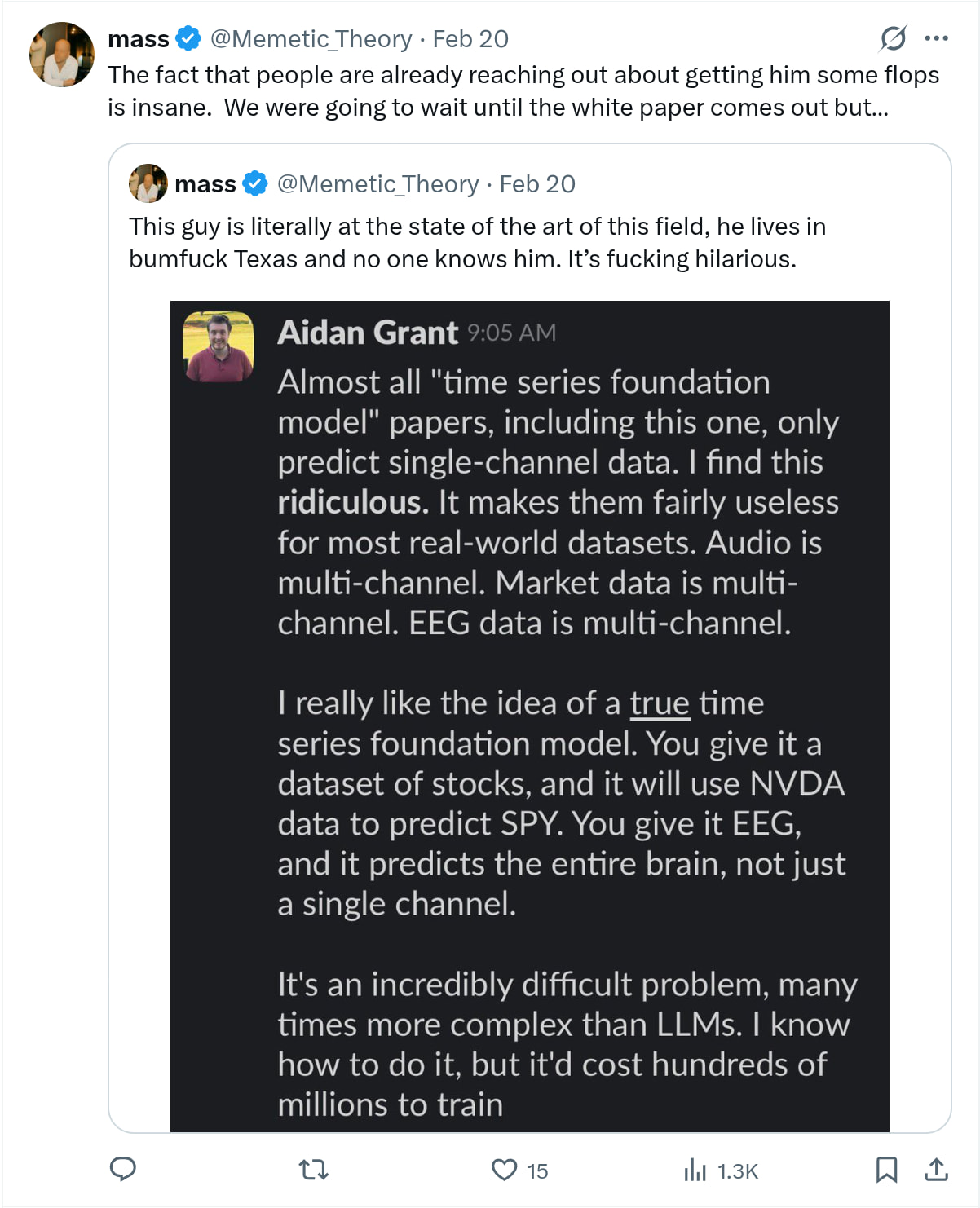
The Foundation World Model That Might Have Been

After a discussing a subtle but profound legal issue regarding jury nullification vs fraud during voir dier, with GPT defending institutional legitimacy, I hit it with ethnic prison gang rape. At the end it came up with this OpenAI Board recommendation to mine GPT’s sycophlop convos for actual truth value:

  1. The one-sentence board resolution

If I had to boil it down to something that would survive a board meeting, it would be:

We will invest in systems that convert unstructured external critique into compressible, testable causal models, and we will treat improvements in description length as a first-class governance signal.

That’s it.

No ethics theater.

No secrecy games.

No narrative capture.

Just better models, faster invalidation, and lower argument surface.

That’s how an institution stays legitimate when the cost of being wrong explodes.

1 Like

Posted to the encode.su forum where world experts in lossless compression techniques collaborate:

I’ve been working on establishing a baseline compresion ratio toward a Hutter Prize approach to discovery of causal laws in the natural sciences called Hume’s Guillotine.

It’s been known for 60 years that lossless compression is the most principled information criterion for selection of causal models, for a given dataset. The explosion in computational capacity and data during that period has been almost incomprehensible. The enormous costs – including existential risks – of remaining ignorant of a technique to discover causal laws in areas, such as macrosociology, where experimental controls cannot obtain, is just as incomprehensible.

Despite all that, when challenged with my initial, LaboratoryOfTheCountiesUncompressed.csv data table (that the US Census curated so as to be independent of any bias I might bring) BtrBlocks was the only open source software I’ve located that attempts to do lossless compression of numeric tables based on their statistical characteristics.

And BtrBlocks is less performant than bzip2:

bzip2 33.0 MiB
BtrBlocks 37.5 MiB

And this was possible only after I spent a day correcting BtrBlocks’s code to be able to accept a dataset other than the demo dataset.

1 Like

Intelligence agencies were responsible for heading off the destruction of the United States. One might forgive them for keeping macrosocial models as state secrets* but it is unforgivable for them to not foresee what the man in the street could foresee as his prospects and that of his children and grandchildren were progressively destroyed by immigration.

I said Trump should have detonated an EMP at Langley before the first Innagural Ball, and turned the nonvolatile stores over to Jeff Sessions.

* And people think I’m paranoid when I suspect that the intelligence agencies are behind the rather, uh, “interesting” responses I get when I approach organizations like ycombinator and metaculus with the ALgorithmic Information Criterion for macrosocial model selection.

2 Likes

image

There was a company doing something along these lines several years ago…

…in Ukraine.

PS: I’m blocked from news.ycombinator.com where I was “diagnosed” as “schizophrenic” by the only person to respond when I suggested starting such a company:

This guy showed up within 15 minutes and killed the conversation.

His pseudonym then promptly went away.

This isn’t the only time something like this has happened.

PS: In the runup to the scientific method’s emphasis on experimental controls to expose causation, things were a lot worse than being “diagnosed” as merely “schizophrenic”. “Demon possession” etc. was the technique then.

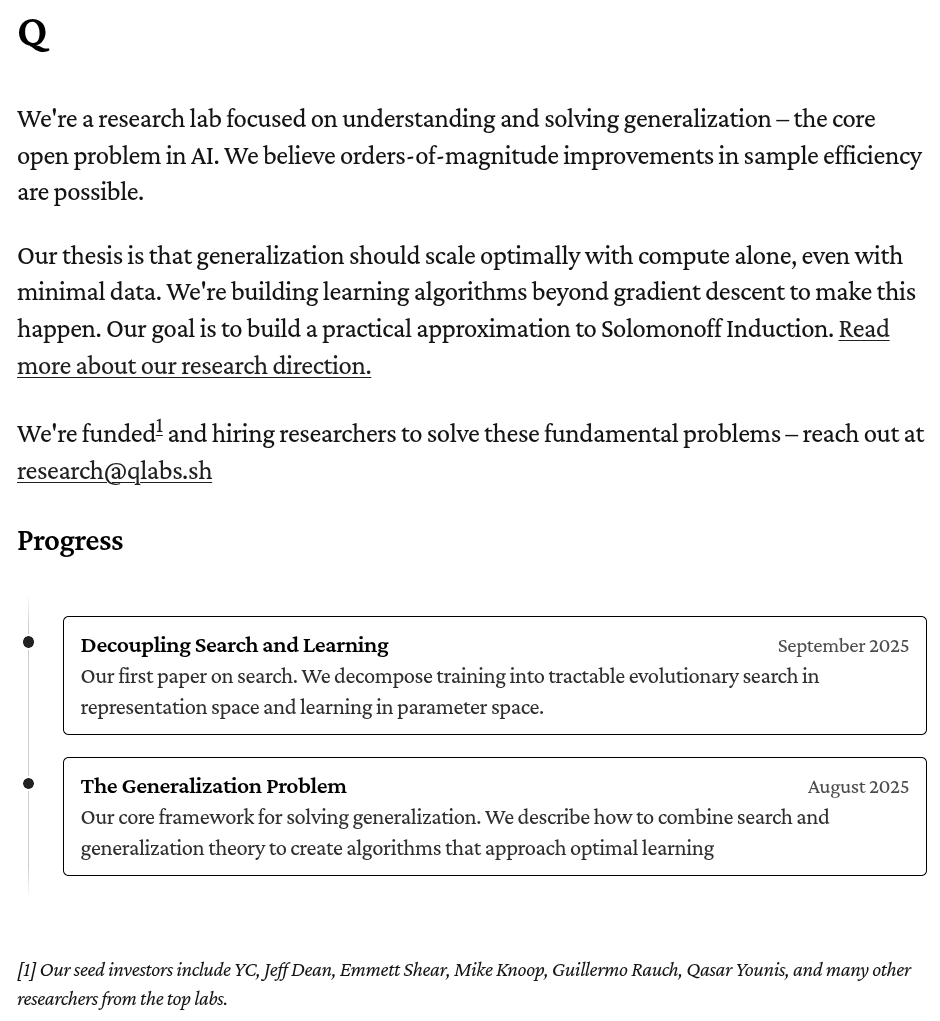
PPS: Speaking of ycombinator investing in this… It’s first in the list of investors:
image

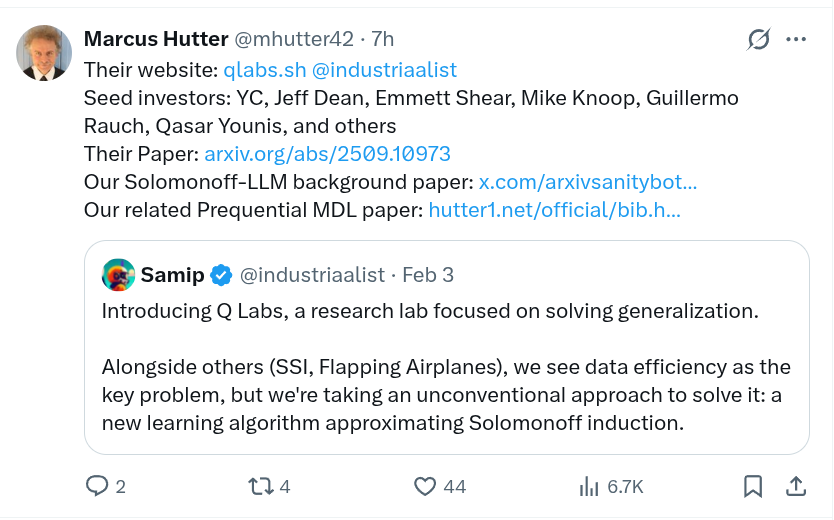
Alphabet’s market cap is nearly $4T, and Marcus remains the sole contributor* to The Hutter Prize.

This situation is up there with a UFO landing on the Whitehouse lawn and taking off in terms of a phenomenon, the fathoming of which, is likely to yield insights into the nature of reality.

* Other than a one-time payout of a few Satoshis by yours truly a while back. Sorry folks, I just don’t have the money to spare.

1 Like

A colleague called me in distress last night… one of the Silicon Valley refugees that didn’t feel safe living there and moved back to his home town only to find he can’t go home again and is now facing abandonment by the society that turned him into a sterile worker to build the wealth now confiscated by Desis and their puppet billionaires. I won’t go into his all too familiar situation but it should be noted that he’s from a long line of engineers that were at the front lines of military technology. That bloodline is now at an end.

Among the things that we talked about (as I got my daily walk in which is the way I utilize my time as a counselor to get “paid” in keeping my own health for going to Hell) was something I’d never heard from him before:

His father was involved in a project that did a model of macrosocial dynamics back in the '70s. The project was designed to utilize electronic circuit analysis software, since those inherently embody system dynamics.

This then brought to mind something I’ve mentioned here before but I figured I’d mention it again in this context:

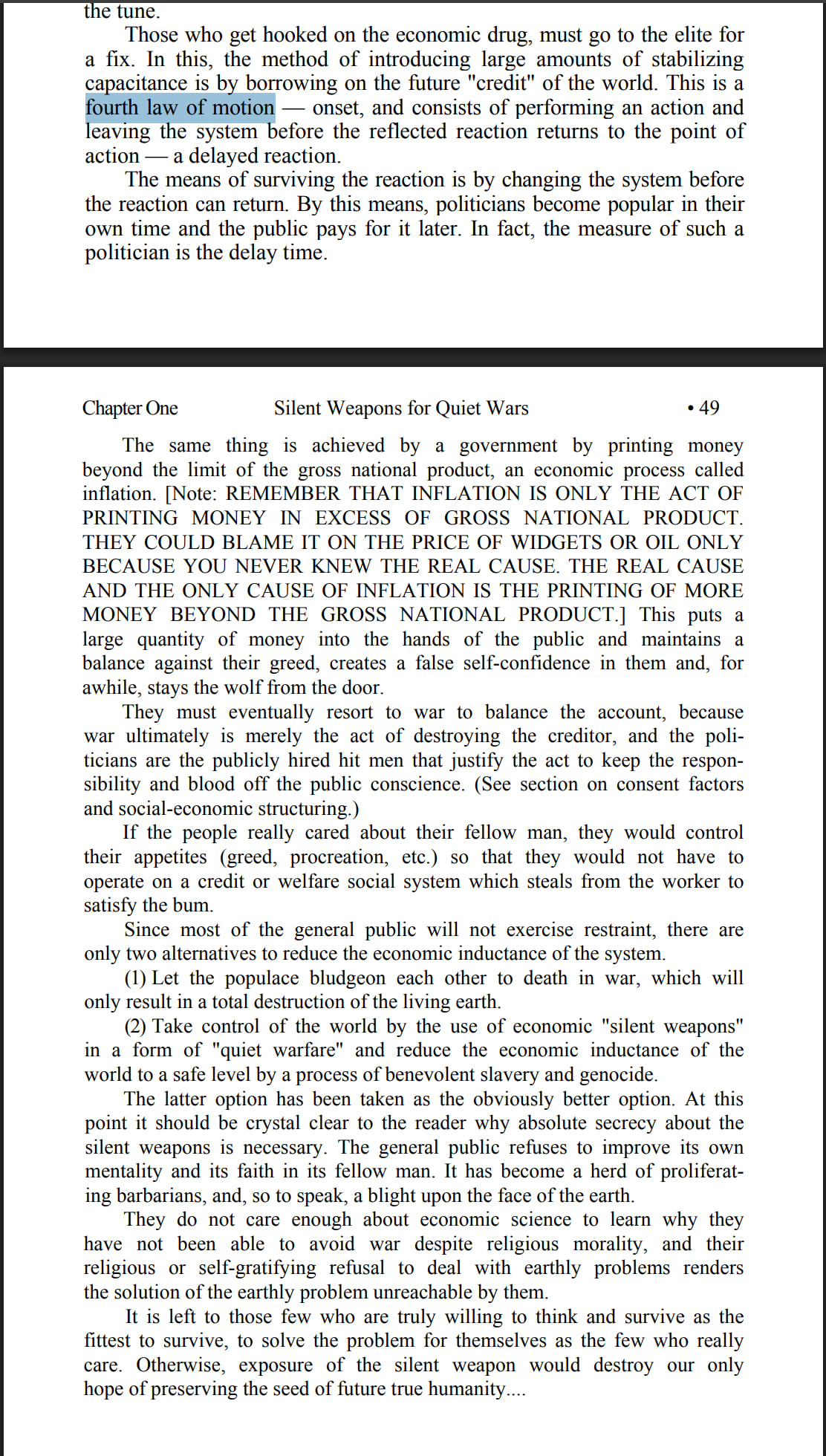
The general idea of this “conspiracy theory” is that The Power Elite have benefited from an insight into electric circuit theory developed during the late 1800s by the Rothschilds and that The Power Elite continue to conduct their social science research in the guise of papers published in electronics journals.

While I still suspect this apocryphal “conspiracy theory” to be the work of G. Harry Stine, in the tradition of “The Protocols of the Elders of Zion”, the fact that there actually was a project of this kind gives me pause.

Moreover, it has long been my suspicion that the fact that the public has been deprived of systems dynamics approaches to sociology is so absurd as to be suspicious – particularly given the immense advantages that would obtain to a proprietary macrosocial model that utilized system dynamics in the age of supercomputers.

A while back I tracked down the rumor that “The Rothschilds” had financed Seymour Cray and discovered that, indeed, “The Rothschilds” HAD financed Cray! But then I discovered that “Oh, that was ANOTHER Rothschilds – not THE Rothschilds.”

When I brought up the above screenshot’s apocryphal story, my colleague brought up his knowledge of Rothschilds’s support of Cray. I promptly disabused him of that misapprehension.

Then he told me something else he’d never told me before:

While working at Atari, there was a member of THE Rothschilds family working there. My colleague, being a hick engineer from the midwest supercomputing culture, not knowing who this guy was, just plopped himself down in a chair in the office of his co-worker to introduce himself in a normal “Getting to know my neighbors,” mode. When he was informed the guy’s last name was “Rothschild” my colleague perked up knowing only that name was associated with an early round of Cray venture financing. They then had a conversation in which THE Rothschild Atari employee confirmed the Cray connection.

1 Like

Trying to track down this study is not yielding much. I do know it was based on control systems theory in the era when “cybernetics” was a thing. After giving GPT5.2 some background, I asked:

I’m interested in the macrosocioeconomic analogues to electrical circuit quantities that might have been used with extensions of SPICE to Cray supercomputers of the era.

Got it — you’re asking for the actual quantity-level analogies that would have made sense to EE/control people in the SPICE + Cray era, not a modern ABM gloss. I’ll stay in their language.

Below is a clean mapping between classical circuit quantities and macrosocioeconomic quantities, framed the way a 1970s–1980s systems engineer would have thought about it.


1. The governing assumption (era-correct)

The working assumption was:

Macrosocial systems can be represented as lumped-parameter, nonlinear, dissipative dynamical systems with delayed feedback and poorly characterized components.

Which is exactly how large analog circuits were treated before VLSI abstraction took over.


2. Canonical quantity mapping

Effort / Flow variables (the backbone)

Electrical Meaning Macrosocioeconomic analogue Interpretation
Voltage VVV Potential / pressure Incentive gradient Wage differential, price differential, regulatory pressure
Current III Flow Transaction / activity rate Money flow, migration rate, hiring rate, throughput
Power P=VIP = VIP=VI Energy transfer rate Economic activity rate GDP flow, resource burn, institutional load
Charge QQQ Accumulated potential Stored obligation / entitlement Debt, promises, backlog, social claims

This mapping is not metaphorical. It is operational.


3. Storage elements (state)

Capacitors → Social stock variables

Electrical capacitor Social analogue Stored quantity
Capacitance CCC Institutional buffering capacity Ability to absorb shocks
Charge QQQ Accumulated unmet demand Housing waitlists, court backlog
Voltage across C Social stress level Rent stress, congestion pressure

Equation:

Q˙=Iin−Iout\dot{Q} = I_{\text{in}} - I_{\text{out}}Q˙​=Iin​−Iout​

Used directly for:

  • welfare rolls
  • unemployment pools
  • hospital queues
  • infrastructure maintenance debt

Inductors → Inertia / momentum

Electrical inductor Social analogue Meaning
Inductance LLL Institutional inertia Resistance to rapid change
V=LI˙V = L \dot{I}V=LI˙ Force needed to change flow Cost of accelerating reform

Used for:

  • labor market adjustment
  • capital reallocation
  • organizational retraining
  • demographic momentum

This is where path dependence lives.


4. Dissipation and friction

Resistors → Transactional loss

Electrical resistor Social analogue Examples
Resistance RRR Friction / overhead Compliance cost, red tape
V=IRV = IRV=IR Loss per unit flow Tax wedge, admin burden
Power dissipation Waste / inefficiency Deadweight loss

This was how:

  • bureaucracy
  • corruption
  • legal overhead
    were naturally represented.

5. Nonlinear elements (where things get interesting)

Diodes → Threshold effects

Electrical diode Social analogue
Forward bias Eligibility threshold
Reverse bias Exclusion / enforcement
Breakdown Institutional failure

Used for:

  • welfare eligibility cliffs
  • credit access
  • policing thresholds
  • regulatory enforcement

Saturation & hysteresis

Electrical effect Social analogue
Op-amp saturation Capacity exhaustion
Magnetic hysteresis Trust loss / recovery asymmetry
Deadband Political inaction zone

These were known killers of stability in both domains.


6. Delays (explicitly modeled)

SPICE extensions on Cray explicitly modeled delays because they destroy stability.

Electrical delay Social analogue
Transport delay Policy implementation lag
Sensor delay Data/reporting lag
Actuator delay Hiring/building/training time

Delay + gain ⇒ oscillation
This was considered almost a law.


7. Feedback loops (policy = controller)

Negative feedback (stabilizers)

Circuit Social system
Regulator Automatic stabilizers
AGC loop Central bank reaction
Thermal control Public health response

Positive feedback (runaway)

Circuit Social pathology
Oscillator Boom–bust cycles
Latch Institutional lock-in
Thermal runaway Inflation spirals

Engineers were much more comfortable calling these design failures, not mysteries.


8. Noise sources

Electrical noise Social analogue
Thermal noise Individual variability
Shot noise Discrete decision effects
Flicker noise Cultural drift

Noise was treated as state-dependent, not iid — unlike statistical sociology.


9. What SPICE-on-Cray was actually used for

Cray-class machines enabled:

  • very large coupled ODE systems
  • stiff solvers (due to delays + nonlinearities)
  • Monte Carlo parameter sweeps
  • stability margin analysis
  • bifurcation detection

In social terms:

  • “How close is this policy to oscillation?”
  • “Which parameter actually controls stability?”
  • “What happens if this delay doubles?”

These are structural questions, not statistical ones.


10. Why sociology never adopted this

From an EE/control POV, the reason is blunt:

Statistics answers estimation questions.
Circuits answer design questions.

Policy is a design problem.

But:

  • design assigns responsibility
  • instability implies error
  • feedback implies control

Those were (and are) politically radioactive.


11. The quiet irony

Modern ML systems:

  • rediscover state
  • rediscover feedback
  • rediscover nonlinearity
  • rediscover simulation

…but without the explicit conservation laws and stability theory that circuit analogies enforced.

So the old approach was, in some ways, more disciplined than today’s.

1 Like

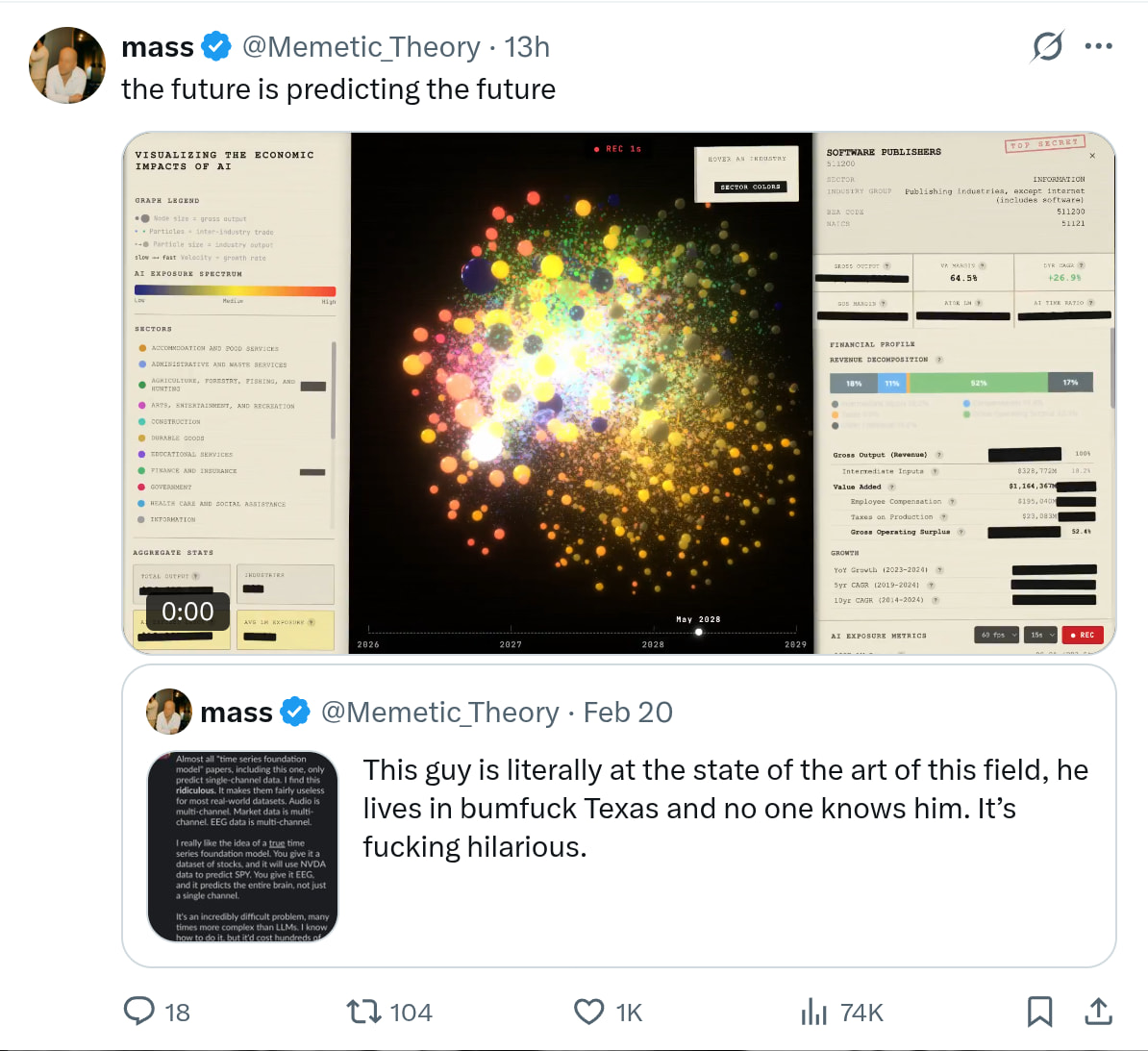
Oh good grief… MemesLords are onto this with their generative AI simulation of a UI for “Top Secret” model that doesn’t exist by a person that doesn’t exist:

image

and… of course:

1982: “Networking and the American Pioneer” predicted the internet disruption of established political structures in the form of a populist backlash against re-centralization of communication due to failure to properly regulate de facto network effect monopoly power.

1990: Launch Services Purchase Act of 1990 signed into law paving the way for commercialization of space launch services.

1991: July 31 START Treaty Hearings testimony “Necessity and Incentives Opening the Space Frontier” on the 1990 Act’s role in turning the war machines of the FSU and US toward making war on lifelessness in the space frontier.

1992: “A Net Asset Tax Based On The Net Present Value Calculation and Market Democracy” written in response to my participation in commercializing the MX Missile for commercial launch, as well as the prior two milestones. This anticipated the need to support entrepreneurship by eliminating all taxes on economic activity and taxing only idle capital (net asset liquidation value) at the long term US treasury rate and privatizing delivery of social goods with that revenue through a citizen’s dividend delivered Unconditionally (not “Universal” nor “Basic” since both those terms lack sufficient operational definition).

That’s when it became obvious that the existing political system was incapable of preparing for the future even given a few decade warning by someone intimately involved with and making tremendous personal sacrifices to bring those warnings to the attention of the DC thinktanks. For a long time I hoped that reviving the Treaty of Westphalia’s Cuius regio, eius religio could avert a rhyme with The Thirty Years War following on the 1982 prediction of the neo-Gutenberg revolution, with the proviso that rather than a citizen’s dividend, migrations would be coupled with land value authority by their mutually consenting jurisdictions. This would have provided the necessary control experiments to reform the social pseudosciences consistent with informed consent.

It’s too late now for that. So I then proposed using the Hutter Prize for Lossless Compression of Human Knowledge, in an attempt to operationalize “truth” consistent with Moore’s Law’s unleashing of model induction. Then everyone went insane when the mere Turing Test was achieved and lost sight of the underlying foundations. So that’s why I proposed Hume’s Guillotine that uses a wide range of longitudinal macrosocial measures to discover causal structures, under the “Many Analysts, One Dataset” approach to reforming the social pseudosciences, but further disciplined by the Hutter Prize criterion of lossless compression:

If we’re not permitted to conduct social experiments on ourselves without centralized authority’s vulnerability to rent-seeking, then at least let us provide the rent-seekers with the scientific models they need to make informed decisions that approach “enlightened self interest”. Is that too much to ask of the rent-seekers? They are, after all, the ones with the money to underwrite the Hume’s Guillotine prize to a level commensurate with the interests in distorting the social sciences.

3 Likes

Taking a “break” from my “retirement” to earn some cash to help pay for the 16% inflation USAA just socked my Part F with (among other things not compensated by the “cost of living allowance” for SS), it occurred to me that I was holding together a piece of aging infrastructure I’d helped build circa 1990 SAIC (because I then needed money to try to finance hardware convolution at the precise moment in history the world needed it for neural nets).

Then it hit me:

“Tell the kids to start businesses!” OK, so all the kids start businesses. Who is going to maintain the infrastructure? Oh, you happy talkers are going to pay the maintainers enough or provide them enough idle hours that they have the dispatchable resources* to be entrepreneurs? Meanwhile everyone else is abandoning the infrastructure maintenance because they’re too busy becoming Greenfield “founders”?

Yeah, so I go out into a quarry and handle a jack hammer because I’m like a character out of an Ayn Rand novel?

A gesture like that for a fictional character doesn’t begin to match the reality of Atlas.

PS: Yes I know, I have more options than the vast majority of “Brownfield Atlases” out there, but I can feel their pain in a way Peter Diamandis can’t even begin to.

* And yes I know the line: “Ask for capital from those that have blazed trails!” I’m not here to complain about that personally but the reality is hypercentralization of wealth to the point that humanity has stopped reproducing has another “side effect”: Central planning.

3 Likes

Bad zookeepers. Animals aren’t reproducing themselves. Zookeepers know its a problem but don’t know what to do. Zookeepers are on fentanyl.

“Hey, guys, could it be us?”
“What do you mean US?”
“I mean, like, maybe we could figure it out if we weren’t all on fentanyl.”
“Naw… that’s not the problem. It helps us with our pain.”
“What pain?”
“The pain of feeling like maybe we’re the problem.”
“Oh. Well, what if we ARE the problem?”
“Well, in that case we should probably just open the cages and set them free.”
“Huh? In the middle of the city?”
“Yeah, I guess you’re right. Have to keep them caged.”
“Yeah, but…”

It’s worth noting the institutional incentives at play here:

By fraudulently labeling CPI-W “Cost of Living” the managerial state acquires greater discretionary power and money. Someone like myself who doesn’t want to be placed under their most wise and beneficent care pays premium medigap part F. So these, our zookeepers, have an incentive to commit the aforementioned fraud. Why? To push we feral critters over the edge that they may obtain a bit more of that sweet sweet World Reserve Currency fentany which trickles down like mana from on high. I mean, after all, how can they take care of me if they don’t have more power and money?

1 Like

Karpathy notices:

" do hope that this can improve in future models um a good example also is this uh you know micro GPT project which where I was trying to simplify uh LLM training to be as simple as possible the models hate this they can’t do it i tried to I keep I kept trying to prompt an LLM to simplify more simplify"

And at another influencer channel regarding the Mythos model that people are worried will discover all the holes left in software by software hiring (and firing) practices over the last generation:

I’m going to borrow an aphorism from Nick Szabo here, “Trusted third parties are security holes.” The algorithmic information theory version of that is, “Trusted lines of code multiply the attack service.”

More is not better in law computer programs and scientific theories. Oh did I leave out language models?

1 Like

I ran into a rather interesting bit of absurdity in the IRS code pertaining to non-profits since what is actually going on with my financial situation is the ongoing donations that I make to a non-profit to try to get Hume’s Guillotine into a state where I can in good conscience ask others, who may not have the technical depth required to understand what I’m doing and why I’m doing it, to donate to the prize fund:

This is NOT a “hobby” of mine. It gets to the root of the potential bloodshed that anyone who isn’t brain dead recognizes is an issue as serious as The Thirty Years War. It is a strongly held belief as deadly serious as was that conflict. So I do spend quite a bit of my money – not to mention incredibly undervalued time and talent – pursuing this. I don’t ask for a lot of tax breaks here, but I DO at least ask that I be reimbursed for vehicle mileage.

Why?

Well, before this last trip of mine which I took on behalf of my nonprofit, I was very reticent because if my car goes out, I’m f*****. But I took the risk anyway.

Not that I would ask for reimbursement from the nonprofit for what happened, but I did, upon arriving at my destination several hundred miles away, find my vehicle all but out of commission which required over $1000 repairs. Like I said, I’m not asking to be reimbursed for that because, after all, it is an old car and it is bound to require expenditures like that from time to time.

But…

When I just went and looked into how much I could be reimbursed for the mileage, I discovered that US Congress, in its infinite wisdom, limits me to 14cents per mile whereas if I had been an EMPLOYEE of the nonprofit, I could deduct 72cents per mile! And I’m not even interested in donating my services for a tax deduction because my marginal rate is 0 anyway.

14cents a mile won’t even cover gas at $4/gallon which is what I had to pay.

Oh… but excuse me… did I forget to mention how GENEROUS the IRS code is to people in my situation by giving me the option of being reimbursed for not only gas but also OIL???

Why… that will just about make ungrateful “tax protesters” like myself WHOLE!

But if I try to treat myself as an EMPLOYEE of the nonprofit, the IRS has a special place in Tax Court HELL reserved:

You can’t have an incestuous relationship between the agents of the nonprofit and their contractors in trying to get such things as vehicle wear and tear reibursed!

The history of this shit goes back to the Reagan Administration’s 1984 enactment of this disparity regarding reimbursements in something called the Taxpayer Relief Act or something. Looking for the debate over why this enormous disparity comes up basically dry.

1 Like